Schumacher SEV1670, reviewed
The Level 1 cord this site sends most readers to, finally examined — including the one column where the charger it beats comes out ahead.
How this page is funded: the buy links below are affiliate links, and Renter Volt earns a commission on qualifying purchases at no cost to you. Nothing here was supplied by a manufacturer, and commission plays no part in the ranking — read the full disclosure. Picks are chosen from published specifications rather than hands-on testing; the method is written down so you can check it. Prices last verified November 8, 2026.
Buy this one if the socket you will use is on an ordinary 15 amp circuit — which is most sockets in most buildings. Twelve amps is exactly what that circuit permits continuously, the 20.5 ft cable is the longest of any Level 1 cord here, and it is the only one publishing both an IP66 housing and a 3 Year Limited Warranty.
The reservation, stated up front: Schumacher names no UL standard for it. That is a real gap, and it is the one column where the Lectron this unit outranks comes out ahead. Everything below is Schumacher's own published material; Renter Volt has not had this charger in its hands and says so plainly.
Quick picks
Ranked, with the reasoning underneath. Tap any row to jump to that write-up; tap the price to check it on Amazon. Prices come from the live layer, never from this page.
| # | Product | Best for | Type | Price |
|---|---|---|---|---|
| 1 | 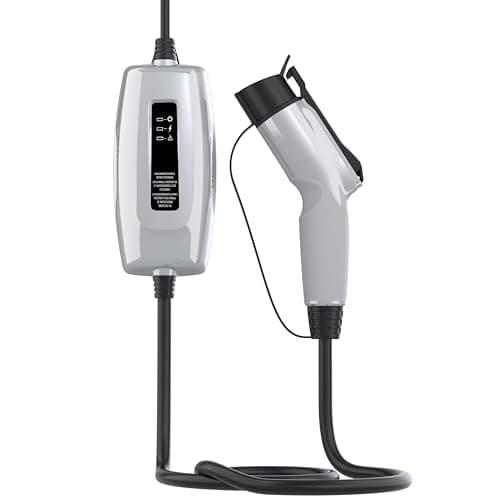 Schumacher Electric SEV1670 Level 1 Portable EV Charger (12A, NEMA 5-15)A 12 amp Level 1 charger sized correctly for an ordinary 15 amp household circuit, with a 20 ft cable that reaches further than most. | A 15 amp circuit and a longer reach | Level 1 EVSE |
#1 · A 15 amp circuit and a longer reach
Schumacher Electric SEV1670 Level 1 Portable EV Charger (12A, NEMA 5-15)
A 12 amp Level 1 charger sized correctly for an ordinary 15 amp household circuit, with a 20 ft cable that reaches further than most.
| Charging current | 12A continuous, 120Vsource |
|---|---|
| Output power | 1.44 kWsource |
| Cable length | 20.5 ftsource |
| Plug / connector | NEMA 5-15 plug, J1772 connectorsource |
| Certification | Published as DOE, FCC Certified and Energy Star; the description says it "meets ETL and Energy Star certification standards". No UL standard namedsource |
| Enclosure | IP66 housingsource |
| Warranty | 3 Year Limited Warrantysource |
| Built-in protection | Leakage, undervoltage, overvoltage, overcurrent, over-temperature, ground-fault and relay-fault protectionsource |
What those numbers mean
Twelve amps is not a low number for this category; it is the correct one. A 15 amp circuit supports 12 amps of continuous load, and overnight charging is continuous by any definition, so this unit uses an ordinary household circuit right up to its limit and no further.
The 20.5 ft cable is four and a half feet longer than the common 16 ft. At a carport or a curbside socket, those few feet are frequently the difference between reaching the charge port and reaching for an extension cord.
Over-temperature protection is on the manufacturer's list, but the published specification does not say where the sensor sits. Treat it as a backstop, and still feel the plug at the wall during the first few long sessions.
What it does well
- Sized for a 15 amp circuit, the most common household circuit there is
- 20.5 ft cable, longer than the usual 16 ft
- Published IP66 housing and a 3 Year Limited Warranty — both rare at this price
- The manufacturer publishes the full list of built-in protections
What it does not
- J1772 only — a Tesla or other NACS car needs an adapter or a NACS unit
- Names no UL standard — the certifications published are DOE, FCC and Energy Star
- No app or scheduling, and no current adjustment in the published specification
- 1.44 kW will not recover a long driving day overnight
Skip this one if: Your car has a NACS (Tesla-style) port, or you regularly drive more than about 40 miles a day. The first needs a different connector; the second needs more power than any Level 1 unit can deliver.
Why 12 amps is the right number, not a compromise
Twelve amps looks like the lesser figure next to a 15 amp charger, and for most renters it is the correct one instead. Charging is a continuous load — hours of near-constant current — and continuous loads are capped at 80% of the breaker rating.
breaker rating × 0.8 = continuous current permitted
15A breaker × 0.8 = 12A → this charger, matched exactly · 20A breaker × 0.8 = 16A → this charger, with headroom to spare · A 15A charger on that same 15A circuit exceeds what it permits
A NEMA 5-15 receptacle is fitted to both 15 amp and 20 amp circuits and looks identical either way. The number is on the breaker, not the socket — how to identify your outlet is the two-minute check.
What you give up against the 15 amp unit is about 25% of the rate, which on a twelve-hour night is roughly 15 miles of range. Whether that matters is a question about your commute rather than about the hardware, and how long charging actually takes does it against your own mileage.
Which Schumacher this is — there are two, and they are not alike
Schumacher sells this Level 1 cord and a dual-level travel charger, and the second is the one people reach for assuming it is simply the better product. For a renter it usually is not, and the reason is the plug.
| SEV1670 — reviewed here | SC1455 EV Travel Charger | |
|---|---|---|
| Charging levels | Level 1 only | Level 1 and Level 2 |
| Current | 12A at 120V | 16A at 240V for Level 2 |
| Level 2 plug | n/a | NEMA 6-20P |
| Level 1 plug | NEMA 5-15 | A "standard 120V wall outlet adapter"; the plug is not named |
| Level 1 amperage | 12A, published | Not published — retailer listings disagree |
| Cable | 20.5 ft | 28 ft |
| Ingress rating | IP66 housing | Not published; "rubber cover to keep out water and dirt" |
| Warranty | 3 Year Limited Warranty | One-year warranty |
Two rows decide this for most renters. The SC1455's Level 2 mode needs a NEMA 6-20P — a 240V 20 amp receptacle that is not a dryer outlet, not a range outlet and not an RV hookup. It is simply not an outlet most rental buildings have, so the dual-level charger frequently arrives and runs at Level 1 anyway. What outlet you can actually reach is the check that settles it, and are dual Level 1 and 2 chargers worth it? covers the category question.
And the warranty runs the wrong way round. The simpler, cheaper Level 1 unit carries three years; the dual-level one carries one. That is unusual enough to be worth saying twice.
What Schumacher publishes for the SEV1670
| Specification | Published? | Value |
|---|---|---|
| Model | Yes | SEV1670 |
| Voltage and current | Yes | 120V AC, 12A in and out |
| Output power in kW | No | Not stated (12A × 120V works out to 1.44 kW) |
| Cable length | Yes | 20.5 ft |
| Plug | Yes | NEMA 5-15P |
| Connector | Yes | J1772 |
| Ingress rating | Yes, for the housing | IP66, plus a rubber cover on the charging gun |
| Operating temperature range | No | Absent from the page |
| Safety certifications | Yes, but no UL standard | DOE, FCC Certified, Energy Star; "meets ETL and Energy Star certification standards" |
| Built-in protections | Yes, seven named | Leakage, under voltage, overvoltage, overcurrent, over temperature, ground fault, relay fault |
| Warranty | Yes | 3 Year Limited Warranty |
| Weight | Yes | 5.06 lb |
| Charge-rate / miles-per-hour claim | No | Not published — unusually restrained for this category |
| Current adjustment | No | Not published; fixed at 12A |
| In the box | Yes | The charger and a user manual |
The IP66, and exactly what it covers
IP66 means dust-tight and protected against powerful water jets. It is a specific, checkable figure and it is better than most of this category publishes — the cross-brand audit found that the most complete spec sheet on this site belongs to a Level 1 product rather than a Level 2 one, and this is that product.
Two honest qualifications. The IP66 is quoted for the housing — the box in the middle of the cord — and the connector is covered separately by what Schumacher describes as a rubber cover. There is no mated ingress figure, which is the number that applies while the thing is actually plugged into the car overnight. And no operating temperature range is published at all, which is the same gap every manufacturer on this site leaves. The outdoor and winter roundup ranks on both figures, and leaving a charger outside covers the join between plug and socket, which is where trouble starts.
The certification gap, which is the real reservation
This is where a review earns its place, because it cuts against the ranking. Schumacher publishes this unit's certifications as DOE, FCC Certified and Energy Star, and its description says the charger "meets ETL and Energy Star certification standards". It names no UL standard anywhere — not UL 2594, not UL 2231, which are the two standards written for charging equipment.
- "Meets ... certification standards" is conformity wording, not a listing claim. Saying a product meets a standard and saying a laboratory has listed it to that standard are different statements, and only the second is a thing a third party has checked.
- ETL does not appear in the published certification list at all — only in the prose description. The list itself reads DOE, FCC, Energy Star.
- Energy Star and DOE are efficiency programs, not safety standards, and FCC covers electromagnetic interference. None of the three is the safety certification a buyer is looking for.
Set against the charger it outranks, the two trade places depending on which column you read. The Lectron Level 1 names UL 2594 and UL 2231 and publishes no warranty period at all; the Schumacher publishes three years and a better ingress rating and names no UL standard. Neither publishes a certificate number, which is the thing that would settle it either way. The Lectron Level 1 review works that side of the comparison, and what to look for in a charger explains why a named standard is one of the six criteria in the first place.
What to do about it, practically: check the unit's own label for an ETL or UL mark before first use. That is a minute of your own verification and it beats our reading of a web page from a particular Tuesday.
Seven protections, named — which is more than most manage
Schumacher publishes the full list rather than saying "multiple protections": leakage, under voltage, overvoltage, overcurrent, over temperature, ground fault and relay fault. Naming them is genuinely better practice than the category norm, and the ground-fault item matters most — it is the protection that makes a cord safe to leave running unattended for eight hours.
One thing the specification does not say is where the temperature sensor sits. Over-temperature protection inside the control box is a different thing from protection at the plug, and the plug at the wall is where heat actually builds. Treat it as a backstop rather than a guarantee, and put a hand on the plug during the first few long sessions — a hot outlet or a melted plug is what that check is for.
Twenty and a half feet, five pounds, and no case
20.5 ft is the longest Level 1 cable on this site, against a category norm of 16 ft. In a carport or at a curbside socket those extra four and a half feet are frequently the difference between reaching the charge port and reaching for an extension cord — which is the purchase this site spends a whole page discouraging.
The costs of that reach are weight and bulk: Schumacher publishes 5.06 lb and a box of roughly 11 by 4 by 14 inches. The published box contents are the charger and a manual — no storage case or bag. If this is going to live in a trunk, that is a bag you will end up buying separately, and a 20.5 ft cable is a lot of cord to coil loose.
How this was judged
- Can a tenant put it into service unaided? Completely. It plugs into a receptacle that already exists, needs no electrician and no permission, and leaves with you. This is the one criterion this site treats as absolute.
- Is the current matched to a circuit the reader can actually reach? This is where it wins. 12A is exactly what the most common household circuit permits continuously, and it is also correct on the next size up. Nothing else here is right on both.
- Reach. 20.5 ft, the longest Level 1 cable on the site, and the specification renters most often get wrong.
- Are the safety standards named and checkable? This is where it loses. No UL standard is named; the published certifications are efficiency and interference programs. No certificate number either.
- Are the specifications governing outdoor life published? A published IP66 for the housing, which beats most of the category — but no mated figure and no operating temperature range.
- Warranty. Three years, published, against a category where one brand publishes nothing at all and Schumacher's own dual-level unit publishes one.
Buy it, or do not
- Buy it if your socket is on a 15 amp circuit, or you do not know which circuit it is on. At 12 amps it cannot be the wrong size, and that is worth more than a faster number you cannot use.
- Buy it if the distance from socket to charge port defeats a 16 ft cord. 20.5 ft is the longest Level 1 reach available here and it is the cheaper fix than anything added afterwards.
- Buy it if a published warranty matters. Three years is the top of this category, and the nearest Level 1 competitor publishes none.
- Do not buy it if your car has a NACS port and you have no adapter. This is a J1772 cord; the NACS Level 1 options are covered in the roundup.
- Think twice if you want a named UL listing on the page before you buy. Schumacher does not give you one here, and the Lectron alternative does — at the cost of its warranty and a weaker ingress figure.
- Think twice if you have confirmed a 20 amp circuit and want every mile you can get overnight. A 15 amp unit is about 25% faster and that circuit supports it.
- Skip Level 1 entirely if you can reach a 240V outlet. Is a Level 2 charger worth it? is the honest version of that calculation.
Where these figures come from
Every specification above is Schumacher's own published product page for this model, plus its EV charger range page for the SC1455 comparison, plus the continuous-load rule from the National Electrical Code. There is no test bench behind this site, no loaner hardware and no hands-on durability claim — whether the IP66 housing stays sealed after two winters of being coiled and uncoiled, where the temperature sensor actually sits, and whether Schumacher honors a warranty claim in year two are all things this page cannot tell you.
Two registry corrections were made while writing this and are recorded rather than made quietly: this product's cable length read 20 ft against Schumacher's published 20.5 ft, and its certification row read "ETL and Energy Star", which implies a listing Schumacher does not claim in those words. Both now match the source. The editorial policy covers how corrections are handled here.
Questions people actually ask
Is the Schumacher SEV1670 a good Level 1 charger?
For most renters, yes — it is the one this site ranks first. Twelve amps is exactly what an ordinary 15 amp circuit permits continuously, the 20.5 ft cable is the longest Level 1 cord here, and it publishes both an IP66 housing and a 3 Year Limited Warranty. Its real gap is that Schumacher names no UL standard for it: the published certifications are DOE, FCC and Energy Star.
Why only 12 amps?
Because that is what a 15 amp household circuit supports continuously under the 80% continuous-load rule, and charging runs for hours. A 12 amp charger is correct on a 15 amp circuit and also correct on a 20 amp one. A 15 amp charger is only correct on the second, which is why it ranks below this unit for a reader who cannot confirm the breaker.
Is the Schumacher SEV1670 UL listed?
Schumacher names no UL standard for it. Its published certifications are DOE, FCC Certified and Energy Star, and its description says the unit meets ETL and Energy Star certification standards — which is conformity wording rather than a listing claim, and ETL does not appear in the certification list itself. Check the unit's own label for an ETL or UL mark before first use.
Is the Schumacher SEV1670 weatherproof?
It publishes IP66 for the housing, which means dust-tight and protected against powerful water jets, plus a rubber cover on the charging gun. Two caveats: that is not a mated rating, so it does not describe the connector while it is plugged into the car, and no operating temperature range is published at all.
How long is the Schumacher charging cable?
20.5 ft, the longest of any Level 1 cord on this site against a category norm of 16 ft. Measure from the socket to where your charge port sits with the car parked as it normally is, because routing takes more cable than the straight-line distance suggests.
What is the difference between the Schumacher SEV1670 and the SC1455?
The SEV1670 is Level 1 only at 12A on a NEMA 5-15, with a 20.5 ft cable and a three-year warranty. The SC1455 adds Level 2 at 16A and 240V, but on a NEMA 6-20P — a receptacle most rental buildings do not have — with a 28 ft cable and a one-year warranty. Schumacher does not publish the SC1455's Level 1 amperage, and retailer listings disagree about it.
Does the Schumacher SEV1670 come with a warranty?
Yes, a 3 Year Limited Warranty, published on Schumacher's own page. That is the top of this category: three years is the standard among the brands on this site, one competitor publishes no period at all, and Schumacher's own dual-level SC1455 carries only one year.
Does it come with a carrying case?
No. The published box contents are the charger and a user manual. At 5.06 lb with 20.5 ft of cable, a bag is a sensible separate purchase if the charger is going to live in a trunk.
Can I adjust the amperage on the Schumacher SEV1670?
No adjustment is published; it is a fixed 12 amp unit. For this circuit that is not a limitation — 12 amps is the ceiling a 15 amp circuit allows anyway. If you need a charger that steps across several outlet types, an adjustable unit is the right category instead.
Sources
Every figure on this page traces to one of these. If a number here disagrees with the manufacturer, the manufacturer is right and we want to know — tell us.
- Schumacher Electric — SEV1670 Level 1 Portable EV Charger, 120V / 12A (product page and specifications)
- Schumacher Electric — EV charger range, including the SC1455 EV Travel Charger (Level 2 240V/16A on a NEMA 6-20P, 28 ft cord, one-year warranty)
- Lectron — Portable Level 1 J1772 EV Charger, 120V / 15A / NEMA 5-15 (product page)
- UL Solutions — UL 2594, standard for electric vehicle supply equipment
- SAE International — J1772 electric vehicle conductive charge coupler standard
- NFPA — NFPA 70, National Electrical Code (free public access)
- U.S. DOE Alternative Fuels Data Center — Electric vehicle charging levels and speeds
- U.S. Department of Energy — Electric vehicle charging at home
Read next
Best Portable Charger
Best portable EV chargers
The portable charger section: plug-in Level 1 and Level 2 units ranked by the outlet you can actually reach, with every spec cited.
Top pick: Grizzl-E Mini Connect Portable Charger

Best Level 1 Charger
The best Level 1 EV chargers
Level 1 chargers ranked for renters: 12 amps against 15 and the breaker that decides it, cable reach, connector and a safety listing you can check.
Top pick: Schumacher Electric SEV1670 Level 1 Portable EV Charger (12A, NEMA 5-15)
Guide
Lectron Level 1 15A charger, reviewed
A close read of the 15A Lectron: why the breaker decides this purchase, the three Lectron Level 1 units people confuse, the IP65 rating its 40A sibling does not publish, and the missing warranty.
Top pick: Lectron Portable Level 1 J1772 Charger (15A, NEMA 5-15)
Guide
What to look for in a portable EV charger
A criteria-first guide to choosing a plug-in charger: the six specifications that matter in order, and a cross-brand table of which makers publish each one and which stay silent.
Top pick: Grizzl-E Mini Connect Portable Charger
Guide
Dual Level 1 and Level 2 chargers: worth it?
When a dual-voltage charger earns its price premium over a single-voltage unit, and the three readers it is genuinely built for.
Top pick: Grizzl-E Mini Connect Portable Charger
Guide
Level 1 vs Level 2, for someone without a garage
The charging-level comparison rewritten for renters, with a renter-viability column and an honest case for Level 1.
Top pick: Lectron Portable Level 1 J1772 Charger (15A, NEMA 5-15)