What to look for in a portable EV charger
Six specifications decide this purchase. Four of them are the ones manufacturers quietly leave out.

How this page is funded: the buy links below are affiliate links, and Renter Volt earns a commission on qualifying purchases at no cost to you. Nothing here was supplied by a manufacturer, and commission plays no part in the ranking — read the full disclosure. Picks are chosen from published specifications rather than hands-on testing; the method is written down so you can check it. Prices last verified October 27, 2026.
Check the outlet first, the cable length second, and the published amperage range third — in that order, before you look at a single brand. If you do not yet know which outlet you can reach, the adjustable Grizzl-E Mini is the purchase that survives being wrong, because it steps from a 15 amp household socket up to a 40 amp range outlet and ships with the plug adapters in between.
What follows is the full list, in the order that actually decides purchases — and then the part no listing will tell you: which manufacturers publish each specification, and which quietly do not.
Quick picks
Ranked, with the reasoning underneath. Tap any row to jump to that write-up; tap the price to check it on Amazon. Prices come from the live layer, never from this page.
| # | Product | Best for | Type | Price |
|---|---|---|---|---|
| 1 | 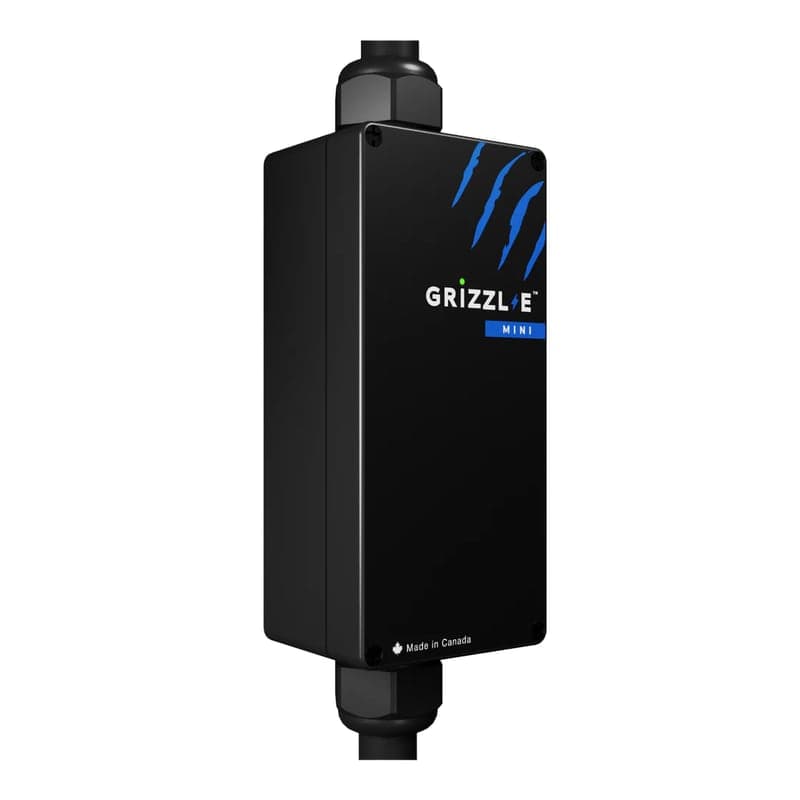 Grizzl-E Mini Connect Portable ChargerAdjustable from 7 to 40 amps and shipped with four plug adapters, which is the closest thing to a unit that fits whatever outlet you turn out to have. | Not knowing your outlet yet | Adjustable Level 1 and 2 EVSE | Check price#ad |
| 2 | 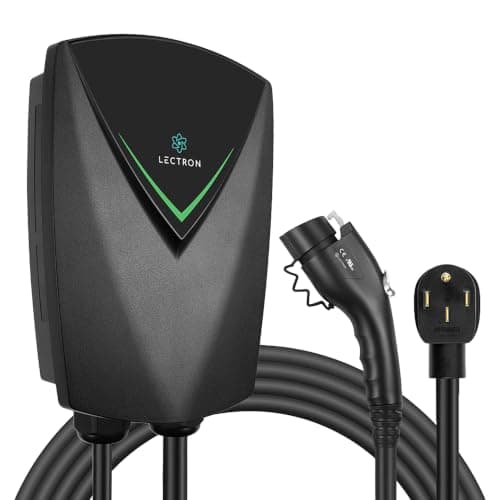 Lectron NEXUS Level 2 Charger (NEMA 14-50 plug)A 23 ft cable on a plug-in 40 amp unit, which is the specification that decides whether a parking space two bays from the outlet works at all. | Long cable reach | Plug-in Level 2 EVSE | |
| 3 | 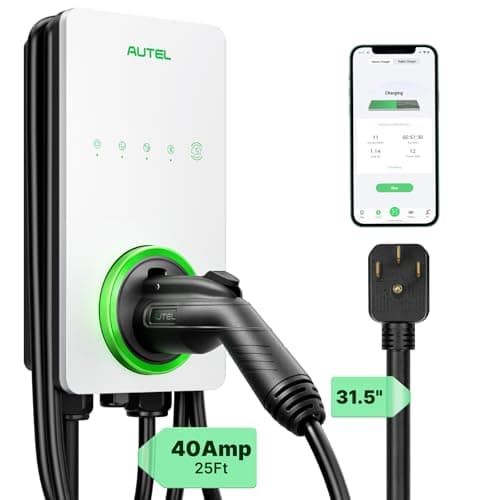 Autel MaxiCharger AC Elite Home (40A, NEMA 14-50 plug)Twenty-five feet of cable and a published NEMA 4 enclosure rating — full 40 amp reach for a bay that is not beside the outlet. | Maximum reach at a fixed 40A | Plug-in Level 2 EVSE | |
| 4 | 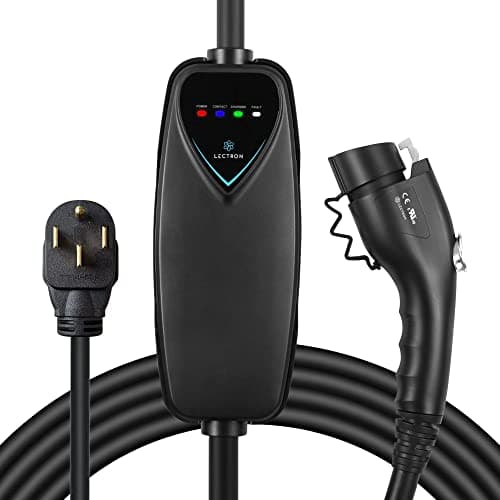 Lectron Portable Level 2 J1772 Charger (40A, NEMA 14-50)The plainest answer to a NEMA 14-50 outlet you can reach: 40 amps, a plug on the end, and nothing screwed to a wall you do not own. | A reachable 14-50 outlet | Plug-in Level 2 EVSE | |
| 5 | 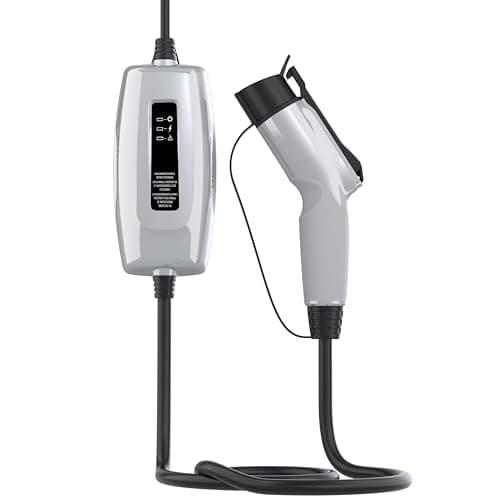 Schumacher Electric SEV1670 Level 1 Portable EV Charger (12A, NEMA 5-15)A 12 amp Level 1 charger sized correctly for an ordinary 15 amp household circuit, with a 20 ft cable that reaches further than most. | A 15 amp circuit and a longer reach | Level 1 EVSE |
#1 · Not knowing your outlet yet
Grizzl-E Mini Connect Portable Charger
Adjustable from 7 to 40 amps and shipped with four plug adapters, which is the closest thing to a unit that fits whatever outlet you turn out to have.
| Adjustable current | 7A to 40A (9.6 kW maximum)source |
|---|---|
| Voltage | Automatically detects 120V (Level 1) or 240V (Level 2)source |
| Cable length | 25 ft (7.6 m)source |
| Plug and adapters | NEMA 14-50 plug plus four included electrical adapterssource |
| Connector | J1772 or Tesla (NACS) versionssource |
| Enclosure | UL Type 4 / IP67 ratedsource |
| Certification | UL tested and certified, Energy Star certifiedsource |
What those numbers mean
The adjustable current is the feature that matters to a renter, and it is not a convenience. A 30 amp dryer circuit legally supports 24 amps of continuous EV load; a unit that can be set to 24 amps can use that circuit, and a fixed 40 amp unit cannot.
25 ft of cable is nine feet more than the common 16 ft, and nine feet is frequently the difference between reaching the car and not.
IP67 and a UL Type 4 enclosure describe the unit's own weather tolerance. They say nothing about the outlet it plugs into, which is usually the part that is not weather-rated.
What it does well
- 7-40A adjustment means one unit fits a 15, 20, 30 or 50 amp circuit
- 25 ft cable is among the longest on a portable unit
- Four plug adapters included, so an outlet change does not mean a new charger
- Available with either a J1772 or a NACS connector
What it does not
- Costs meaningfully more than a fixed-amperage unit that does one job
- The bundled adapters make it easy to plug into a circuit you have not actually checked
Skip this one if: You know exactly which outlet you have, it is not changing, and you would rather put the money into a longer cable than into adjustability you will set once and never touch.
#ad · how this is funded · price as of October 27, 2026
#2 · Long cable reach
Lectron NEXUS Level 2 Charger (NEMA 14-50 plug)
A 23 ft cable on a plug-in 40 amp unit, which is the specification that decides whether a parking space two bays from the outlet works at all.
| Input | 240V, 40A maximumsource |
|---|---|
| Output power | 9.6 kWsource |
| Cable length | 23 ftsource |
| Plug / connector | NEMA 14-50 plug, J1772 / CCS connectorsource |
| Enclosure | IP66-rated automotive-grade housingsource |
| Certification | UL 2594 / UL 2231 / UL 2251 / UL 817 certifiedsource |
| Manufacturer charge-rate claim | Up to 38 miles of range per hoursource |
What those numbers mean
23 ft against the 16 ft of the cheaper Lectron unit is the whole argument for this one. Cable length is the specification renters underestimate most and the one an extension cable is the worst way to fix.
IP66 means the housing tolerates jets of water. Read that as permission to leave the unit outdoors, not as permission to leave the outlet it plugs into exposed.
The manufacturer's 38 miles per hour figure assumes a car that can accept the full 9.6 kW. Halve your car's onboard charger rating and you halve that number.
What it does well
- 23 ft cable, seven feet more than the common 16 ft portable
- IP66 housing rated for sustained outdoor exposure
- Four UL listings including UL 2251 for the coupler
What it does not
- Physically larger and heavier to move between parking spots than a bare portable
- Fixed 40 amps, so it cannot step down onto a 30 amp dryer circuit
Skip this one if: Your outlet is within a few feet of the charge port. You would be paying for reach you do not need and carrying the extra bulk for nothing.
#ad · how this is funded · price as of October 27, 2026
#3 · Maximum reach at a fixed 40A
Autel MaxiCharger AC Elite Home (40A, NEMA 14-50 plug)
Twenty-five feet of cable and a published NEMA 4 enclosure rating — full 40 amp reach for a bay that is not beside the outlet.
| Input / output | 240V, 40A maximum, 9.6 kWsource |
|---|---|
| Cable length | 25 ftsource |
| Plug / connector | NEMA 14-50 plug, SAE J1772 connectorsource |
| Enclosure rating | NEMA 4 (published; no IP figure given)source |
| Current adjustment | "Adjustable charging up to 40 Amps" — no lower limit publishedsource |
| Warranty | Three year limited warrantysource |
| Connectivity | Wi-Fi / Bluetooth / Ethernet / CAN / RS485source |
| Efficiency certification | ENERGY STAR certified (AUTEL Maxi US AC W12, EVSE spec v1.2)source |
What those numbers mean
Twenty-five feet ties the longest cable on this site — the Grizzl-E Mini — but the Mini is an adjustable unit built around smaller circuits. This is the 25 ft option that runs the full 40 amps on a NEMA 14-50, and 16 ft is the category norm for that class.
The NEMA 4 enclosure rating is a published figure, which is rarer in this category than it should be. It is not the same as an IP rating and Autel publishes no IP number and no operating temperature range on this page.
Autel's own page says "Recommended hardwire for outdoor installation". A renter cannot hardwire anything, so read that as the manufacturer steering year-round outdoor use away from the plug-in version you can actually use.
What it does well
- 25 ft cable — tied for the longest on this site, and the longest at a full 40 amps
- Publishes a NEMA 4 enclosure rating, which most of this category does not
- Three year limited warranty, published on Autel's own page
- ENERGY STAR certified, verifiable in the EPA's own product database
What it does not
- No operating temperature range published anywhere on the product page
- Autel's page still carries a "*Certification Pending May 2022" note and names no UL standard or certificate number
- The adjustable range is given only as "up to 40 Amps" — the lower limit is not published, so a 30 amp circuit is not a documented use
- Costs meaningfully more than a plain fixed 40 amp unit for the same 9.6 kW
Skip this one if: Sixteen feet already reaches your charge port. The extra cable is what you are paying for here, and if you do not need it a plain 40 amp unit delivers identical power for less.
#ad · how this is funded · price as of October 27, 2026
#4 · A reachable 14-50 outlet
Lectron Portable Level 2 J1772 Charger (40A, NEMA 14-50)
The plainest answer to a NEMA 14-50 outlet you can reach: 40 amps, a plug on the end, and nothing screwed to a wall you do not own.
| Input | 240V, 40A maximumsource |
|---|---|
| Output power | Up to 9.6 kWsource |
| Cable length | 16 ftsource |
| Plug / connector | NEMA 14-50 plug, J1772 connectorsource |
| Certification | UL 2594 / UL 2231 certifiedsource |
| Manufacturer charge-rate claim | Roughly 30 miles of range per hour of chargingsource |
What those numbers mean
9.6 kW is the ceiling this unit can deliver, not what your car will take. A vehicle with a 7.2 kW onboard charger draws 7.2 kW from it and no more, and that is a car limitation no charger fixes.
The 16 ft cable is the number to check before anything else. Measure from the outlet to where your charge port sits when the car is parked as it will actually be parked, not as you would like to park it. Sixteen feet disappears faster than people expect once it has to route around a wall.
A 40 amp unit needs a 50 amp circuit behind the outlet to run at 40 amps continuously. If the outlet is on a smaller breaker, the answer is a lower-amperage charger, not this one turned down.
What it does well
- Plugs in and unplugs — it leaves with you at the end of the lease
- UL 2594 and UL 2231 certified, the two standards that matter for EVSE
- 40 amps covers the fastest charging any renter-reachable outlet realistically supports
What it does not
- 16 ft of cable is short for a parking space that is not directly beside the outlet
- No amperage adjustment, so it is the wrong unit for a 30 amp circuit
Skip this one if: Your only 240V outlet is a 30 amp dryer receptacle. This unit expects a 50 amp circuit behind a NEMA 14-50, and derating it is not an option it offers.
#ad · how this is funded · price as of October 27, 2026
#5 · A 15 amp circuit and a longer reach
Schumacher Electric SEV1670 Level 1 Portable EV Charger (12A, NEMA 5-15)
A 12 amp Level 1 charger sized correctly for an ordinary 15 amp household circuit, with a 20 ft cable that reaches further than most.
| Charging current | 12A continuous, 120Vsource |
|---|---|
| Output power | 1.44 kWsource |
| Cable length | 20 ftsource |
| Plug / connector | NEMA 5-15 plug, J1772 connectorsource |
| Certification | ETL and Energy Starsource |
| Enclosure | IP66 housingsource |
| Built-in protection | Leakage, undervoltage, overvoltage, overcurrent, over-temperature, ground-fault and relay-fault protectionsource |
What those numbers mean
Twelve amps is not a low number for this category; it is the correct one. A 15 amp circuit supports 12 amps of continuous load, and overnight charging is continuous by any definition, so this unit uses an ordinary household circuit right up to its limit and no further.
The 20 ft cable is four feet longer than the common 16 ft. At a carport or a curbside socket, those four feet are frequently the difference between reaching the charge port and reaching for an extension cord.
Over-temperature protection is on the manufacturer's list, but the published specification does not say where the sensor sits. Treat it as a backstop, and still feel the plug at the wall during the first few long sessions.
What it does well
- Sized for a 15 amp circuit, the most common household circuit there is
- 20 ft cable, longer than the usual 16 ft
- ETL and Energy Star certified, with an IP66 housing
- The manufacturer publishes the full list of built-in protections
What it does not
- J1772 only — a Tesla or other NACS car needs an adapter or a NACS unit
- No app or scheduling, and no current adjustment in the published specification
- 1.44 kW will not recover a long driving day overnight
Skip this one if: Your car has a NACS (Tesla-style) port, or you regularly drive more than about 40 miles a day. The first needs a different connector; the second needs more power than any Level 1 unit can deliver.
The six criteria, in order of what they decide
1. The outlet you can reach — this governs everything else
Every other decision is downstream of this one, and buying before settling it is how people end up with a charger whose plug does not fit anything in the building. A NEMA 14-50 supports 40 amps continuously; a dryer circuit supports 24; an ordinary household socket gives you Level 1. How to identify your outlet is a two-minute job with a phone camera.
If you genuinely do not know yet — you are moving, or the building is vague — buy adjustable and stop worrying about the rest.
2. Cable length — the specification renters get wrong most often
Sixteen feet is the category norm and it disappears quickly: out of the receptacle, around a wall or a bollard, to the car, with slack at the port. Measure with a tape from the outlet to where the charge port sits with the car parked as it will actually be parked. This single number decides more purchases in a carport than amperage ever does, and EV chargers with a long cable ranks the field on it.
3. The amperage RANGE, not the headline amperage
Listings advertise the ceiling. The number that decides whether a charger fits a smaller circuit is the floor — what it can be set down to — and plenty of products never publish one.
breaker rating × 0.8 = continuous current permitted
50A breaker × 0.8 = 40A · 30A dryer circuit × 0.8 = 24A · 20A household circuit × 0.8 = 16A · 15A household circuit × 0.8 = 12A
The 80% figure is the continuous-load rule, and charging is the textbook continuous load. A charger with no setting below its rating is a charger that fits exactly one circuit. Working out the amp rating you need applies this to your outlet.
And one ceiling nobody mentions: your car. A vehicle with a 7.2 kW onboard charger draws about 30 amps no matter what the cord is rated for. Buying 40 amps for a car that takes 30 buys nothing. 24A, 32A or 40A works through that comparison.
4. A named safety standard — and ideally a certificate number
The standards that apply to charging equipment are UL 2594 and UL 2231; UL 2251 and UL 2252 are the coupler and adapter standards. A listing that says "safety certified" and stops has told you nothing, because the word refers to no document.
The stronger signal is a certificate number, which refers to a specific file held by the body that issued it and can be looked up. Almost nothing in this category publishes one — among everything on this site, the Splitvolt splitter does, and the chargers mostly do not.
5. Ingress rating and temperature range — if it lives outdoors
If the charger will be under cover, skip this criterion entirely. If it will not, these are the two figures that govern its life, and they are the two most commonly missing. The rating that matters is the one while the connector is mated and sitting out all night, not the unmated figure. The outdoor and winter roundup ranks on exactly these two numbers, and leaving one outside covers the join between charger and outlet, which is where the trouble starts.
6. A published warranty period
Not a return window — a warranty. A return window covers a unit that arrives faulty; a warranty covers one that fails in month fourteen. They are not substitutes, and in this category the warranty is the only durability figure anyone commits to. How long a portable charger lasts is built entirely on that point.
Who publishes what — the table no listing will show you
This is compiled from each manufacturer's own product page, and it is the most useful thing on this page. A blank is not an accusation about the hardware; it is a statement that the company has not published the figure.
| Unit | Cable | Adjustable range | Safety standard named | Ingress rating | Operating temp. | Warranty |
|---|---|---|---|---|---|---|
| Grizzl-E Mini Connect | 25 ft | Yes, 7-40A with plug adapters | Yes | UL Type 4 enclosure | Not published as a range | 3 or 5 years |
| Lectron NEXUS (14-50) | 23 ft | No | UL 2594 / 2231 / 2251 / 817 | IP66 | Not published | Not published |
| Autel MaxiCharger (plug-in 40A) | 25 ft | "up to 40A", no floor given | No standard named | NEMA 4 enclosure | Not published | 3 years |
| Lectron 40A (14-50) | 16 ft | No | UL 2594 / UL 2231 | Not in the spec text | Not published | Not published |
| Schumacher SEV1670 (Level 1) | 20.5 ft | No | DOE / FCC / Energy Star | IP66 | Not published | 3 years |
| ChargePoint Home Flex | 23 ft | Yes, by circuit size | "UL Listed", no number | Not published | Not published | 3 years |
| Emporia Classic | 25 ft | Yes, by breaker size | "UL Certified" | NEMA 4 enclosure | Not published | 3 years |
Which of the five to buy
- You do not know which outlet you will have — the adjustable Grizzl-E Mini. It covers 15 amp household sockets through 40 amp range outlets and ships with the plug adapters. Being wrong costs you nothing.
- You have a confirmed NEMA 14-50 and want the best-documented unit — the Lectron NEXUS. It is the only charger here publishing both a named UL set and an IP66 rating. Its gap is that Lectron publishes no warranty period.
- Your parking space is more than sixteen feet from the outlet — the Autel MaxiCharger, at 25 ft and a full 40 amps, with a three-year warranty.
- You have a 14-50, the cable reaches, and you want to spend the least — the plain Lectron 40A. Nothing to configure on a 50 amp circuit, and the full review covers what it does not publish.
- You only have a 120V socket — the Schumacher SEV1670, which publishes more about itself than most Level 2 units do. Is Level 1 bad for the battery? answers the question that usually follows.
Three things not to buy on
- A miles-per-hour claim. Manufacturers compute it against a car of their choosing. Your car's onboard charger sets the real rate, and a claim of "up to 38 miles per hour" tells you about their test vehicle, not yours.
- The headline amperage alone. A 40 amp unit on a 30 amp circuit is not a 40 amp charger; it is a problem. And on a 7.2 kW car it is not faster than 30 amps either.
- A smart feature you have not decided you want. App control is genuinely useful on a time-of-use tariff and otherwise is a thing to set up. Are smart chargers worth it? is the honest version of that argument.
What this page cannot tell you
No unit in that table has been through our hands, and the methodology says so. Every cell is the manufacturer's own published product page as of this page's date, which means a blank reports what a company has not published rather than what its hardware lacks — a product may well be weatherproof and simply never say so. That distinction matters, and it is why the table reports publication rather than performance.
Questions people actually ask
What should I look for in a portable EV charger?
In order: the outlet you can actually reach, the cable length measured to where your car really parks, the adjustable amperage range rather than the headline number, a named UL standard, an ingress rating and temperature range if it lives outdoors, and a published warranty period. The last four are the ones routinely missing from listings.
How do I choose an EV charger if I don't know my outlet yet?
Buy adjustable. A unit spanning roughly 7 to 40 amps with included plug adapters fits everything from a 15 amp household socket to a 50 amp range outlet, which means being wrong about the building costs you nothing. That is the single best insurance purchase in this category for a renter.
How long should an EV charging cable be?
Longer than you think. Sixteen feet is the category norm and it has to route out of the receptacle, around obstacles and to a charge port that may be on the far side of the car. Measure with a tape with the car parked as it normally is. 25 ft units exist and in a carport the extra is often the difference between working and not.
What UL standard should an EV charger have?
UL 2594 and UL 2231 are the standards for charging equipment; UL 2251 and UL 2252 cover couplers and adapters. A listing saying only "safety certified" has named no document. Better still is a certificate number, which refers to a specific file you can look up — very little in this category publishes one.
Does a more expensive EV charger have better specifications?
Not reliably. Across the units on this site the most complete published spec sheet belongs to one of the cheapest products — a Level 1 cord that publishes an IP66 rating and a three-year warranty, where several more expensive Level 2 units publish neither an ingress rating nor a warranty period.
Do I need a weatherproof EV charger?
Only if it will live uncovered. Under a carport or in a garage bay the ingress rating stops mattering. If it will be exposed year-round, look for a published mated ingress figure and an operating temperature range — and be aware that almost nobody in this category publishes the temperature range at all.
Is a 40 amp charger better than a 32 amp one?
Only if both your circuit and your car can use 40 amps. A 50 amp breaker permits 40 amps continuously; a 30 amp dryer circuit permits 24. And a car with a 7.2 kW onboard charger takes about 30 amps regardless. Buy for the lower of those three ceilings.
Sources
Every figure on this page traces to one of these. If a number here disagrees with the manufacturer, the manufacturer is right and we want to know — tell us.
- Grizzl-E Mini Connect — published specifications (EVolt Home, authorized dealer listing)
- Grizzl-E — frequently asked questions (warranty terms, enclosure type, support process)
- Lectron — published specification table for the Level 1 and Level 2 charger range
- Lectron — Portable Level 2 J1772 EV Charger, 240V / 40A / NEMA 14-50 (product page)
- Autel Energy (US store) — MaxiCharger AC Elite Home 40A, NEMA 14-50 plug-in (published specifications)
- Schumacher Electric — SEV1670 Level 1 Portable EV Charger, 120V / 12A (product page and specifications)
- ChargePoint — Home Flex home charger: configurations, amperage and certifications
- Emporia Energy — Classic Level 2 EV Charger specifications
- UL Solutions — UL 2594, standard for electric vehicle supply equipment
- NFPA — NFPA 70, National Electrical Code (free public access)
- SAE International — J1772 electric vehicle conductive charge coupler standard
Read next
Best Portable Charger
Best portable EV chargers
The portable charger section: plug-in Level 1 and Level 2 units ranked by the outlet you can actually reach, with every spec cited.
Top pick: Grizzl-E Mini Connect Portable Charger

Best Level 2 Portable
Best portable Level 2 EV chargers
The Level 2 roundup — plug-in 240V chargers compared on amperage range, cable length and published certification.
Top pick: Grizzl-E Mini Connect Portable Charger
Guide
Working out the amp rating you need
A step-by-step method for sizing charger amperage to a real circuit, including how to find the breaker and what to do when you cannot.
Top pick: Grizzl-E Mini Connect Portable Charger
Guide
Autel MaxiCharger AC Elite Home, reviewed
A close read of the plug-in 40A MaxiCharger: the 25 ft cable, the published NEMA 4 enclosure, the certification line still marked pending since 2022, and the outdoor advice Autel gives that a tenant cannot follow.
Top pick: Autel MaxiCharger AC Elite Home (40A, NEMA 14-50 plug)
Guide
Identify your outlet in about a minute
A visual identification method for the NEMA outlets that matter, plus the two lookalike pairs that cause the wrong purchase.
Top pick: Grizzl-E Mini Connect Portable Charger
Best Long-Cable Charger
EV chargers with a long cable
Chargers ranked by the cable on the end of them, with the arithmetic for how much horizontal reach 16, 20, 23 and 25 ft actually buys.
Top pick: Emporia Classic Level 2 EV Charger (NEMA 14-50 plug)