How to charge two EVs from one outlet
Two cars, one 240V outlet, and a household that has to stop negotiating over an extension cord every evening.
How this page is funded: the buy links below are affiliate links, and Renter Volt earns a commission on qualifying purchases at no cost to you. Nothing here was supplied by a manufacturer, and commission plays no part in the ranking — read the full disclosure. Picks are chosen from published specifications rather than hands-on testing; the method is written down so you can check it. Prices last verified October 27, 2026.
Buy an automatic splitter switch — the Splitvolt NEMA 14-30/14-50 if your charger ends in a 14-50 plug, the NeoCharge Smart Splitter if both cars run smaller cords. Never a Y adapter. A splitter switch gives power to one outlet at a time on purpose; a Y adapter lets two chargers pull from one circuit simultaneously, and that is how a 30 amp circuit ends up carrying 60.
The second thing to know is the ceiling. On a dryer circuit, everything here is capped at 24 amps total — not 24 amps each. Which car gets it, and when, is the question this page is really about.
Quick picks
Ranked, with the reasoning underneath. Tap any row to jump to that write-up; tap the price to check it on Amazon. Prices come from the live layer, never from this page.
| # | Product | Best for | Type | Price |
|---|---|---|---|---|
| 1 | 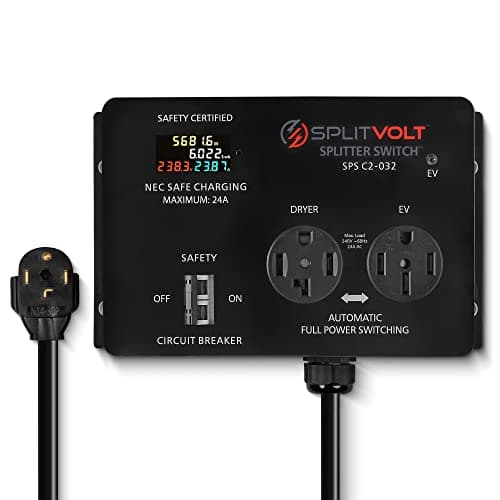 Splitvolt Splitter Switch (NEMA 14-30 in, 14-30 + 14-50 out, 240V, 24A)The only splitter here that ends in a NEMA 14-50, so a 14-50 charger reaches a dryer circuit — at 24 amps, which you must set yourself. | A 14-50 charger on a dryer circuit | Automatic 240V splitter | |
| 2 | 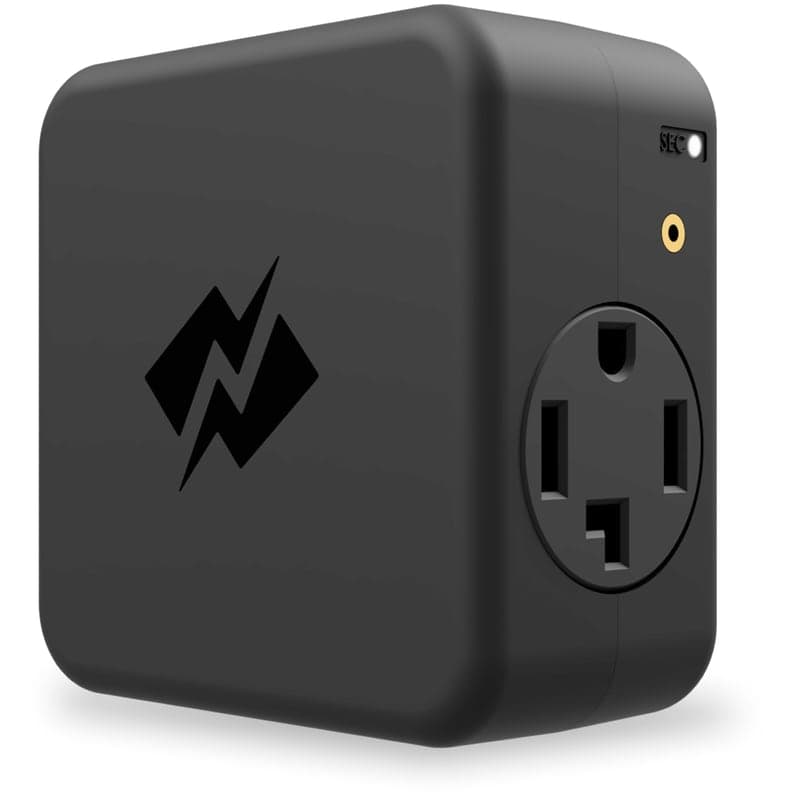 NeoCharge Smart Splitter (NEMA 14-30)The four-prong equivalent: it shares a modern dryer circuit, prioritizes the dryer, and switches to the car when the laundry finishes. | A modern 4-prong dryer outlet | Automatic 240V splitter | Check price#ad |
| 3 | 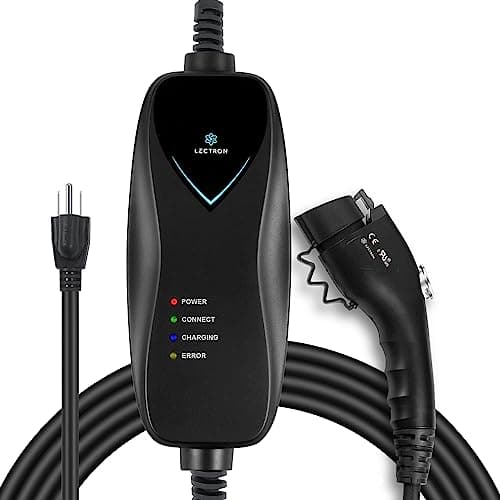 Lectron Portable Level 1 J1772 Charger (15A, NEMA 5-15)The unglamorous answer that covers most commutes: an ordinary 120V socket, overnight, and no conversation with anybody about electrical work. | An ordinary wall socket | Level 1 EVSE |
#1 · A 14-50 charger on a dryer circuit
Splitvolt Splitter Switch (NEMA 14-30 in, 14-30 + 14-50 out, 240V, 24A)
The only splitter here that ends in a NEMA 14-50, so a 14-50 charger reaches a dryer circuit — at 24 amps, which you must set yourself.
| Wall socket connection | NEMA 14-30 male (the modern four-prong dryer outlet)source |
|---|---|
| Outlets provided | NEMA 14-30 female (dryer) and NEMA 14-50 female (EV)source |
| Maximum load | 240V ~ 60Hz 24A ACsource |
| Internal protection | Integrated 24A circuit breaker with easy resetsource |
| Certification | cETLus listed Intertek 5021938; conforms to UL 60730-1, certified to CSA E60730-1source |
| Switching | Automated power switching between the dryer and EV socketssource |
| Dust and water protection | Indoor use onlysource |
| Warranty | 1 year manufacturer's limited warranty; a 4 year extension is sold separatelysource |
What those numbers mean
The NEMA 14-50 output is what makes this different from every other splitter on this site. A charger that ends in a 14-50 plug physically cannot reach a dryer receptacle; this gives it a 14-50 to plug into.
What it does NOT do is raise the current. The circuit behind it is still 30 amps, the device is capped at 24, and Splitvolt states plainly that you must set your EV or adjustable charger to 24 amps maximum. A fixed 40 amp charger is the wrong partner for it.
Splitvolt publishes an actual certificate number — Intertek 5021938 — rather than the word "certified". That is a claim you can look up, which is the distinction this site keeps insisting on.
What it does well
- Publishes a checkable cETLus certificate number, not just a certification claim
- The only splitter here with a NEMA 14-50 output, so a 14-50 charger can use a dryer circuit
- Integrated 24A breaker with a reset, so the protection is inside the device
- Automatic switching — nobody has to remember to unplug the dryer
What it does not
- Expensive — it costs more than many of the chargers it feeds
- Indoor use only, per Splitvolt's own specification
- 24A ceiling, and you have to set the charger down to it yourself; the device will not do it for you
- One year of warranty as standard, which is short against the three years the charger brands publish
Skip this one if: Your charger has no current adjustment. A fixed 40 amp unit plugged into this will try to draw 40 amps from a 30 amp circuit, which is the exact situation the 24 amp setting exists to prevent.
#ad · how this is funded · price as of October 27, 2026
#2 · A modern 4-prong dryer outlet
NeoCharge Smart Splitter (NEMA 14-30)
The four-prong equivalent: it shares a modern dryer circuit, prioritizes the dryer, and switches to the car when the laundry finishes.
| Outlet type | Plugs into an existing four-prong 220/240V NEMA 14-30 dryer outletsource |
|---|---|
| EV current limit | The EV or charger must be set to 24 amps or less when sharing with a dryersource |
| Switching | Auto-switching prioritizes the dryer and switches to EV charging when it finishessource |
| Certification | UL safety certified and NEC compliantsource |
| Installation | No electrician needed — plug and playsource |
What those numbers mean
NEMA 14-30 is the four-prong dryer outlet standard in homes built after the mid-1990s, so which splitter you need is really a question about the age of the building.
The 24 amp ceiling is the same arithmetic as the three-prong version, for the same reason: 30 amp circuit, 80% continuous rule.
Dryer priority is the right default for a shared household. A dryer cycle is an hour; a charging session has all night to finish.
What it does well
- Works with the grounded four-prong outlet, which is the safer configuration to begin with
- UL safety certified
- Auto-switching, so nobody has to remember to unplug anything
What it does not
- Same 24A ceiling as any 30 amp circuit sharing arrangement
- Wrong device for a three-prong NEMA 10-30 outlet
Skip this one if: Your building predates the four-prong standard and the laundry outlet has three prongs. That is a NEMA 10-30 and needs the three-prong splitter instead.
#ad · how this is funded · price as of October 27, 2026
#3 · An ordinary wall socket
Lectron Portable Level 1 J1772 Charger (15A, NEMA 5-15)
The unglamorous answer that covers most commutes: an ordinary 120V socket, overnight, and no conversation with anybody about electrical work.
| Input | 120V, 15A maximumsource |
|---|---|
| Output power | 1.8 kWsource |
| Cable length | 16 ftsource |
| Plug / connector | NEMA 5-15 plug, J1772 connectorsource |
| Certification | UL 2594 / UL 2231 certified, and separately described as ETL-certified; no certificate number publishedsource |
| Ingress rating | IP65 weather-resistant, stated in the specification textsource |
| Manufacturer charge-rate claim | 45+ miles of range overnight; 3-5 miles of range per hoursource |
What those numbers mean
1.8 kW sounds trivial next to 9.6 kW, and for a road trip it is. For a commute it usually is not: the average US driver covers well under 45 miles a day, and this replaces that overnight while the car sits anyway.
The honest ceiling is the circuit behind the socket, not the cable. This unit draws 15 amps for hours, which a 20 amp circuit supports continuously and a 15 amp circuit does not — so check the breaker before the first overnight session, and on a 15 amp circuit choose a 12 amp unit instead.
This is the only category of EV charging that is genuinely invisible to a landlord. It draws less than a hair dryer and plugs into a receptacle that already exists.
What it does well
- Works with a socket that already exists, everywhere, with no permission needed
- UL 2594 and UL 2231 certified rather than a generic cordset
- Cheapest possible entry into home charging, by a wide margin
What it does not
- 1.8 kW will not recover a long driving day overnight
- 16 ft cable, and the nearest 120V socket is often not the nearest thing to the car
- Its 15 amp draw needs a 20 amp circuit behind the socket; an ordinary 15 amp circuit supports 12 amps continuously
Skip this one if: You regularly drive more than about 45 miles a day. Level 1 will fall a little further behind every night and you will spend the difference at public chargers.
Why a Y adapter is the wrong answer
Passive Y splitters are sold widely and cheaply — a NEMA 14-50 plug branching into two 14-50 receptacles, ETL listed, often under fifty dollars. They are real products with a legitimate use: RV and camper setups where the two loads are small and intermittent. We are not linking one, because for two EVs it is the wrong device and the reason is not subtle.
charger A amps + charger B amps = total demand on one circuit
Two 40A chargers on a passive Y = 80A demanded from a 50A circuit · Two 24A chargers on a dryer circuit's Y = 48A demanded from a 30A circuit · Neither charger knows the other exists, because a passive splitter contains no electronics
The breaker is the only thing standing between that and an overloaded conductor, and a breaker is a last line of defense rather than a load-management strategy. Why the breaker keeps tripping is what this looks like on a good day.
A splitter switch solves it by never energizing both outlets at once. That is the entire product, and it is why one costs several times what a Y adapter does.
What the two splitter makers actually publish
| Splitvolt 14-30/14-50 | NeoCharge Smart Splitter | |
|---|---|---|
| Input plug | NEMA 14-30 male | 24A model: NEMA 14-30P or 10-30P. 40A model: NEMA 14-50P, 10-50P or 6-50P |
| Outputs | NEMA 14-30 female + NEMA 14-50 female | Two matching receptacles (2× 14-30R, or 2× 14-50R on the 40A model) |
| Maximum load | 240V, 24A | 24A model: 24A / 5.7 kW. 40A model: 40A / 9.6 kW |
| Two EVs at once? | Title states dryer-and-EV or two EVs; one socket is live at a time | "in turn or at the same time" — simultaneous requires each load set to 20A or less |
| Internal breaker | Integrated 24A breaker with reset | Not published |
| Certification | cETLus listed, Intertek 5021938 (a number you can look up) | cUL Listed, NEC compliant (no number published) |
| Warranty | 1 year; 4 year extension sold separately | 1 year; a paid package takes it to 3 years |
| Indoor or outdoor | Indoor use only | Indoor use only |
Two things in that table decide most purchases. The first is the Splitvolt's NEMA 14-50 output — it is the only device here that gives a 14-50 charger somewhere to plug in on a dryer circuit, which is otherwise a physical dead end. The second is that NeoCharge publishes genuine simultaneous charging on its larger model, with each car held at 20 amps or less. Splitvolt's device switches between sockets instead.
The 24 amp ceiling, and the thing you have to do yourself
If the outlet is a dryer receptacle, the circuit behind it is 30 amps, and the continuous-load rule caps you at 24. Splitvolt states it plainly: you "must adjust your EV or adjustable charger to 24 amps max output." The splitter will not do this for you. It is a setting on your charger, and it is on you.
24A × 240V ÷ 1000 = kW, then × hours = kWh
24A × 240V = 5.76 kW · Eight hours all to one car = 46 kWh, which is most of a pack · Four hours each = 23 kWh each, roughly 80 miles apiece at 3.5 mi/kWh
Eighty miles overnight, each, is more than the average American drives in a day. Two cars sharing one dryer circuit is usually enough — and that is the finding most households are surprised by. What it costs to charge prices the same energy.
This is why a fixed 40 amp charger is the wrong partner for any of this. It has no setting to come down to 24, so it will attempt 40 on a 30 amp circuit. Working out the amp rating you need does this for your own outlet, and the Lectron 40A review is an example of a unit that is excellent on a 14-50 and wrong here.
The cheaper answer most two-EV households should take first
Before spending four hundred dollars on a splitter switch, price the obvious alternative: give the second car a Level 1 cord on an ordinary 120V socket. That is the third pick above, and for a lot of households it is simply the better purchase.
| Automatic splitter switch | One 240V charger + one 120V cord | |
|---|---|---|
| Hardware cost | The splitter, plus a second charger | A Level 1 cord, and nothing else |
| What car B gets overnight | Up to 24A of 240V, in its turn | About 1.4 kW, or roughly 40 miles in eight hours |
| Needs the same room | Yes — both cars must reach one outlet | No — the 120V socket can be anywhere reachable |
| Who it suits | Two high-mileage drivers, or a long commute each | A household where one car does the miles and the other does errands |
| Failure mode | One device both cars depend on | Independent — one failure strands one car |
Forty miles a night covers the second car in a majority of two-car households, and it does it for the price of a cord rather than a cord plus a splitter. If that is your situation, the Level 1 roundup is the whole purchase.
How these were judged
- Can a tenant install it unaided? Every device here plugs in. Nothing is hardwired, nothing needs a permit, and all of it leaves when the lease does.
- Does it prevent simultaneous draw, or merely allow it? This is the criterion that eliminates the entire passive-splitter category, cheap and available though it is.
- Is the certification checkable? Splitvolt publishes an Intertek certificate number. NeoCharge publishes "cUL Listed" without a number. Both are better than the unlisted devices in this category; only one can be looked up.
- Does it match the plug your charger already has? The 14-50 output is the Splitvolt's real argument, and the reason it ranks first despite costing more.
- What happens at the ceiling? Whether the device limits current itself, or expects you to set the charger. All of these expect you to set the charger.
- Is there a cheaper way to the same outcome? Asked on every page here, and on this one the answer is often yes — which is why a $160 Level 1 cord is ranked third rather than omitted.
What this page cannot tell you
Neither splitter has been through our hands; the methodology is explicit that nothing on this site has. Every figure above is from Splitvolt's and NeoCharge's own product pages. What neither company publishes is how the switching behaves over years of daily cycling, or what happens when the device itself fails with two cars depending on it — and a one-year standard warranty on both is the only durability signal either one offers.
Questions people actually ask
Can you charge two electric cars from one outlet?
Yes, with an automatic splitter switch that energizes one socket at a time, or with NeoCharge's larger model which permits simultaneous charging with each car set to 20 amps or less. What you must not use is a passive Y adapter, which lets both chargers draw at once from a circuit sized for one.
Is a NEMA 14-50 Y splitter safe for two EV chargers?
No. A passive Y contains no electronics, so neither charger knows the other is drawing. Two 40 amp chargers on one would demand 80 amps from a 50 amp circuit. Y splitters have legitimate uses with small intermittent loads such as RV hookups; two EVs is not one of them.
How fast can two EVs charge on a shared dryer outlet?
The total is capped at 24 amps on a 30 amp dryer circuit, which is about 5.76 kW. Split as four hours each that is roughly 23 kWh per car, or about 80 miles apiece — more than most people drive in a day. The cap is on the circuit, not on each car.
Do I need to set my charger down to 24 amps?
Yes, and the splitter will not do it for you. Splitvolt states that you must adjust your EV or adjustable charger to 24 amps maximum output. A charger with no current adjustment, such as a fixed 40 amp unit, is the wrong device for a dryer circuit regardless of what it is plugged into.
Which splitter works with a charger that has a NEMA 14-50 plug?
The Splitvolt NEMA 14-30/14-50 model, because it is the only one here that provides a NEMA 14-50 receptacle on its EV side. A 14-50 plug physically will not fit a dryer receptacle or a 14-30 output, so this is a question about plug shape before it is a question about amperage.
Can a splitter switch be installed outside?
No. Splitvolt lists indoor use only under dust and water protection, and NeoCharge says the same. Both are designed for a laundry room or a garage bay.
Is it cheaper to buy a splitter or a second charger?
Often a second charger, specifically a Level 1 cord for the lower-mileage car. A splitter switch costs around four hundred dollars and you still need a second charger behind it; a Level 1 cord is well under two hundred and returns about 40 miles overnight from an ordinary 120V socket.
Will a splitter let both cars charge at the same time?
NeoCharge publishes that its splitter can charge both in turn or at the same time, with simultaneous charging requiring each load to be set to 20 amps or less. Splitvolt's device switches power between its two sockets rather than running both. Check which behavior a listing is actually selling.
Sources
Every figure on this page traces to one of these. If a number here disagrees with the manufacturer, the manufacturer is right and we want to know — tell us.
- Splitvolt — Splitter Switch NEMA 14-30/14-50, 240V / 24A, cETLus listed Intertek 5021938 (product page)
- Splitvolt — Splitter Switch NEMA 10-30, 240V / 24A, cETLus certified (product page)
- Splitvolt — frequently asked questions
- NeoCharge — NEMA 14-30 Smart Splitter (product page)
- NeoCharge — How to charge your EV using your dryer outlet (NEMA 14-30 guide)
- NFPA — NFPA 70, National Electrical Code (free public access)
- U.S. DOE Alternative Fuels Data Center — Electric vehicle charging levels and speeds
- Lectron — Portable Level 1 J1772 EV Charger, 120V / 15A / NEMA 5-15 (product page)
Read next
Best Dryer-Outlet Setup
Charging from an outlet you already have
The existing-240V section: dryer, range and RV outlets, how to share one safely, and what changes in an older building.
Top pick: Splitvolt Splitter Switch (NEMA 10-30, 240V, 24A)

Best Dryer Splitter
The dryer outlet splitter, reviewed
An independent look at automatic 240V splitters: certifications, the built-in breaker, and how they differ from a passive Y-adapter.
Top pick: Splitvolt Splitter Switch (NEMA 10-30, 240V, 24A)

Guide
NEMA 14-30: the modern dryer outlet
How to use a four-prong dryer circuit for EV charging, what the 24 amp limit returns overnight, and the sharing device that makes it work.
Top pick: NeoCharge Smart Splitter (NEMA 14-30)
Guide
Charging from a shared laundry room
How to use a shared laundry circuit for EV charging: the hardware, the conversation, and the etiquette that stops it being withdrawn.
Top pick: NeoCharge Smart Splitter (NEMA 14-30)
Guide
Working out the amp rating you need
A step-by-step method for sizing charger amperage to a real circuit, including how to find the breaker and what to do when you cannot.
Top pick: Grizzl-E Mini Connect Portable Charger

Best Level 1 Charger
The best Level 1 EV chargers
Level 1 chargers ranked for renters: 12 amps against 15 and the breaker that decides it, cable reach, connector and a safety listing you can check.
Top pick: Schumacher Electric SEV1670 Level 1 Portable EV Charger (12A, NEMA 5-15)