How long does a portable EV charger last?
No manufacturer publishes an answer. The warranty is the only durability figure anyone commits to, and the spread is enormous.
How this page is funded: the buy links below are affiliate links, and Renter Volt earns a commission on qualifying purchases at no cost to you. Nothing here was supplied by a manufacturer, and commission plays no part in the ranking — read the full disclosure. Picks are chosen from published specifications rather than hands-on testing; the method is written down so you can check it. Prices last verified October 27, 2026.
Nobody publishes an answer, so buy the warranty instead — and on that measure the Grizzl-E Mini wins outright at three to five years. Not one manufacturer on this site publishes a service life, a failure rate or a cycle count for its charger. The warranty period is the only durability figure any of them commits to in writing, and it ranges from five years down to none at all.
That is a strange thing to discover about a category of outdoor electrical equipment that people expect to keep for a decade. It is also genuinely useful, because it turns a vague question into one you can compare across brands in a single table.
Quick picks
Ranked, with the reasoning underneath. Tap any row to jump to that write-up; tap the price to check it on Amazon. Prices come from the live layer, never from this page.
| # | Product | Best for | Type | Price |
|---|---|---|---|---|
| 1 | 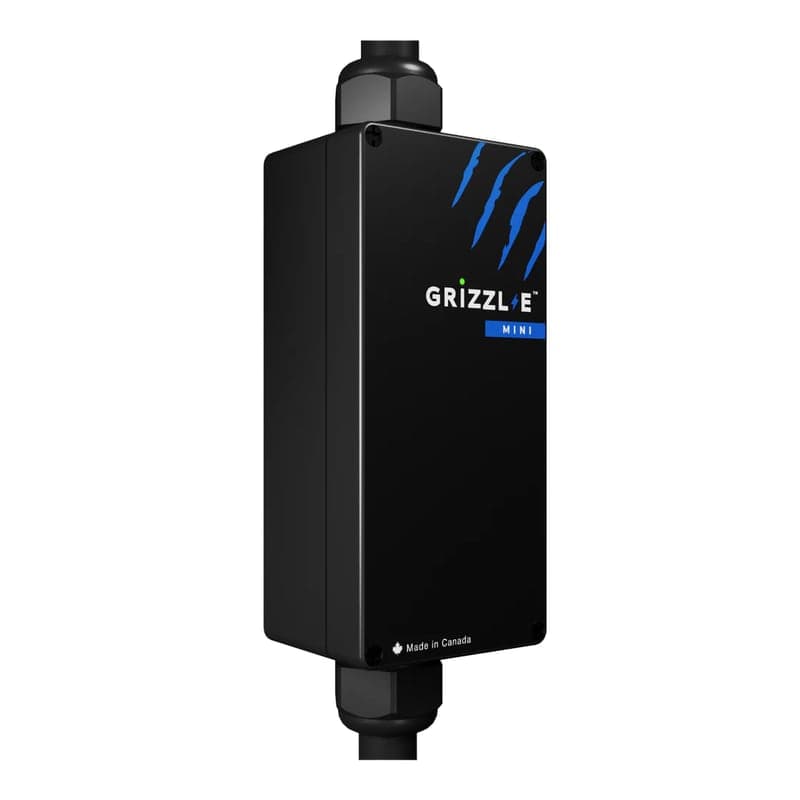 Grizzl-E Mini Connect Portable ChargerAdjustable from 7 to 40 amps and shipped with four plug adapters, which is the closest thing to a unit that fits whatever outlet you turn out to have. | Not knowing your outlet yet | Adjustable Level 1 and 2 EVSE | Check price#ad |
| 2 | 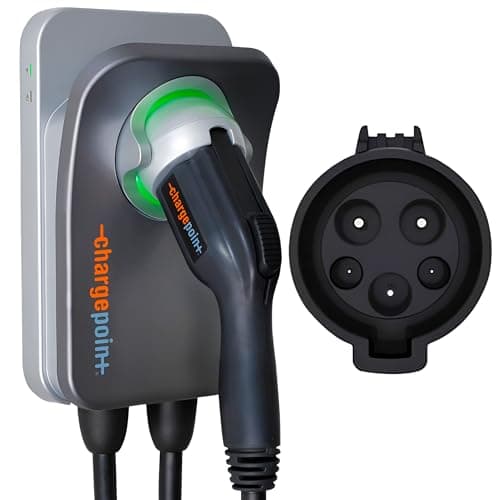 ChargePoint Home Flex Level 2 EV Charger (40A, NEMA 14-50 plug)A plug-in 40 amp smart charger whose app runs both this unit and ChargePoint's public network, which is the one thing here the cheaper units cannot match. | One app for home and public | Plug-in smart EVSE | |
| 3 | 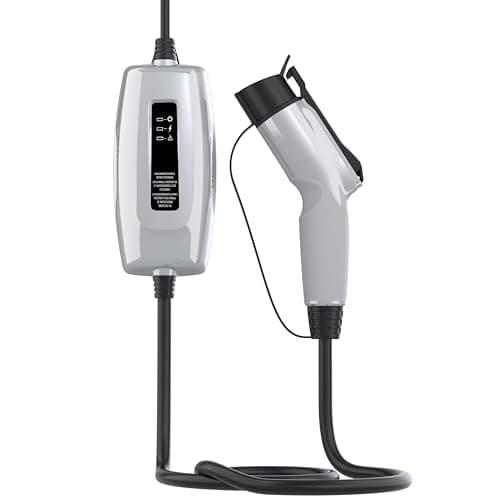 Schumacher Electric SEV1670 Level 1 Portable EV Charger (12A, NEMA 5-15)A 12 amp Level 1 charger sized correctly for an ordinary 15 amp household circuit, with a 20 ft cable that reaches further than most. | A 15 amp circuit and a longer reach | Level 1 EVSE | |
| 4 | 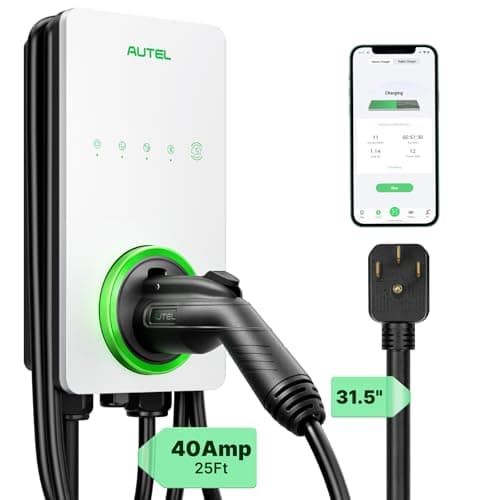 Autel MaxiCharger AC Elite Home (40A, NEMA 14-50 plug)Twenty-five feet of cable and a published NEMA 4 enclosure rating — full 40 amp reach for a bay that is not beside the outlet. | Maximum reach at a fixed 40A | Plug-in Level 2 EVSE |
#1 · Not knowing your outlet yet
Grizzl-E Mini Connect Portable Charger
Adjustable from 7 to 40 amps and shipped with four plug adapters, which is the closest thing to a unit that fits whatever outlet you turn out to have.
| Adjustable current | 7A to 40A (9.6 kW maximum)source |
|---|---|
| Voltage | Automatically detects 120V (Level 1) or 240V (Level 2)source |
| Cable length | 25 ft (7.6 m)source |
| Plug and adapters | NEMA 14-50 plug plus four included electrical adapterssource |
| Connector | J1772 or Tesla (NACS) versionssource |
| Enclosure | UL Type 4 / IP67 ratedsource |
| Certification | UL tested and certified, Energy Star certifiedsource |
What those numbers mean
The adjustable current is the feature that matters to a renter, and it is not a convenience. A 30 amp dryer circuit legally supports 24 amps of continuous EV load; a unit that can be set to 24 amps can use that circuit, and a fixed 40 amp unit cannot.
25 ft of cable is nine feet more than the common 16 ft, and nine feet is frequently the difference between reaching the car and not.
IP67 and a UL Type 4 enclosure describe the unit's own weather tolerance. They say nothing about the outlet it plugs into, which is usually the part that is not weather-rated.
What it does well
- 7-40A adjustment means one unit fits a 15, 20, 30 or 50 amp circuit
- 25 ft cable is among the longest on a portable unit
- Four plug adapters included, so an outlet change does not mean a new charger
- Available with either a J1772 or a NACS connector
What it does not
- Costs meaningfully more than a fixed-amperage unit that does one job
- The bundled adapters make it easy to plug into a circuit you have not actually checked
Skip this one if: You know exactly which outlet you have, it is not changing, and you would rather put the money into a longer cable than into adjustability you will set once and never touch.
#ad · how this is funded · price as of October 27, 2026
#2 · One app for home and public
ChargePoint Home Flex Level 2 EV Charger (40A, NEMA 14-50 plug)
A plug-in 40 amp smart charger whose app runs both this unit and ChargePoint's public network, which is the one thing here the cheaper units cannot match.
| Amperage | 16 to 50A flexible amperage across the range; the plug-in version delivers up to 40Asource |
|---|---|
| Circuit required (plug-in) | A circuit rated 40A or 50A. ChargePoint states the hardwired version is required for all other circuit ratingssource |
| Cable length | 23 ftsource |
| Plug / connector | NEMA 14-50 plug (a 6-50 version is also sold), J1772 or NACS connectorsource |
| Certification | UL Listed and ENERGY STAR certifiedsource |
| Warranty | 3 yearssource |
| Outdoor installation | ChargePoint requires hardwiring the station or using a weatherproof receptacle for outdoor installationsource |
What those numbers mean
The 50 amp headline belongs to the hardwired version. On a plug it delivers up to 40 amps, which is the ceiling a 50 amp circuit permits continuously and the same ceiling every plug-in charger shares.
The circuit requirement is stricter than it first looks. ChargePoint states the plug-in version needs a circuit rated 40 or 50 amps and that the hardwired version is required for anything else, so a smaller circuit is not something you can simply dial down to.
The app is the real differentiator. It handles this charger and ChargePoint's public stations from one place, which is worth more to somebody who charges partly away from home than to somebody with a driveway and a fixed routine.
What it does well
- One app for this charger and ChargePoint's public network
- Amperage is selected in the app to match the breaker feeding the outlet
- UL Listed and ENERGY STAR certified, with a three-year warranty
- Sold with a J1772 or a NACS connector, and a NACS cable conversion kit exists for units already owned
What it does not
- The plug-in version needs a circuit rated 40 or 50 amps; ChargePoint requires hardwiring for anything smaller
- 23 ft of cable, shorter than some rivals at this price
- Outdoors, ChargePoint asks for hardwiring or a weatherproof receptacle rather than a bare plug
- It sits at the top of the plug-in price bracket
Skip this one if: Your 240V outlet is on a circuit smaller than 40 amps, or you never use public charging and only want an overnight timer. In both cases you would be paying for the part of this charger you cannot use.
#3 · A 15 amp circuit and a longer reach
Schumacher Electric SEV1670 Level 1 Portable EV Charger (12A, NEMA 5-15)
A 12 amp Level 1 charger sized correctly for an ordinary 15 amp household circuit, with a 20 ft cable that reaches further than most.
| Charging current | 12A continuous, 120Vsource |
|---|---|
| Output power | 1.44 kWsource |
| Cable length | 20 ftsource |
| Plug / connector | NEMA 5-15 plug, J1772 connectorsource |
| Certification | ETL and Energy Starsource |
| Enclosure | IP66 housingsource |
| Built-in protection | Leakage, undervoltage, overvoltage, overcurrent, over-temperature, ground-fault and relay-fault protectionsource |
What those numbers mean
Twelve amps is not a low number for this category; it is the correct one. A 15 amp circuit supports 12 amps of continuous load, and overnight charging is continuous by any definition, so this unit uses an ordinary household circuit right up to its limit and no further.
The 20 ft cable is four feet longer than the common 16 ft. At a carport or a curbside socket, those four feet are frequently the difference between reaching the charge port and reaching for an extension cord.
Over-temperature protection is on the manufacturer's list, but the published specification does not say where the sensor sits. Treat it as a backstop, and still feel the plug at the wall during the first few long sessions.
What it does well
- Sized for a 15 amp circuit, the most common household circuit there is
- 20 ft cable, longer than the usual 16 ft
- ETL and Energy Star certified, with an IP66 housing
- The manufacturer publishes the full list of built-in protections
What it does not
- J1772 only — a Tesla or other NACS car needs an adapter or a NACS unit
- No app or scheduling, and no current adjustment in the published specification
- 1.44 kW will not recover a long driving day overnight
Skip this one if: Your car has a NACS (Tesla-style) port, or you regularly drive more than about 40 miles a day. The first needs a different connector; the second needs more power than any Level 1 unit can deliver.
#4 · Maximum reach at a fixed 40A
Autel MaxiCharger AC Elite Home (40A, NEMA 14-50 plug)
Twenty-five feet of cable and a published NEMA 4 enclosure rating — full 40 amp reach for a bay that is not beside the outlet.
| Input / output | 240V, 40A maximum, 9.6 kWsource |
|---|---|
| Cable length | 25 ftsource |
| Plug / connector | NEMA 14-50 plug, SAE J1772 connectorsource |
| Enclosure rating | NEMA 4 (published; no IP figure given)source |
| Current adjustment | "Adjustable charging up to 40 Amps" — no lower limit publishedsource |
| Warranty | Three year limited warrantysource |
| Connectivity | Wi-Fi / Bluetooth / Ethernet / CAN / RS485source |
| Efficiency certification | ENERGY STAR certified (AUTEL Maxi US AC W12, EVSE spec v1.2)source |
What those numbers mean
Twenty-five feet ties the longest cable on this site — the Grizzl-E Mini — but the Mini is an adjustable unit built around smaller circuits. This is the 25 ft option that runs the full 40 amps on a NEMA 14-50, and 16 ft is the category norm for that class.
The NEMA 4 enclosure rating is a published figure, which is rarer in this category than it should be. It is not the same as an IP rating and Autel publishes no IP number and no operating temperature range on this page.
Autel's own page says "Recommended hardwire for outdoor installation". A renter cannot hardwire anything, so read that as the manufacturer steering year-round outdoor use away from the plug-in version you can actually use.
What it does well
- 25 ft cable — tied for the longest on this site, and the longest at a full 40 amps
- Publishes a NEMA 4 enclosure rating, which most of this category does not
- Three year limited warranty, published on Autel's own page
- ENERGY STAR certified, verifiable in the EPA's own product database
What it does not
- No operating temperature range published anywhere on the product page
- Autel's page still carries a "*Certification Pending May 2022" note and names no UL standard or certificate number
- The adjustable range is given only as "up to 40 Amps" — the lower limit is not published, so a 30 amp circuit is not a documented use
- Costs meaningfully more than a plain fixed 40 amp unit for the same 9.6 kW
Skip this one if: Sixteen feet already reaches your charge port. The extra cable is what you are paying for here, and if you do not need it a plain 40 amp unit delivers identical power for less.
#ad · how this is funded · price as of October 27, 2026
Every published warranty, compared
Compiled from each manufacturer's own page. Where a company publishes nothing, the table says so rather than guessing.
| Product | Published warranty | What the manufacturer actually says |
|---|---|---|
| Grizzl-E Mini Connect | 3 or 5 years | "covered by either a 3-year or 5-year replacement warranty" — a replacement warranty, not a repair one |
| Autel MaxiCharger (plug-in 40A) | 3 years | "Three year limited warranty" |
| ChargePoint Home Flex | 3 years | "3-year warranty for peace of mind" |
| Emporia Classic | 3 years | "Warranty: 3 years" |
| Schumacher SEV1670 (Level 1) | 3 years | "3 Year Limited Warranty" — on the cheapest product in the table |
| Splitvolt Splitter Switch | 1 year | "1 Year Manufacturer's Limited Warranty"; a 4 year extension is sold separately |
| NeoCharge Smart Splitter | 1 year | "1-year limited warranty"; a paid package "takes it to 3 years" |
| Lectron 40A (14-50) | None published | A 30-day return policy and no warranty period stated |
Three years is the category standard, and the two outliers are the interesting rows. Grizzl-E publishes a replacement warranty of up to five years, which is the strongest commitment in the table — a replacement warranty is also a materially better promise than a repair one, because it does not leave you waiting on a service queue. Lectron publishes no warranty period at all for its 40A unit, only a 30-day return window, which its review treats as that unit's most serious reservation.
The Grizzl-E FAQ contradicts itself, and it is worth knowing
Grizzl-E's own FAQ page contains both of these statements:
- "If you purchase your charger from Amazon or any other verified reseller the 3 Year Warranty will apply."
- "The manufacturer's warranty does not change based on the place of purchase."
Those cannot both be true as written. The first says where you buy decides the term; the second says it does not. The practical reading is that three years is what an Amazon purchase gets and the five-year figure attaches elsewhere or to particular models — but we are not going to present our reading as Grizzl-E's position.
What to do about it: assume three years if you buy through Amazon, and if the five-year term is the reason you are buying, confirm it in writing with Grizzl-E before you order. Its FAQ gives a support route for exactly that. The Grizzl-E Mini review covers the rest of what that unit publishes.
What actually fails, as far as anyone publishes it
This is where the honest answer is short. No manufacturer in the table publishes a failure-mode analysis, a mean time between failures or a cycle count for its connector. What they publish instead is enclosure construction, and that at least tells you what each company thought it was defending against:
- Grizzl-E describes a "fully air-tight UL Type 4 aluminum cast enclosure" and says the unit "takes on cold and heat, snow and rain" — construction claims rather than a tested lifespan.
- Autel and Emporia both publish a NEMA 4 enclosure rating, which is a defined standard rather than a description.
- Lectron's NEXUS and the Schumacher Level 1 cord both publish IP66, the most specific ingress figures on the site.
- ChargePoint publishes no enclosure rating on its product page at all, which is a notable absence given the unit's price.
Not one of them publishes an operating temperature range. For a device that lives through winters, that is the gap that matters most — and it is why the outdoor and winter roundup ranks on the two figures that are published rather than on durability claims nobody substantiates.
What the DOE says about the thing people confuse this with
Searches about EV charger lifespan often really mean the car's battery, which is a different component with far better public data. The Department of Energy publishes that EV batteries "may last 12 to 15 years in moderate climates and 8 to 12 years in severe climates", and the Alternative Fuels Data Center notes that "many manufacturers offer 8-year/100,000-mile warranties" for them.
So the pack you are charging carries a published lifespan estimate and an eight-year warranty, while the cord charging it carries three years and no lifespan figure at all. If the battery is what you were asking about, is Level 1 charging bad for the battery? is the page that handles it.
How these four picks were chosen for this page
- Published warranty period, weighted first. On a page about how long things last, the only committed number has to lead. Anything publishing nothing is excluded from the picks here regardless of how good the hardware is.
- Replacement over repair. Grizzl-E's is a replacement warranty, which is a stronger promise than a repair one and is why it ranks first.
- A published enclosure or ingress rating. A defined standard — NEMA 4, UL Type 4, IP66 — beats an adjective. All four picks publish one.
- Renter-installable, without exception. Everything here plugs in, as on every page of this site.
- Spread across the real situations. One adjustable unit, one networked 40A unit, one long-cable 40A unit and one Level 1 cord, so the page answers for whichever outlet you actually have.
- What is NOT credited: durability adjectives. "Toughest and longest lasting" is a marketing claim with no number behind it, and this page does not rank on it.
What this page cannot tell you
We have not run a charger to failure, cycled a connector or had a unit through a winter — the methodology is explicit that nothing on this site has been tested. Every warranty figure above is quoted from the manufacturer's own page and was checked on this page's date; warranty terms change more often than specifications do, so confirm yours before buying. And the central finding stands: the actual service life of a portable EV charger is not published by anyone, so nobody can honestly tell you the number — including us.
Questions people actually ask
How long do EV chargers last?
No manufacturer publishes a service life, a failure rate or a cycle count, so there is no honest number to quote. The only durability figure any of them commits to is the warranty, which across the units on this site runs from five years at the top down to none at all at the bottom. Three years is the category standard.
What warranty do EV chargers come with?
Three years is standard. Grizzl-E publishes a 3 or 5 year replacement warranty, Autel, ChargePoint, Emporia and Schumacher each publish three years, the two splitter brands publish one year with paid extensions, and Lectron publishes no warranty period for its 40A unit at all — only a 30-day return policy.
Which portable EV charger has the longest warranty?
The Grizzl-E, which publishes a 3 or 5 year replacement warranty. Note that its own FAQ says an Amazon purchase gets the 3 year term, while elsewhere on the same page it says the warranty does not change by place of purchase. If the 5 year term is why you are buying, confirm it with Grizzl-E in writing first.
Is a 30-day return policy the same as a warranty?
No, and the difference is the whole point. A return window covers a unit that arrives faulty or wrong. A warranty covers one that fails in month fourteen. A product offering only the first has made no commitment about the second.
What usually fails on a portable EV charger?
Nobody publishes failure-mode data, so we will not invent any. What manufacturers do publish is enclosure construction — UL Type 4, NEMA 4 or IP66 on the better-documented units — which indicates what each company designed against. Not one of them publishes an operating temperature range, which is the gap that matters most for a charger that lives outdoors.
Do EV charging cables wear out?
Connectors and cables are mechanical parts and will wear with use, but no manufacturer on this site publishes a mating-cycle rating or a cable service life, so there is no figure to give you. Treat an unexplained rise in charging faults or any visible damage to the connector as a reason to stop using it.
How long does the car's battery last compared with the charger?
Much longer, and with far better public data. The DOE publishes 12 to 15 years in moderate climates and 8 to 12 in severe ones, and most manufacturers warrant the pack for 8 years or 100,000 miles. The charging cord carries three years and no published lifespan.
Is it worth paying more for a longer warranty?
On this evidence, the warranty is the only durability information you are given, so it is doing more work than usual in the decision. But note that the cheapest product in our comparison — a Level 1 cord — publishes the same three years as units costing several times more, so a longer warranty is not something you reliably buy with a higher price here.
Sources
Every figure on this page traces to one of these. If a number here disagrees with the manufacturer, the manufacturer is right and we want to know — tell us.
- Grizzl-E — frequently asked questions (warranty terms, enclosure type, support process)
- Grizzl-E Mini Connect — published specifications (EVolt Home, authorized dealer listing)
- Autel Energy (US store) — MaxiCharger AC Elite Home 40A, NEMA 14-50 plug-in (published specifications)
- ChargePoint — Home Flex home charger: configurations, amperage and certifications
- Emporia Energy — Classic Level 2 EV Charger specifications
- Schumacher Electric — SEV1670 Level 1 Portable EV Charger, 120V / 12A (product page and specifications)
- Splitvolt — Splitter Switch NEMA 14-30/14-50, 240V / 24A, cETLus listed Intertek 5021938 (product page)
- NeoCharge — NEMA 14-30 Smart Splitter (product page)
- Lectron — Portable Level 2 J1772 EV Charger, 240V / 40A / NEMA 14-50 (product page)
- Lectron — published specification table for the Level 1 and Level 2 charger range
- U.S. DOE Alternative Fuels Data Center — maintenance and safety of electric vehicles (battery life and warranties)
- U.S. DOE / EPA fueleconomy.gov — electric vehicle batteries: published service-life range and replacement cost
Read next
Guide
Learn
Reference and explainers: charging levels, cost per mile, session times, outdoor safety and a glossary written in plain English.

Guide
What to look for in a portable EV charger
A criteria-first guide to choosing a plug-in charger: the six specifications that matter in order, and a cross-brand table of which makers publish each one and which stay silent.
Top pick: Grizzl-E Mini Connect Portable Charger

Best Adjustable Portable
Grizzl-E Mini Connect, reviewed
The adjustable 7-40A portable charger examined properly: what the range buys you, what the 25 ft cable is worth, and who should buy something else.
Top pick: Grizzl-E Mini Connect Portable Charger
Guide
Lectron Level 2 40A charger, reviewed
A close read of the 40A Lectron: the WiFi-versus-Plug-and-Play trap, the two specifications it never publishes, the missing warranty, and the circuit on which it is the wrong purchase.
Top pick: Lectron Portable Level 2 J1772 Charger (40A, NEMA 14-50)
Guide
Is Level 1 charging bad for your EV battery?
What the DOE and a controlled national-lab study actually publish about charging rate and battery life, why Level 1 was never the suspect, and the cords to buy if 120V is what you have.
Top pick: Lectron Portable Level 1 J1772 Charger (15A, NEMA 5-15)

Best for Outdoors
Best EV charging gear for outdoors and winter
Outdoor and cold-weather charging gear ranked on published ingress and temperature ratings — plus the free habits that matter more than any of it.
Top pick: Lectron NEXUS Level 2 Charger (NEMA 14-50 plug)