Emporia Classic EV Charger, reviewed
A good smart charger sold in four versions, two of which a renter cannot install at all — and they cost the same.
How this page is funded: the buy links below are affiliate links, and Renter Volt earns a commission on qualifying purchases at no cost to you. Nothing here was supplied by a manufacturer, and commission plays no part in the ranking — read the full disclosure. Picks are chosen from published specifications rather than hands-on testing; the method is written down so you can check it. Prices last verified September 14, 2026.
The Emporia Classic is the smart charger renters shortlist, and the single most important thing about it is not a specification — it is which version you put in the cart. Emporia sells the Classic in four configurations. Two of them are hardwired, which is construction on somebody else's building and not available to you. The plug-in and the hardwired versions are listed at the same price, so price tells you nothing about which one you are looking at.
Quick picks
Ranked, with the reasoning underneath. Tap any row to jump to that write-up; tap the price to check it on Amazon. Prices come from the live layer, never from this page.
| # | Product | Best for | Type | Price |
|---|---|---|---|---|
| 1 | 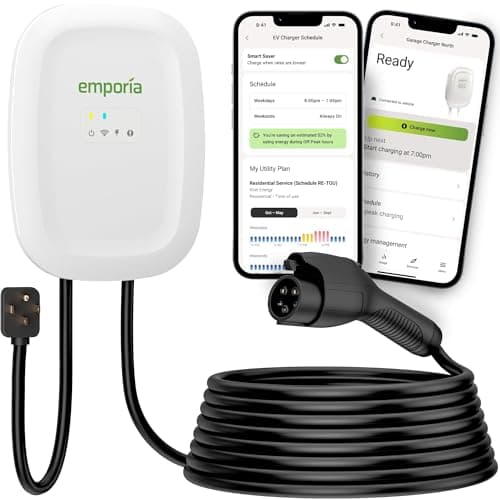 Emporia Classic Level 2 EV Charger (NEMA 14-50 plug)A plug-in smart charger whose scheduling genuinely pays for itself if your utility bills you differently overnight. Emporia Classic Level 2 EV Charger (NEMA 14-50 plug)A plug-in smart charger whose scheduling genuinely pays for itself if your utility bills you differently overnight. | Charging on a schedule | Plug-in smart EVSE |
#1 · Charging on a schedule
Emporia Classic Level 2 EV Charger (NEMA 14-50 plug)
A plug-in smart charger whose scheduling genuinely pays for itself if your utility bills you differently overnight.
| Maximum output | 9.6 kW (40A) with a NEMA 14-50 outlet; 11.5 kW (48A) hardwiredsource |
|---|---|
| Connector | J1772 or NACS (Tesla) modelssource |
| Enclosure | Type 4 enclosure, watertight, indoor or outdoorsource |
| Certification | UL certified and GFCI protectedsource |
| Scheduling | Off-peak scheduling and real-time charge-rate monitoring in the Emporia appsource |
What those numbers mean
Note the honest asymmetry in the first row: the 48 amp headline number is the hardwired figure. On a NEMA 14-50 plug — the only version a renter should be looking at — it is a 40 amp charger. That is not a downgrade, it is what the plug is rated for.
The scheduling is the actual reason to pay more here. If you are on a time-of-use rate, charging on a timer is worth real money over the length of a lease.
It is a wall-mount form factor with a plug on it. You can hang it on a hook or leave it in the trunk; nothing about it requires a bracket screwed into the landlord's drywall.
What it does well
- Scheduling and energy monitoring that are useful rather than decorative
- Type 4 watertight enclosure rated for outdoor use
- Sold with either a J1772 or a NACS connector
- The plug-in version needs no electrician and comes off the wall when you move
What it does not
- The advertised 48 amps is hardwired-only; the plug-in version is 40 amps
- Scheduling needs Wi-Fi, which is not a given in a detached carport or a parking structure
Skip this one if: Your electricity costs the same at every hour and there is no Wi-Fi where you park. You would be paying for a feature set you cannot reach or use.
#ad · how this is funded · price as of September 14, 2026
The four variants, and the two you cannot use
Emporia's own store lists the Classic by connector and by connection method. The connector choice is about your car. The connection choice is about whether you need an electrician — and it is the one that decides whether this purchase works in a rental at all.
| Version | Connector | How it connects | Usable in a rental? |
|---|---|---|---|
| J1772 / NEMA 14-50 | J1772 | Plugs into an existing 14-50 receptacle | Yes — this is the one |
| J1772 / Hardwire | J1772 | Wired into a junction box by an electrician | No |
| NACS / NEMA 14-50 | NACS (Tesla) | Plugs into an existing 14-50 receptacle | Yes, if your car is NACS |
| NACS / Hardwire | NACS (Tesla) | Wired into a junction box by an electrician | No |
What Emporia publishes, read closely
- Up to 48 amps hardwired, or 40 amps on a NEMA 14-50 outlet. Emporia prints both figures itself. The plug version is a 40 amp charger.
- 25 ft cable with a remote holder. Nine feet longer than the 16 ft that is common on portable units, and the specification renters underestimate most.
- J1772 or NACS (Tesla) connector. You can match your car's inlet directly instead of adding an adapter to the chain.
- NEMA 4 rated for indoor or outdoor installation.
- Energy Star rated and UL Certified, with GFCI protection built into the unit.
- Three-year warranty.
- Charge rate is adjustable in the app to match your breaker, with breaker sizes from 15A upward offered during setup.
The 48 amp headline is not the number you get
Every listing for this charger leads with 48 amps. On a plug, you get 40. That is not Emporia being evasive — they publish both numbers plainly — but it is the figure that travels in product titles and review headlines, and it is the hardwired one.
amps × 240V ÷ 1000 = kW
40A → 9.6 kW on a NEMA 14-50 plug · 48A → 11.5 kW hardwired
The gap is about two kilowatts, or roughly twenty minutes on a typical overnight session. It is not the difference anybody should pay an electrician to close. Hardwired vs plug-in works through the whole trade-off.
Forty amps is not a compromise, either. It is what a 50 amp circuit supports continuously under the National Electrical Code's 80% rule, and it is the ceiling on every plug-in Level 2 charger sold, from any brand. A renter losing the 48 amp figure is losing something they were never able to use.
The charge rate does adjust — and this still is not a dryer-outlet charger
This is worth stating carefully, because the shorthand in this category gets it wrong in both directions. The Classic is frequently described as a fixed 40 amp unit. It is not: Emporia's installation guide walks you through setting your breaker size in the app, offering sizes from 15 amps upward, and raising or lowering the charge rate to match. Electrically, it can be told to draw less.
What does not adjust is the plug on the end of it. The plug-in Classic terminates in a NEMA 14-50, and a NEMA 14-30 dryer outlet is a different receptacle. The charger cannot reach the circuit, and putting an adapter between them to make the shape fit is the instinct this site argues against everywhere else — the adapter changes the shape of the connection and nothing about what the circuit behind it can carry.
So the practical answer is unchanged even though the reason is different: if the only 240V you can reach is a dryer outlet, buy a charger that ships with the plug adapters and a current setting for them, which is the case for the Grizzl-E Mini. If you have a real NEMA 14-50, the Classic's adjustability is still worth something — it means the charger survives a move to a building with a smaller breaker behind the same receptacle.
The GFCI catch, which almost nobody mentions
This matters more to this site's reader than to a homeowner, because renters are usually plugging into a receptacle somebody else specified — an RV pedestal, a newer garage circuit, a range outlet in a unit built to current code. You do not get to choose the breaker. Breaker keeps tripping covers how to tell a nuisance trip from a real fault, which is the distinction that matters before you assume the charger is broken.
Classic or Pro? For a renter the question answers itself
Emporia sells a Pro above the Classic, and the comparison is the most-searched question about this charger. Emporia's own explainer is unusually clear about the difference, and it settles the matter quickly for anybody who does not own their electrical panel.
Both units carry the same core specifications: up to 48 amps hardwired or 40 on a plug, Smart Scheduling, the same 25-foot cable and the same three-year warranty. The Pro's premium is PowerSmart load management, which throttles the charger in real time to keep the whole home under its service limit. It exists so that homes with panels too small for a Level 2 circuit can add one without an upgrade.
There is a second-order point here too. Emporia notes that a Classic can be upgraded later by adding a Vue monitor and a firmware change, so buying the Classic does not close the door if you eventually own the panel. That makes the Classic the better purchase on both ends of the decision for this audience.
What the smart features are actually worth
Scheduling is the reason to pay above the budget tier for this unit, and its value is entirely determined by one question: does your electricity cost the same at every hour? On a flat rate, a timer saves nothing and you have bought a plain 40 amp charger at a smart charger's price. On a time-of-use tariff, shifting a full charge into the cheap overnight window is real money across the length of a lease, and it compounds every night without you doing anything.
The energy reporting is a smaller but genuine benefit for a renter specifically: if you are reimbursing a landlord or splitting a shared outlet with a neighbor, a per-session kWh figure turns an argument into arithmetic. What it costs to charge has the formula to turn those kilowatt-hours into dollars at your own rate.
All of it runs through the app, and the app needs a network. Setup connects over Bluetooth and then wants Wi-Fi. A detached carport, a below-grade parking structure or a back fence is frequently outside the router's reach, and in that spot the smart charger becomes a plain one. Check the signal where the car actually parks — not where you are standing when you order it.
Living with it outdoors
The NEMA 4 rating covers the unit for outdoor use, and Emporia's guide adds the practical note that it should be mounted right-side up and under cover where possible. The part that is usually not rated is the receptacle it plugs into, which in an older carport may have no weather cover at all. Leaving a charger outside covers the drip loop and the while-in-use cover, both of which cost very little and address the actual weak point.
Who should skip it
- Your electricity costs the same all day. The scheduling is the premium, and on a flat rate it returns nothing. A fixed-amperage unit from the budget tier does the identical electrical job.
- There is no Wi-Fi where you park. Same conclusion, different cause. You would be buying an app you cannot reach.
- Your only 240V is a dryer outlet. The plug is a 14-50 and it will not reach a 14-30 or a 10-30 circuit.
- You have not confirmed which outlet you get. An adjustable unit that ships with plug adapters covers being wrong; this one does not.
- You were about to buy the Pro for the load management. It needs a monitor installed in a panel you do not control.
The verdict
For a renter with a confirmed NEMA 14-50 and a time-of-use electricity rate, the Classic is the right smart charger: the scheduling pays for itself, the 25-foot cable solves the reach problem that ends most carport installs, it is UL certified and NEMA 4 rated, and it unplugs and leaves with you at the end of the lease. Buy the NEMA 14-50 variant, match the connector to your car, and check the Wi-Fi before it arrives.
For everybody else this site is written for — an unconfirmed outlet, a dryer circuit, a flat electricity rate, or no signal in the parking structure — the money is better spent on adjustability than on an app. Best portable Level 2 ranks the alternatives for exactly that reader.
What we could not evaluate
Everything that needs a unit in hand. App reliability over months, how the cable behaves below freezing, connector wear across hundreds of cycles, how the enclosure ages in direct sun, and whether the scheduling holds through a firmware update. There is no test bench behind this site and we will not imply otherwise. What is above is Emporia's published specification, its own installation guide and its own Classic-versus-Pro explainer, the arithmetic, and reasoning about which buyer the result fits. The method is written down, including what it cannot tell you.
Questions people actually ask
Is the Emporia Classic worth it?
On a time-of-use electricity rate with a confirmed NEMA 14-50 and Wi-Fi where you park, yes — the scheduling pays for itself over a lease and the 25 ft cable solves the reach problem. On a flat rate, or with no signal at the parking space, you are paying a premium for features that return nothing.
Which Emporia Classic should a renter buy?
The NEMA 14-50 version, in the connector your car uses. Emporia also sells hardwired versions of both connectors at the same price, and those need an electrician and permanent work on the building, which is not a tenant's decision to make.
Does the Emporia Classic really charge at 48 amps?
Only hardwired. On a NEMA 14-50 plug it is a 40 amp charger delivering up to 9.6 kW, which is the ceiling on every plug-in Level 2 unit. Emporia publishes both figures; the 48 amp number is the one that ends up in product titles.
Can the Emporia Classic charge from a dryer outlet?
Not as it ships. The charge rate can be lowered in the app to match a smaller breaker, but the plug-in unit ends in a NEMA 14-50 and a dryer outlet is a different receptacle, so it cannot reach the circuit. A charger supplied with plug adapters is the dryer-outlet answer.
Emporia Classic or Pro?
For a renter, the Classic. Both deliver the same 40 amps on a plug with the same cable and warranty; the Pro's premium is PowerSmart load management, which needs a Vue Energy Monitor installed inside the electrical panel. A tenant cannot do that, so the Pro's main feature stays switched off.
Why does my Emporia trip the breaker?
If it is plugged into a GFCI breaker, that may be a known interaction rather than a fault: the charger has its own GFCI protection and two in series can false-trip. Emporia's own fix is a hardwired install, which is not available to most renters.
Can the Emporia Classic be left outside?
The unit is NEMA 4 rated for outdoor use, and Emporia advises mounting it right-side up under cover where possible. The receptacle it plugs into is usually the part with no weather rating, so a while-in-use cover and a drip loop matter more than the charger's own rating.
Sources
Every figure on this page traces to one of these. If a number here disagrees with the manufacturer, the manufacturer is right and we want to know — tell us.
- Emporia Energy — Classic Level 2 EV Charger specifications
- Emporia Energy — Home Level 2 EV Charger, NACS or J1772 (product page)
- Emporia Energy — Classic EV Charger installation guide (charge-rate and breaker-size settings, GFCI guidance)
- Emporia Energy — Classic vs Pro EV Chargers: Which Is Right For You?
- NFPA — NFPA 70, National Electrical Code (free public access)
- U.S. DOE Alternative Fuels Data Center — Electric vehicle charging levels and speeds
Read next
Best Portable Charger
Best portable EV chargers
The portable charger section: plug-in Level 1 and Level 2 units ranked by the outlet you can actually reach, with every spec cited.
Top pick: Grizzl-E Mini Connect Portable Charger
Best Head-to-Head
Grizzl-E Mini vs Emporia Classic
The head-to-head renters actually run: adjustable 7-40A flexibility against app scheduling and energy reporting.
Top pick: Grizzl-E Mini Connect Portable Charger
Best Adjustable Portable
Grizzl-E Mini Connect, reviewed
The adjustable 7-40A portable charger examined properly: what the range buys you, what the 25 ft cable is worth, and who should buy something else.
Top pick: Grizzl-E Mini Connect Portable Charger
Best Plug-In Level 2
Hardwired vs plug-in EV charger
What hardwiring actually buys you, what it costs you, and why a renter's answer to this question is decided before the comparison starts.
Top pick: Grizzl-E Mini Connect Portable Charger

Best Level 2 Portable
Best portable Level 2 EV chargers
The Level 2 roundup — plug-in 240V chargers compared on amperage range, cable length and published certification.
Top pick: Grizzl-E Mini Connect Portable Charger

Guide
NEMA 14-50: the best outlet you can find
What a NEMA 14-50 gives you, where they turn up in rentals, and the checks worth doing before an eight-hour session.
Top pick: Lectron Portable Level 2 J1772 Charger (40A, NEMA 14-50)