Charging an EV when you only have street parking
The hardest version of this problem, answered honestly — including the part where the answer is that home charging is not available to you yet.

How this page is funded: the buy links below are affiliate links, and Renter Volt earns a commission on qualifying purchases at no cost to you. Nothing here was supplied by a manufacturer, and commission plays no part in the ranking — read the full disclosure. Picks are chosen from published specifications rather than hands-on testing; the method is written down so you can check it. Prices last verified October 27, 2026.
If your car parks on a public street, home charging is usually not available to you, and the honest thing is to say that first. Nothing on this site fixes a car that is thirty feet from your building on the far side of a public sidewalk. What this page does instead is separate the cases where street parking still works from the cases where it does not, and describe the routine that replaces home charging when it does not.
The cases where it still works
- Your parking is technically street-side but on your own property line — a driveway apron, a private strip, a designated space adjacent to the building. Then the question is simply reach, and reach is solvable.
- There is a reachable exterior outlet and no public path between it and the car. Cable across your own ground is a manageable risk; cable across a public sidewalk is not.
- You have permitted or assigned parking adjacent to the building, common in older converted housing, and the assignment gives you a defensible claim to the nearest exterior receptacle.
In all three, a Level 1 charger and a properly-specified route are the answer. In none of them is a household extension cord the answer — see is an EV extension cord safe, which explains why extending on the car side is the correct approach and extending on the wall side is not.
Quick picks
Ranked, with the reasoning underneath. Tap any row to jump to that write-up; tap the price to check it on Amazon. Prices come from the live layer, never from this page.
| # | Product | Best for | Type | Price |
|---|---|---|---|---|
| 1 | 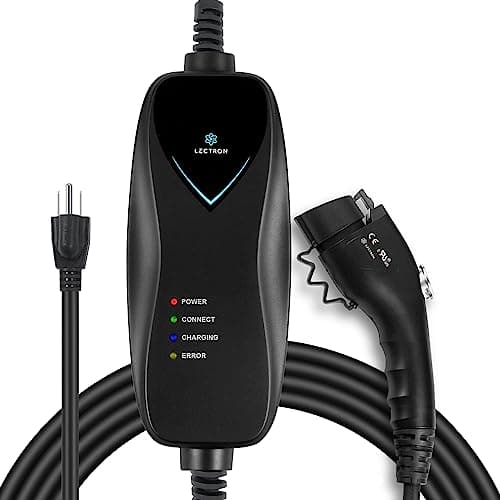 Lectron Portable Level 1 J1772 Charger (15A, NEMA 5-15)The unglamorous answer that covers most commutes: an ordinary 120V socket, overnight, and no conversation with anybody about electrical work. Lectron Portable Level 1 J1772 Charger (15A, NEMA 5-15)The unglamorous answer that covers most commutes: an ordinary 120V socket, overnight, and no conversation with anybody about electrical work. | An ordinary wall socket | Level 1 EVSE | |
| 2 | 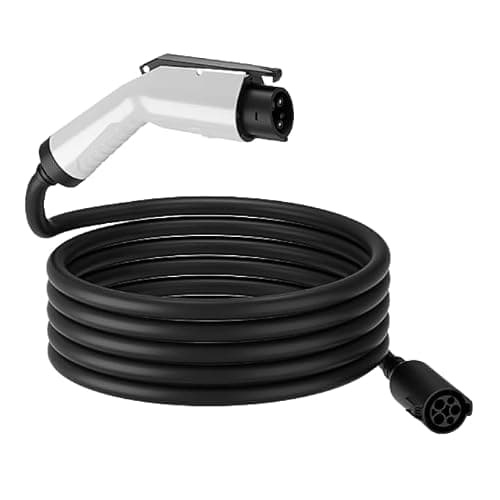 A2Z EV J1772 to J1772 Extension Cord, 16 ftA purpose-built EV extension on the car side of the charger — the correct place to add length — and the only one here whose maker publishes the code caveat that comes with it. A2Z EV J1772 to J1772 Extension Cord, 16 ftA purpose-built EV extension on the car side of the charger — the correct place to add length — and the only one here whose maker publishes the code caveat that comes with it. | A charger that will not reach | J1772 extension cable |
#1 · An ordinary wall socket
Lectron Portable Level 1 J1772 Charger (15A, NEMA 5-15)
The unglamorous answer that covers most commutes: an ordinary 120V socket, overnight, and no conversation with anybody about electrical work.
| Input | 120V, 15A maximumsource |
|---|---|
| Output power | 1.8 kWsource |
| Cable length | 16 ftsource |
| Plug / connector | NEMA 5-15 plug, J1772 connectorsource |
| Certification | UL 2594 / UL 2231 certified, and separately described as ETL-certified; no certificate number publishedsource |
| Ingress rating | IP65 weather-resistant, stated in the specification textsource |
| Manufacturer charge-rate claim | 45+ miles of range overnight; 3-5 miles of range per hoursource |
What those numbers mean
1.8 kW sounds trivial next to 9.6 kW, and for a road trip it is. For a commute it usually is not: the average US driver covers well under 45 miles a day, and this replaces that overnight while the car sits anyway.
The honest ceiling is the circuit behind the socket, not the cable. This unit draws 15 amps for hours, which a 20 amp circuit supports continuously and a 15 amp circuit does not — so check the breaker before the first overnight session, and on a 15 amp circuit choose a 12 amp unit instead.
This is the only category of EV charging that is genuinely invisible to a landlord. It draws less than a hair dryer and plugs into a receptacle that already exists.
What it does well
- Works with a socket that already exists, everywhere, with no permission needed
- UL 2594 and UL 2231 certified rather than a generic cordset
- Cheapest possible entry into home charging, by a wide margin
What it does not
- 1.8 kW will not recover a long driving day overnight
- 16 ft cable, and the nearest 120V socket is often not the nearest thing to the car
- Its 15 amp draw needs a 20 amp circuit behind the socket; an ordinary 15 amp circuit supports 12 amps continuously
Skip this one if: You regularly drive more than about 45 miles a day. Level 1 will fall a little further behind every night and you will spend the difference at public chargers.
#2 · A charger that will not reach
A2Z EV J1772 to J1772 Extension Cord, 16 ft
A purpose-built EV extension on the car side of the charger — the correct place to add length — and the only one here whose maker publishes the code caveat that comes with it.
| Rating | 48A, AC Level 1 and Level 2source |
|---|---|
| Length | 16 ft / 5 msource |
| Compatibility | J1772 EV charging station into a J1772 / CCS1 vehiclesource |
| Component certification | UL-certified cable (E341631), UL 2251 connectors, UL 62 cabling; CE on the connector, FCC (EMI)source |
| Assembled-unit listing | Not UL Listed as an assembled unit — the manufacturer states an end-product category for EV extension cables is still being finalizedsource |
| Manufacturer's recommended use | Portable, occasional or emergency use; NEC Article 625 generally expects the cable to be integral to the station for permanent installationssource |
| Warranty | 12 months against manufacturing defectssource |
What those numbers mean
Extending on the J1772 side is safer than extending on the wall side, because the EVSE is still the thing controlling current and it still sits between the outlet and the extension.
Read the last three specification rows together, because they are the honest part. The components carry UL certification but the assembled cable is not UL Listed, and the manufacturer says so plainly rather than letting the component certifications imply something they do not. It also tells you NEC Article 625 expects a charging cable to be integral to the station for a permanent installation, and that this cord is for portable or occasional use. No other extension we looked at publishes any of that.
48A is well above the 40A ceiling of plug-in Level 2 charging, so the cable is never the constraint. Used at 24 amps on a shared dryer circuit it has a great deal of margin, which is exactly where you want to be.
What it does well
- Built for EV charging rather than a household cord pressed into the job
- 48A rating leaves real margin at any renter-reachable current
- The manufacturer publishes the UL-listing status and the NEC caveat instead of glossing over them
- Designed and tested in North America, with a stated 12-month warranty
What it does not
- Adds two contact interfaces to a circuit that runs for hours at high current
- Not UL Listed as an assembled unit — a real distinction, even though its components are certified
- 16 ft, so it is a shorter reach than some discontinued alternatives offered
- Not a substitute for a charger with a long enough cable in the first place
Skip this one if: You have not yet bought the charger. Buy a unit with a 23 or 25 ft cable and skip the extension entirely — one continuous cable always beats two joined ones.
#ad · how this is funded · price as of October 27, 2026
The case where it does not work, and what to do instead
If the car parks on a public street with a public sidewalk in between, treat home charging as unavailable and build a routine around that. It is a genuinely workable way to own an EV — it is how most of Europe's urban EV owners live — but it is a different pattern and pretending otherwise helps nobody.
| Source | Typical pattern | What to check first |
|---|---|---|
| Workplace charging | Level 2 while you are at work, several days a week | Whether it is J1772 or NACS — you may need an adapter |
| Weekly DC fast stop | One 30-45 minute session covers a typical commuting week | Per-kWh price against your local gasoline cost |
| Destination charging | Grocery, gym, cinema — slow but free time you are spending anyway | Session limits and idle fees |
| A friend or relative's outlet | Occasional Level 1 top-up | Nothing — this is why owning your own Level 1 cable is worth it |
Why cable-across-the-sidewalk keeps coming up, and why we still say no
Cable channels and pavement gullies are sold for exactly this, and in a handful of cities they are formally permitted. In most places they are not, and the failure mode is not a fine — it is somebody catching a foot in the dark. This is the one recommendation on the site that does not come with a workaround, and it is not moralizing: it is that we cannot write a specification that makes an unattended trip hazard on a public path acceptable.
If your city does run a permitted gully or cross-pavement scheme, that is a genuine option and worth pursuing through the city rather than improvising. Ask the local authority, not a hardware retailer.
The lamp-post question
Lamp-post charging is real infrastructure in several countries and is beginning to appear in a small number of US cities. It is not something you can add yourself, and there is no product that lets you use one that has not been converted. If your street has them, they are usually operated through a network app; if it does not, this is a municipal question rather than a purchasing one.
What to buy if you park on the street
Own a Level 1 charger anyway. It costs little, it lives in the trunk, and the moment you visit somewhere with an outlet — a relative over a weekend, a rental, a friend's driveway — you have charging. It is the single highest-utility purchase for someone whose home parking does not work, precisely because it makes every other outlet in your life usable.
Questions people actually ask
Can I charge an electric car if I park on the street?
Sometimes. If the car parks on your own property line with no public path in between, a Level 1 charger and a correctly routed cable work. If a public sidewalk sits between the outlet and the car, home charging is not realistically available and the answer is a routine built on workplace, destination and fast charging.
Can I run a cable across the pavement to my car?
We do not recommend it, and this is the one place on the site with no workaround offered. An unattended cable on a public path is a trip hazard. A small number of cities operate permitted cable gullies — if yours does, pursue that through the local authority.
How often would I need to fast charge with no home charging?
For a typical commuting pattern, roughly one 30-45 minute DC session a week, less if there is any charging at work. The cost question is genuinely local — see home versus public charging.
Is a Level 1 charger worth owning if I cannot charge at home?
Yes, more than for most people. It turns every ordinary outlet you ever park near into a charging opportunity, and it costs a fraction of what a single month of fast charging does.
Sources
Every figure on this page traces to one of these. If a number here disagrees with the manufacturer, the manufacturer is right and we want to know — tell us.
Read next

Start here
You don't have a garage. Here's what actually works.
The pillar guide: what charging looks like when there is no garage, no driveway and no landlord willing to run a new circuit.
Top pick: Lectron Portable Level 1 J1772 Charger (15A, NEMA 5-15)

Guide
How to charge an EV in an apartment complex
The ordered playbook for apartment charging: survey the property, find reachable power, and make the ask that gets a yes.
Top pick: Lectron Tesla (NACS) to J1772 Adapter, 48A
Guide
Is an EV extension cord safe?
The extension cord safety question, answered with the actual failure mechanism, the specification that avoids it, and what we will not endorse.
Top pick: A2Z EV J1772 to J1772 Extension Cord, 16 ft
Guide
Home vs public charging
The home-versus-public cost comparison for renters, plus a workable routine for anyone with no home charging at all.
Top pick: Lectron Portable Level 1 J1772 Charger (15A, NEMA 5-15)
Guide
Level 1 vs Level 2, for someone without a garage
The charging-level comparison rewritten for renters, with a renter-viability column and an honest case for Level 1.
Top pick: Lectron Portable Level 1 J1772 Charger (15A, NEMA 5-15)

Guide
Is a Level 2 charger worth it if you rent?
A decision framework for Level 2 rather than a sales pitch: the two numbers that decide it, and the cases where Level 1 genuinely wins.
Top pick: Lectron Portable Level 1 J1772 Charger (15A, NEMA 5-15)