Charging from a shared laundry room
The best 240V outlet in most rental buildings is in a room everybody uses. That makes this a social problem as much as an electrical one.
How this page is funded: the buy links below are affiliate links, and Renter Volt earns a commission on qualifying purchases at no cost to you. Nothing here was supplied by a manufacturer, and commission plays no part in the ranking — read the full disclosure. Picks are chosen from published specifications rather than hands-on testing; the method is written down so you can check it. Prices last verified October 27, 2026.
The shared laundry room is the most overlooked 240V circuit in rental housing, and it is the one people walk past every week. A dryer outlet gives 24 amps of continuous EV charging — roughly 200 miles over a night — and an automatic splitter means nobody has to give up the dryer to get it.
The electrical part is straightforward and covered in the splitter review. The part that decides whether this works is social, and that is what this page is mostly about.
First, the three physical questions
- Can you reach the car from it? Measure the real route, through the door, around the building. This is what defeats most laundry-room plans and it is worth checking before anything else.
- Which outlet is it? Three prongs or four decides which splitter you buy.
- Is there more than one dryer position? A room with a spare, unused 240V receptacle is a much easier conversation than one where you are proposing to share the working dryer's circuit.
If the answer to the first is no, stop here. A perfect outlet you cannot reach is not an outlet, and running a cable through a propped-open fire door is not a solution — it is a different problem with worse consequences.
Quick picks
Ranked, with the reasoning underneath. Tap any row to jump to that write-up; tap the price to check it on Amazon. Prices come from the live layer, never from this page.
| # | Product | Best for | Type | Price |
|---|---|---|---|---|
| 1 | 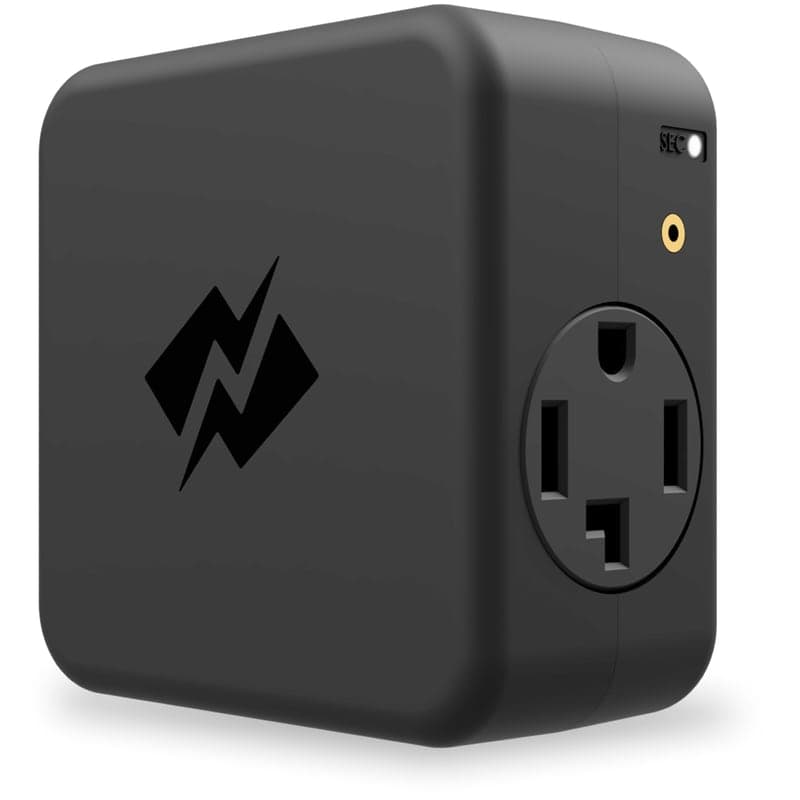 NeoCharge Smart Splitter (NEMA 14-30)The four-prong equivalent: it shares a modern dryer circuit, prioritizes the dryer, and switches to the car when the laundry finishes. NeoCharge Smart Splitter (NEMA 14-30)The four-prong equivalent: it shares a modern dryer circuit, prioritizes the dryer, and switches to the car when the laundry finishes. | A modern 4-prong dryer outlet | Automatic 240V splitter | Check price#ad |
| 2 | 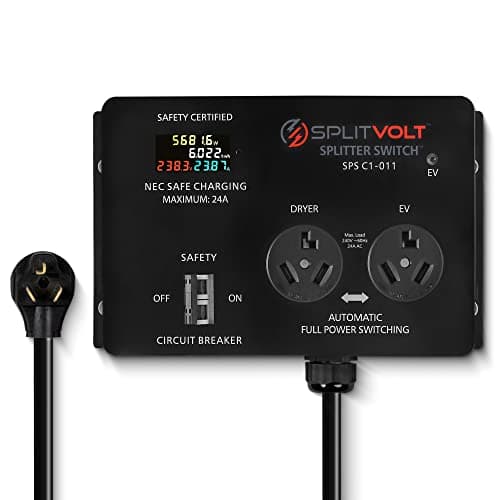 Splitvolt Splitter Switch (NEMA 10-30, 240V, 24A)The one device that makes a shared older dryer outlet a legitimate EV circuit — it switches automatically and carries its own breaker. Splitvolt Splitter Switch (NEMA 10-30, 240V, 24A)The one device that makes a shared older dryer outlet a legitimate EV circuit — it switches automatically and carries its own breaker. | An older 3-prong dryer outlet | Automatic 240V splitter | |
| 3 |  LENZ Charger Lock for J1772 to Tesla Adapters (2-pack)A locking ring that borrows your car's own door lock to hold the adapter on, which is a cleverer answer than a cable and costs less than losing the adapter once. LENZ Charger Lock for J1772 to Tesla Adapters (2-pack)A locking ring that borrows your car's own door lock to hold the adapter on, which is a cleverer answer than a cable and costs less than losing the adapter once. | Shared or public parking | Adapter locking ring |
#1 · A modern 4-prong dryer outlet
NeoCharge Smart Splitter (NEMA 14-30)
The four-prong equivalent: it shares a modern dryer circuit, prioritizes the dryer, and switches to the car when the laundry finishes.
| Outlet type | Plugs into an existing four-prong 220/240V NEMA 14-30 dryer outletsource |
|---|---|
| EV current limit | The EV or charger must be set to 24 amps or less when sharing with a dryersource |
| Switching | Auto-switching prioritizes the dryer and switches to EV charging when it finishessource |
| Certification | UL safety certified and NEC compliantsource |
| Installation | No electrician needed — plug and playsource |
What those numbers mean
NEMA 14-30 is the four-prong dryer outlet standard in homes built after the mid-1990s, so which splitter you need is really a question about the age of the building.
The 24 amp ceiling is the same arithmetic as the three-prong version, for the same reason: 30 amp circuit, 80% continuous rule.
Dryer priority is the right default for a shared household. A dryer cycle is an hour; a charging session has all night to finish.
What it does well
- Works with the grounded four-prong outlet, which is the safer configuration to begin with
- UL safety certified
- Auto-switching, so nobody has to remember to unplug anything
What it does not
- Same 24A ceiling as any 30 amp circuit sharing arrangement
- Wrong device for a three-prong NEMA 10-30 outlet
Skip this one if: Your building predates the four-prong standard and the laundry outlet has three prongs. That is a NEMA 10-30 and needs the three-prong splitter instead.
#ad · how this is funded · price as of October 27, 2026
#2 · An older 3-prong dryer outlet
Splitvolt Splitter Switch (NEMA 10-30, 240V, 24A)
The one device that makes a shared older dryer outlet a legitimate EV circuit — it switches automatically and carries its own breaker.
| Input plug | NEMA 10-30 malesource |
|---|---|
| Output sockets | Two NEMA 10-30 female outlets — one for the dryer, one for the EV chargersource |
| Rating | 240V ~ 60Hz, 24A AC maximum loadsource |
| Protection | Integrated 24A circuit breaker with easy resetsource |
| Switching | Automated power switching between the dryer and EV power socketssource |
| Certification | Conforms to UL 60730-1, certified to CSA E60730-1, cETLus listed Intertek 5021938source |
| Installation | No electrical installation required — plug and playsource |
What those numbers mean
24A is the number to design around, and it is not the manufacturer being cautious. A 30 amp circuit supports 24 amps of continuous load under the 80% rule, and continuous is exactly what EV charging is.
Automatic switching is what makes this a device rather than a Y-splitter. Both loads on one 30 amp circuit at once would trip the breaker at best; the switch guarantees only one draws at a time.
The integrated 24A breaker is the part that earns the trust. It means the splitter protects the circuit itself instead of relying only on a panel breaker you cannot see and wiring you cannot inspect.
What it does well
- Plugs in — genuinely no electrician, no permit, no landlord construction
- Its own 24A breaker rather than trusting the panel alone
- cETLus listed with the Intertek file number published
- Automatic switching, so the dryer keeps priority without anybody replugging anything
What it does not
- 24A caps charging at roughly 5.7 kW, well below a NEMA 14-50's ceiling
- NEMA 10-30 is an ungrounded three-wire configuration, which is a real caveat rather than a formality
- Only useful if you can physically reach the laundry outlet from the car
Skip this one if: Your dryer outlet is the modern four-prong NEMA 14-30. Buy the four-prong splitter instead — this one will not fit, and forcing the fit is exactly the wrong instinct.
#ad · how this is funded · price as of October 27, 2026
#3 · Shared or public parking
LENZ Charger Lock for J1772 to Tesla Adapters (2-pack)
A locking ring that borrows your car's own door lock to hold the adapter on, which is a cleverer answer than a cable and costs less than losing the adapter once.
| Type | Locking ring that snaps onto the charging adapter until it clicks into placesource |
|---|---|
| Function | Prevents unwanted unplugging — the adapter cannot be disconnected while the car is lockedsource |
| Compatibility | J1772 to Tesla charging adapters, and most Tesla models including S, 3, X and Ysource |
| Materials | Manufacturer states corrosion, weather and heat resistant; no specific material is publishedsource |
| Quantity | Set of two locking ringssource |
What those numbers mean
This is the cheapest item on the site and the one most likely to save you the price of something else. An adapter in a shared garage is small, generic and worth real money secondhand.
The mechanism is worth understanding because it is not a padlock. The ring holds the adapter captive on the charging handle, and the thing actually doing the securing is your car's own charge-port lock — which is already engaged while the car is locked. That means there is no extra key to carry and nothing extra to unlock, but it also means the protection ends the moment you unlock the car.
The manufacturer does not publish a lock mechanism type or a security rating, so we are not going to imply one. Treat it as a deterrent against somebody opportunistic walking past, not a defense against tools.
What it does well
- Addresses the specific theft that renters in shared parking actually report
- No extra key and nothing extra to unlock — it rides on the car's own lock
- Ships as a pair, so a second car or a spare adapter is covered
- Costs a fraction of the adapter it protects
What it does not
- No published security rating or lock-mechanism specification
- Protection lapses whenever the car is unlocked
- Fits adapters of a particular shape — check yours against the listing before buying
Skip this one if: You charge in a locked private garage, or you take the adapter with you every time. Then it is a step in your routine that buys nothing.
#ad · how this is funded · price as of October 27, 2026
The conversation, and who to have it with
A shared laundry room is a common area, so this is a building conversation rather than a neighbor conversation — though it is worth being on good terms with both. The framing that works is the same one that works everywhere else in this subject: small, specific, bounded, and paid for.
- Name the device. "A UL-listed splitter that plugs into the existing dryer outlet and guarantees only one appliance draws power at a time, with the dryer taking priority." That sentence answers the objection before it is made.
- Say what it does not do. No wiring, no drilling, nothing altered, removed by unplugging.
- Offer to pay. A flat monthly amount is the easiest thing for a manager to administer.
- Address the other residents directly. "The dryer keeps priority, so nobody's laundry is affected" is the thing your neighbors actually care about.
- Volunteer to be governed by a policy rather than asking for an exception. The landlord letter has a laundry-room variant.
The etiquette that keeps it available
- Never leave a cable across a doorway or walkway. Not once. This is the one that ends arrangements.
- Leave the dryer socket usable at all times. That is what the splitter is for; do not defeat it by unplugging things.
- Charge overnight, when the room is not in use, and set a departure time in the car so it finishes without you having to be there.
- Coil and store the cable when you are done, out of the way of anyone carrying a laundry basket.
- Do not leave anything valuable attached. A lock if you must leave equipment, and take small parts with you.
- Tell the other residents what the device does. Most objections come from people assuming their dryer will be affected.
If the room has a spare receptacle
This is the best case and it is worth actively looking for. Buildings with two dryer positions and one dryer, or a disconnected outlet from a machine that was removed, are common. A spare 240V receptacle nobody is using changes the conversation entirely: you are not sharing anything, you are using something idle, and no splitter is required at all.
Ask the building whether the second position is live. It is a factual question and it costs nothing.
What it gives you, in practical terms
About 5.8 kW, which is roughly 18 miles of range per hour and 170 to 200 miles over a twelve-hour night. Enough to fully charge most cars from a normal daily state, every night, with charging paused only for the length of a dryer cycle you will sleep through.
That is a genuinely good outcome for a building where everybody else has concluded that EV ownership is not possible. It is also the least-known one, which is why it is worth checking the laundry room before you check anything else.
Questions people actually ask
Can I charge my EV in a shared laundry room?
Often yes, using an automatic splitter on the dryer outlet at up to 24 amps. It needs the building's permission because the room is a common area, and it needs a cable route that never crosses a doorway or walkway.
Will charging affect other residents' laundry?
Not with an automatic splitter. The dryer keeps priority and the car pauses while a cycle runs, resuming afterwards. Saying that clearly is what defuses most objections.
How do I ask my building about using the laundry outlet?
Name the specific outlet, describe the splitter as a listed plug-in device that gives the dryer priority, offer to pay for the electricity, and volunteer to follow whatever general rule they set. There is a ready-made letter for it.
What if there is a spare dryer position?
That is the best outcome — ask whether the second receptacle is live. An idle 240V outlet needs no splitter and no sharing arrangement at all.
Sources
Every figure on this page traces to one of these. If a number here disagrees with the manufacturer, the manufacturer is right and we want to know — tell us.
Read next
Best Dryer-Outlet Setup
Charging from an outlet you already have
The existing-240V section: dryer, range and RV outlets, how to share one safely, and what changes in an older building.
Top pick: Splitvolt Splitter Switch (NEMA 10-30, 240V, 24A)
Best Dryer Splitter
The dryer outlet splitter, reviewed
An independent look at automatic 240V splitters: certifications, the built-in breaker, and how they differ from a passive Y-adapter.
Top pick: Splitvolt Splitter Switch (NEMA 10-30, 240V, 24A)

Guide
NEMA 14-30: the modern dryer outlet
How to use a four-prong dryer circuit for EV charging, what the 24 amp limit returns overnight, and the sharing device that makes it work.
Top pick: NeoCharge Smart Splitter (NEMA 14-30)

Guide
The letter to send your landlord
A ready-to-send request letter for building managers, plus the reasoning behind every line in it and the three variants that fit different asks.

Best Adapter Lock
The adapter lock, reviewed honestly
What an adapter lock actually secures, the threat model it addresses, and the published specifications it does and does not have.
Top pick: LENZ Charger Lock for J1772 to Tesla Adapters (2-pack)
Guide
Your EV charger keeps tripping the breaker
A diagnostic order for breaker trips during charging, from the amperage setting through shared loads to GFCI interaction — and what fixes each.
Top pick: Grizzl-E Mini Connect Portable Charger