Before you buy an EV without a garage
Five checks, in order. Run them before the test drive, not after the delivery, because two of them change which car you should buy.
How this page is funded: the buy links below are affiliate links, and Renter Volt earns a commission on qualifying purchases at no cost to you. Nothing here was supplied by a manufacturer, and commission plays no part in the ranking — read the full disclosure. Picks are chosen from published specifications rather than hands-on testing; the method is written down so you can check it. Prices last verified October 27, 2026.
Two of the five checks below can change which car you should buy, so run them before you are standing in a showroom. Charging access is not a post-purchase logistics problem to be solved later — it interacts with battery size, with onboard charger rating and with connector type, and it is much cheaper to know first.
Check 1: walk to where the car will park and find the power
This is the check everybody skips. Go and look. Photograph what you find. Then identify it — a three-prong 240V receptacle and a four-prong one look similar in a phone photo and lead to different purchases.
If you find nothing at all, that is a real answer and it changes the calculation rather than ending it. Skip to check 5.
Check 2: your actual daily mileage, not your worst week
People plan charging around their annual road trip and then live with a daily commute. Look at the last month of driving instead. The number that matters is the median day, because that is what has to be replaced overnight.
| Outlet | Charging rate | 12 hours parked replaces roughly |
|---|---|---|
| 120V household socket | About 1.4-1.8 kW | 36-60 miles |
| 30 amp dryer circuit at 24A | About 5.7 kW | 150-200 miles |
| 50 amp circuit at 40A | About 9.6 kW | 250-350 miles |
Read that table honestly against your median day. For a large share of drivers the first row is already sufficient, and if it is, the entire charging problem shrinks to owning one cable.
Check 3: which connector, and what your building already has
If your building has charging installed, look at the end of the cable. A NACS-connector building and a J1772 car are compatible for a few dollars, but you need to know that before you are surprised by it. And if you are choosing between two cars, the one whose port matches your building's existing infrastructure is worth a genuine preference — see the direction guide.
Check 4: how far the cable has to go
Measure the real route from the outlet to where the car's charge port will be. Around obstacles, not through them. Then note which side of the car the port is on, because a port on the far side costs you the width of the car in cable, and portable chargers commonly ship with 16 ft. The gauge and length chart has the arithmetic.
Quick picks
Ranked, with the reasoning underneath. Tap any row to jump to that write-up; tap the price to check it on Amazon. Prices come from the live layer, never from this page.
| # | Product | Best for | Type | Price |
|---|---|---|---|---|
| 1 | 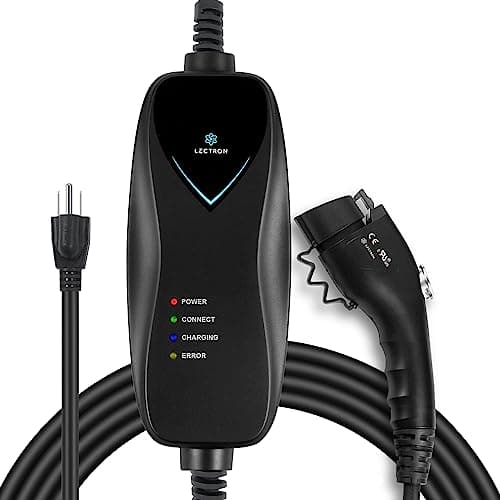 Lectron Portable Level 1 J1772 Charger (15A, NEMA 5-15)The unglamorous answer that covers most commutes: an ordinary 120V socket, overnight, and no conversation with anybody about electrical work. Lectron Portable Level 1 J1772 Charger (15A, NEMA 5-15)The unglamorous answer that covers most commutes: an ordinary 120V socket, overnight, and no conversation with anybody about electrical work. | An ordinary wall socket | Level 1 EVSE | |
| 2 | 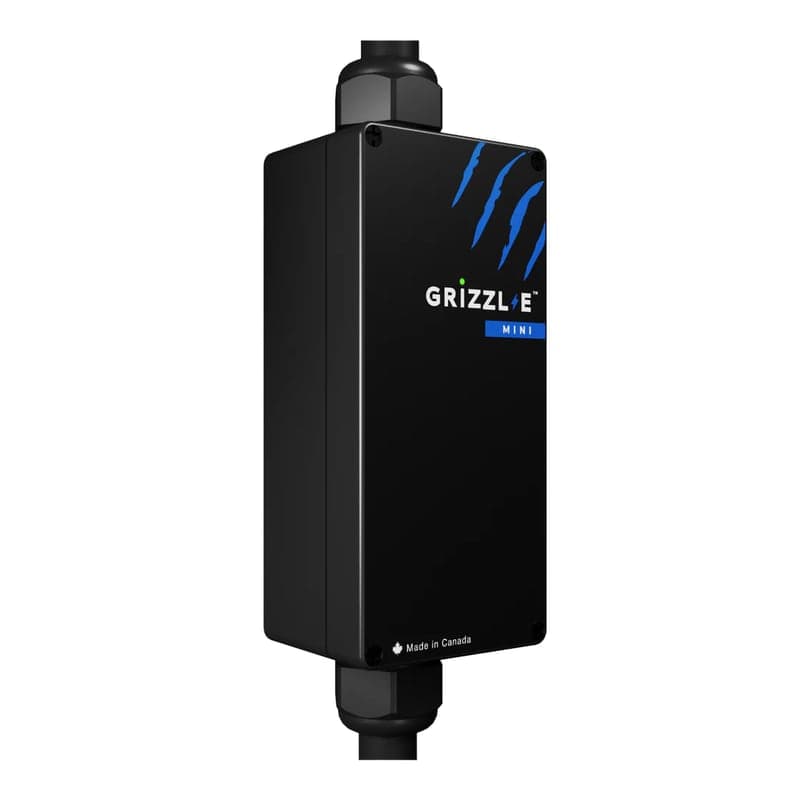 Grizzl-E Mini Connect Portable ChargerAdjustable from 7 to 40 amps and shipped with four plug adapters, which is the closest thing to a unit that fits whatever outlet you turn out to have. Grizzl-E Mini Connect Portable ChargerAdjustable from 7 to 40 amps and shipped with four plug adapters, which is the closest thing to a unit that fits whatever outlet you turn out to have. | Not knowing your outlet yet | Adjustable Level 1 and 2 EVSE | Check price#ad |
#1 · An ordinary wall socket
Lectron Portable Level 1 J1772 Charger (15A, NEMA 5-15)
The unglamorous answer that covers most commutes: an ordinary 120V socket, overnight, and no conversation with anybody about electrical work.
| Input | 120V, 15A maximumsource |
|---|---|
| Output power | 1.8 kWsource |
| Cable length | 16 ftsource |
| Plug / connector | NEMA 5-15 plug, J1772 connectorsource |
| Certification | UL 2594 / UL 2231 certified, and separately described as ETL-certified; no certificate number publishedsource |
| Ingress rating | IP65 weather-resistant, stated in the specification textsource |
| Manufacturer charge-rate claim | 45+ miles of range overnight; 3-5 miles of range per hoursource |
What those numbers mean
1.8 kW sounds trivial next to 9.6 kW, and for a road trip it is. For a commute it usually is not: the average US driver covers well under 45 miles a day, and this replaces that overnight while the car sits anyway.
The honest ceiling is the circuit behind the socket, not the cable. This unit draws 15 amps for hours, which a 20 amp circuit supports continuously and a 15 amp circuit does not — so check the breaker before the first overnight session, and on a 15 amp circuit choose a 12 amp unit instead.
This is the only category of EV charging that is genuinely invisible to a landlord. It draws less than a hair dryer and plugs into a receptacle that already exists.
What it does well
- Works with a socket that already exists, everywhere, with no permission needed
- UL 2594 and UL 2231 certified rather than a generic cordset
- Cheapest possible entry into home charging, by a wide margin
What it does not
- 1.8 kW will not recover a long driving day overnight
- 16 ft cable, and the nearest 120V socket is often not the nearest thing to the car
- Its 15 amp draw needs a 20 amp circuit behind the socket; an ordinary 15 amp circuit supports 12 amps continuously
Skip this one if: You regularly drive more than about 45 miles a day. Level 1 will fall a little further behind every night and you will spend the difference at public chargers.
#2 · Not knowing your outlet yet
Grizzl-E Mini Connect Portable Charger
Adjustable from 7 to 40 amps and shipped with four plug adapters, which is the closest thing to a unit that fits whatever outlet you turn out to have.
| Adjustable current | 7A to 40A (9.6 kW maximum)source |
|---|---|
| Voltage | Automatically detects 120V (Level 1) or 240V (Level 2)source |
| Cable length | 25 ft (7.6 m)source |
| Plug and adapters | NEMA 14-50 plug plus four included electrical adapterssource |
| Connector | J1772 or Tesla (NACS) versionssource |
| Enclosure | UL Type 4 / IP67 ratedsource |
| Certification | UL tested and certified, Energy Star certifiedsource |
What those numbers mean
The adjustable current is the feature that matters to a renter, and it is not a convenience. A 30 amp dryer circuit legally supports 24 amps of continuous EV load; a unit that can be set to 24 amps can use that circuit, and a fixed 40 amp unit cannot.
25 ft of cable is nine feet more than the common 16 ft, and nine feet is frequently the difference between reaching the car and not.
IP67 and a UL Type 4 enclosure describe the unit's own weather tolerance. They say nothing about the outlet it plugs into, which is usually the part that is not weather-rated.
What it does well
- 7-40A adjustment means one unit fits a 15, 20, 30 or 50 amp circuit
- 25 ft cable is among the longest on a portable unit
- Four plug adapters included, so an outlet change does not mean a new charger
- Available with either a J1772 or a NACS connector
What it does not
- Costs meaningfully more than a fixed-amperage unit that does one job
- The bundled adapters make it easy to plug into a circuit you have not actually checked
Skip this one if: You know exactly which outlet you have, it is not changing, and you would rather put the money into a longer cable than into adjustability you will set once and never touch.
#ad · how this is funded · price as of October 27, 2026
Check 5: price the gap honestly
If home charging is not available, the running cost changes and it is worth knowing by how much before you commit. Public DC fast charging is frequently several times the price of residential electricity per kWh, and in some markets it lands close to the per-mile cost of gasoline. That does not make the car a bad decision — there are other reasons to want one — but it should be a decision made with the number in front of you rather than after the first bill.
Cost to charge shows the formula so you can run it with your own utility rate and your own local fast-charging price, and home versus public puts the two side by side.
What the checks change about the car itself
- No 240V access? A bigger battery is worth more than a faster onboard charger, because your recovery rate is fixed and your buffer is what saves you.
- Only a 30 amp shared circuit? A car with a high onboard charger rating buys you nothing — the circuit caps you at about 5.7 kW regardless.
- A 50 amp outlet you can reach? Now the car's onboard charger rating matters, because it is the thing that decides whether you get 9.6 kW or half of it.
- Building already has NACS charging? A NACS-port car removes an adapter from your daily routine, which is a small but genuine convenience.
Questions people actually ask
Should I buy an electric car if I have no garage?
For most people with any reachable outlet, yes. Run the five checks first: find the power, measure your median daily mileage against what overnight charging replaces, confirm the connector, measure the cable route, and price the gap if no home charging exists.
What if there is no outlet where I park at all?
Then price the routine that replaces home charging — workplace, destination and a weekly fast-charging stop — before you buy, because the running cost is materially different from home charging and worth knowing in advance.
Does a bigger battery help if I can only charge at 120V?
Yes. With a fixed low recovery rate, capacity is buffer. A larger battery means a heavy driving day costs you a smaller proportion of your reserve and you catch up over the following nights.
Does my car's onboard charger rating matter?
Only up to what your circuit can supply. On a 30 amp shared circuit capped at 24 amps you will see about 5.7 kW whatever the car can accept. On a 50 amp circuit the car's rating becomes the limiting factor.
Sources
Every figure on this page traces to one of these. If a number here disagrees with the manufacturer, the manufacturer is right and we want to know — tell us.
- U.S. DOE Alternative Fuels Data Center — Electric vehicle charging levels and speeds
- U.S. Energy Information Administration — Average retail price of electricity to residential customers
- U.S. Department of Energy — Electric vehicle charging at home
- Grizzl-E Mini Connect — published specifications (EVolt Home, authorized dealer listing)
Read next

Start here
You don't have a garage. Here's what actually works.
The pillar guide: what charging looks like when there is no garage, no driveway and no landlord willing to run a new circuit.
Top pick: Lectron Portable Level 1 J1772 Charger (15A, NEMA 5-15)

Guide
Identify your outlet in about a minute
A visual identification method for the NEMA outlets that matter, plus the two lookalike pairs that cause the wrong purchase.
Top pick: Grizzl-E Mini Connect Portable Charger

Guide
What it actually costs to charge
The cost arithmetic in full: cost per charge, cost per mile, and an honest comparison against gasoline using your own numbers.
Top pick: Lectron Portable Level 1 J1772 Charger (15A, NEMA 5-15)
Guide
Home vs public charging
The home-versus-public cost comparison for renters, plus a workable routine for anyone with no home charging at all.
Top pick: Lectron Portable Level 1 J1772 Charger (15A, NEMA 5-15)

Guide
Gauge and length: the arithmetic
Wire gauge, current and distance, with the voltage-drop formula written out and a reference table built from it.
Top pick: A2Z EV J1772 to J1772 Extension Cord, 16 ft
Best Head-to-Head
Grizzl-E Mini vs Emporia Classic
The head-to-head renters actually run: adjustable 7-40A flexibility against app scheduling and energy reporting.
Top pick: Grizzl-E Mini Connect Portable Charger