Is there a portable battery that charges an EV?
Two different products share one name. Only one of them actually works, and it is the cheaper one.
How this page is funded: the buy links below are affiliate links, and Renter Volt earns a commission on qualifying purchases at no cost to you. Nothing here was supplied by a manufacturer, and commission plays no part in the ranking — read the full disclosure. Picks are chosen from published specifications rather than hands-on testing; the method is written down so you can check it. Prices last verified October 27, 2026.
No. There is no portable battery you can buy that meaningfully charges an electric car, and the arithmetic is not close. If you searched for a "portable EV charger" expecting something like a phone power bank, buy a Level 1 charging cord instead — around $120 to $170 for a good one, and it is the product that actually solves the problem you have.
This page exists because one phrase sells two completely different things. Understanding which one you were looking for takes about ninety seconds and saves a wasted purchase.
Quick picks
Ranked, with the reasoning underneath. Tap any row to jump to that write-up; tap the price to check it on Amazon. Prices come from the live layer, never from this page.
| # | Product | Best for | Type | Price |
|---|---|---|---|---|
| 1 | 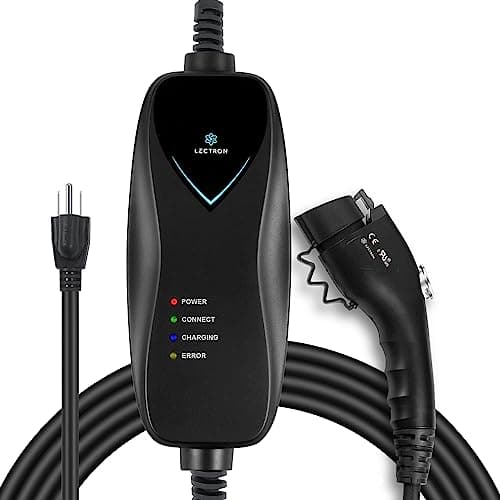 Lectron Portable Level 1 J1772 Charger (15A, NEMA 5-15)The unglamorous answer that covers most commutes: an ordinary 120V socket, overnight, and no conversation with anybody about electrical work. | An ordinary wall socket | Level 1 EVSE | |
| 2 | 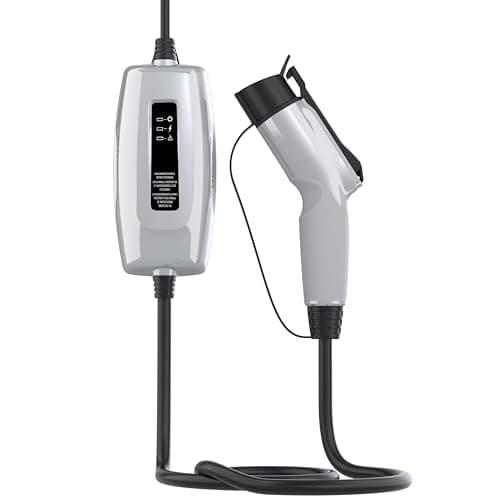 Schumacher Electric SEV1670 Level 1 Portable EV Charger (12A, NEMA 5-15)A 12 amp Level 1 charger sized correctly for an ordinary 15 amp household circuit, with a 20 ft cable that reaches further than most. | A 15 amp circuit and a longer reach | Level 1 EVSE | |
| 3 | 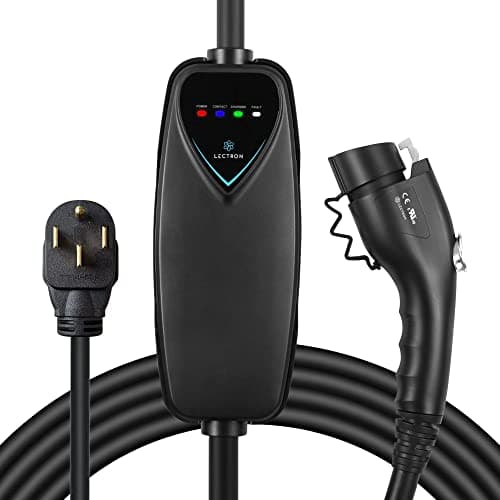 Lectron Portable Level 2 J1772 Charger (40A, NEMA 14-50)The plainest answer to a NEMA 14-50 outlet you can reach: 40 amps, a plug on the end, and nothing screwed to a wall you do not own. | A reachable 14-50 outlet | Plug-in Level 2 EVSE |
#1 · An ordinary wall socket
Lectron Portable Level 1 J1772 Charger (15A, NEMA 5-15)
The unglamorous answer that covers most commutes: an ordinary 120V socket, overnight, and no conversation with anybody about electrical work.
| Input | 120V, 15A maximumsource |
|---|---|
| Output power | 1.8 kWsource |
| Cable length | 16 ftsource |
| Plug / connector | NEMA 5-15 plug, J1772 connectorsource |
| Certification | UL 2594 / UL 2231 certified, and separately described as ETL-certified; no certificate number publishedsource |
| Ingress rating | IP65 weather-resistant, stated in the specification textsource |
| Manufacturer charge-rate claim | 45+ miles of range overnight; 3-5 miles of range per hoursource |
What those numbers mean
1.8 kW sounds trivial next to 9.6 kW, and for a road trip it is. For a commute it usually is not: the average US driver covers well under 45 miles a day, and this replaces that overnight while the car sits anyway.
The honest ceiling is the circuit behind the socket, not the cable. This unit draws 15 amps for hours, which a 20 amp circuit supports continuously and a 15 amp circuit does not — so check the breaker before the first overnight session, and on a 15 amp circuit choose a 12 amp unit instead.
This is the only category of EV charging that is genuinely invisible to a landlord. It draws less than a hair dryer and plugs into a receptacle that already exists.
What it does well
- Works with a socket that already exists, everywhere, with no permission needed
- UL 2594 and UL 2231 certified rather than a generic cordset
- Cheapest possible entry into home charging, by a wide margin
What it does not
- 1.8 kW will not recover a long driving day overnight
- 16 ft cable, and the nearest 120V socket is often not the nearest thing to the car
- Its 15 amp draw needs a 20 amp circuit behind the socket; an ordinary 15 amp circuit supports 12 amps continuously
Skip this one if: You regularly drive more than about 45 miles a day. Level 1 will fall a little further behind every night and you will spend the difference at public chargers.
#2 · A 15 amp circuit and a longer reach
Schumacher Electric SEV1670 Level 1 Portable EV Charger (12A, NEMA 5-15)
A 12 amp Level 1 charger sized correctly for an ordinary 15 amp household circuit, with a 20 ft cable that reaches further than most.
| Charging current | 12A continuous, 120Vsource |
|---|---|
| Output power | 1.44 kWsource |
| Cable length | 20 ftsource |
| Plug / connector | NEMA 5-15 plug, J1772 connectorsource |
| Certification | ETL and Energy Starsource |
| Enclosure | IP66 housingsource |
| Built-in protection | Leakage, undervoltage, overvoltage, overcurrent, over-temperature, ground-fault and relay-fault protectionsource |
What those numbers mean
Twelve amps is not a low number for this category; it is the correct one. A 15 amp circuit supports 12 amps of continuous load, and overnight charging is continuous by any definition, so this unit uses an ordinary household circuit right up to its limit and no further.
The 20 ft cable is four feet longer than the common 16 ft. At a carport or a curbside socket, those four feet are frequently the difference between reaching the charge port and reaching for an extension cord.
Over-temperature protection is on the manufacturer's list, but the published specification does not say where the sensor sits. Treat it as a backstop, and still feel the plug at the wall during the first few long sessions.
What it does well
- Sized for a 15 amp circuit, the most common household circuit there is
- 20 ft cable, longer than the usual 16 ft
- ETL and Energy Star certified, with an IP66 housing
- The manufacturer publishes the full list of built-in protections
What it does not
- J1772 only — a Tesla or other NACS car needs an adapter or a NACS unit
- No app or scheduling, and no current adjustment in the published specification
- 1.44 kW will not recover a long driving day overnight
Skip this one if: Your car has a NACS (Tesla-style) port, or you regularly drive more than about 40 miles a day. The first needs a different connector; the second needs more power than any Level 1 unit can deliver.
#3 · A reachable 14-50 outlet
Lectron Portable Level 2 J1772 Charger (40A, NEMA 14-50)
The plainest answer to a NEMA 14-50 outlet you can reach: 40 amps, a plug on the end, and nothing screwed to a wall you do not own.
| Input | 240V, 40A maximumsource |
|---|---|
| Output power | Up to 9.6 kWsource |
| Cable length | 16 ftsource |
| Plug / connector | NEMA 14-50 plug, J1772 connectorsource |
| Certification | UL 2594 / UL 2231 certifiedsource |
| Manufacturer charge-rate claim | Roughly 30 miles of range per hour of chargingsource |
What those numbers mean
9.6 kW is the ceiling this unit can deliver, not what your car will take. A vehicle with a 7.2 kW onboard charger draws 7.2 kW from it and no more, and that is a car limitation no charger fixes.
The 16 ft cable is the number to check before anything else. Measure from the outlet to where your charge port sits when the car is parked as it will actually be parked, not as you would like to park it. Sixteen feet disappears faster than people expect once it has to route around a wall.
A 40 amp unit needs a 50 amp circuit behind the outlet to run at 40 amps continuously. If the outlet is on a smaller breaker, the answer is a lower-amperage charger, not this one turned down.
What it does well
- Plugs in and unplugs — it leaves with you at the end of the lease
- UL 2594 and UL 2231 certified, the two standards that matter for EVSE
- 40 amps covers the fastest charging any renter-reachable outlet realistically supports
What it does not
- 16 ft of cable is short for a parking space that is not directly beside the outlet
- No amperage adjustment, so it is the wrong unit for a 30 amp circuit
Skip this one if: Your only 240V outlet is a 30 amp dryer receptacle. This unit expects a 50 amp circuit behind a NEMA 14-50, and derating it is not an option it offers.
#ad · how this is funded · price as of October 27, 2026
The two things called a "portable EV charger"
- A portable EVSE (the real one)
- A cord. One end plugs into an outlet you already have, the other into your car. It contains no battery and stores no energy — it is a safety-and-handshake device that lets the outlet talk to the car. This is what every product on this site is, and what the portable chargers section covers.
- A battery pack (the one people imagine)
- A box holding stored energy, like a phone power bank scaled up. These exist as portable power stations, but the capacity gap between one and a car battery is enormous, and that gap is what the rest of this page is about.
Almost everyone searching "portable EV charger battery" wants the second thing and needs the first. The reason is one number.
The arithmetic, with real published capacities
Take the largest portable power station most people have heard of. EcoFlow publishes the DELTA Pro's capacity as 3.6 kWh. Now take a current EV: Nissan publishes the 2026 LEAF's pack at 75 kWh. Those are both manufacturers' own figures, and they are the whole argument.
power station capacity ÷ vehicle pack capacity = share of a full charge
3.6 kWh ÷ 75 kWh = 4.8% of the pack · At roughly 3.5 miles per kWh, 3.6 kWh is about 12 miles of range · And that is before any conversion loss, which is real in both directions
Emptying a flagship power station completely into a car returns roughly a tenth of what an overnight Level 1 session gives you from a wall socket that costs nothing. How long charging takes does the overnight version of this arithmetic.
Worse, the direction of the problem is wrong. A power station of that size costs considerably more than any charger on this site, weighs enough that "portable" means wheels rather than a handle, and has to be recharged from a wall outlet — the same wall outlet that could have charged the car directly, faster, for free.
| Approach | Energy available | Roughly what that is | What it costs you |
|---|---|---|---|
| Portable power station (3.6 kWh, published) | 3.6 kWh, once, then it needs recharging | Under 5% of a 75 kWh pack | More than any charger here, plus the weight |
| Level 1 cord on a 120V socket | Unlimited — it draws from the building | A full overnight session, every night | Around $120-$170 once |
| Level 2 cord on a 240V outlet | Unlimited — it draws from the building | Most of a pack overnight | Around $170-$600 once |
What about the EV-specific battery products in the news?
Purpose-built mobile EV chargers do exist — trailer-mounted units for roadside assistance fleets, and a handful of consumer-scale concepts that have appeared at trade shows and on television. We are not recommending any of them, and the reason is this site's plainest rule: we feature only products that are currently purchasable, verified before publishing. Concept hardware and fleet equipment fail that test, so they do not appear in the picks above.
If one becomes a product you can order and receive, it belongs in this category and this page will say so. Until then, treating it as an option is the same mistake as buying on a press release.
So do portable EV chargers actually work?
The cord kind, yes — completely, and they are the backbone of charging without a garage. A portable EVSE is not a compromised version of a wall unit; on a plug-in basis it delivers the same current the same way, and the only thing it gives up is being bolted to a wall you do not own. Hardwired against plug-in sets out that trade in full.
What a portable EVSE will not do is manufacture electricity. It needs an outlet. If you have no reachable outlet at all, the honest answer is not a battery — it is the no-install options page, and in a genuinely off-grid case, charging from a generator, which has its own arithmetic and its own disappointments.
How these three picks were chosen
- Does it need an electrician? No pick on this site does. All three plug in, and all three leave with you at the end of a lease.
- Does it match an outlet a renter can actually reach? Two Level 1 units for an ordinary 120V socket, which is the outlet almost everyone has, and one Level 2 unit for a NEMA 14-50 if you are lucky enough to find one.
- Are the safety standards named? All three name standards. The Schumacher additionally publishes an IP66 ingress rating, which is unusually specific for the money.
- Is the cable long enough to be useful? The Schumacher's 20.5 ft is the longest of the two Level 1 units, and in a carport that difference decides more than amperage does.
- Is it honest about what it is? None of these is sold as a battery, because none of them is one.
If you do not yet know which outlet you can reach — and most people searching this question do not — start at how to identify your outlet before buying anything. It is a two-minute job with a phone camera and it determines the entire purchase.
What this page cannot tell you
Renter Volt has no lab and has tested none of this hardware, which the methodology page states plainly. Everything above is published capacity figures from the manufacturers named, arithmetic you can re-run yourself, and the editorial judgment that a product nobody can buy is not a recommendation. What it cannot tell you is how any specific power station behaves on any specific car — because, as noted, nobody publishes that either.
Questions people actually ask
Is there a portable charger for electric cars like a phone power bank?
Not in any practical consumer form. The largest common portable power station publishes 3.6 kWh of capacity against a current EV pack of around 75 kWh — under 5% of a charge, roughly 12 miles, for a device that costs more than any charging cord and then has to be recharged from a wall outlet itself. What is sold as a "portable EV charger" is a cord that plugs into an outlet, and that is the product that works.
Can a power bank charge an electric car?
A phone-sized power bank, no — not to any measurable degree. A large portable power station can deliver a few kWh, which is a handful of miles. The physics problem is that a car battery is roughly twenty times the capacity of the biggest portable battery most people own.
Do portable EV chargers actually work?
Yes, when "portable EV charger" means the cord, which is what the term almost always sells. It draws from the outlet you plug it into and delivers the same current a wall-mounted unit would at the same amperage. The only thing it gives up is being permanently mounted, which is the whole point for a renter.
How many miles does a portable power station add to an EV?
Using published figures: a 3.6 kWh unit emptied completely is roughly 12 miles at about 3.5 miles per kWh, before conversion losses. No manufacturer publishes a miles-added figure for this use, which is itself worth noting before you buy one for that purpose.
What is the cheapest way to charge an EV if I have no charger at all?
A Level 1 cord on an ordinary 120V socket. It is the least expensive hardware in the category, it needs no electrician and no landlord permission, and overnight it returns more energy than any portable battery you could buy for several times the price.
Is a portable EV charger the same as a Level 2 charger?
It can be. Portable describes the mounting, not the power. Portable Level 1 units run on 120V and portable Level 2 units run on 240V, and a plug-in Level 2 unit delivers the same amperage as a hardwired one of the same rating. See level 1 against level 2 for which one your situation justifies.
Will a portable EV charger drain my car's battery?
No. A portable EVSE moves energy from the outlet into the car and holds none itself. When it is unplugged from the wall it does nothing at all.
Sources
Every figure on this page traces to one of these. If a number here disagrees with the manufacturer, the manufacturer is right and we want to know — tell us.
- EcoFlow — DELTA Pro portable power station, published battery capacity and AC output
- Nissan — 2026 LEAF press kit and specifications (75 kWh battery, 7.2 kW onboard charger, J1772 AC port and NACS fast-charge port, 150 kW DC peak, 10-80% in 35 minutes)
- U.S. DOE Alternative Fuels Data Center — Electric vehicle charging levels and speeds
- U.S. Department of Energy — Electric vehicle charging at home
- Lectron — Portable Level 1 J1772 EV Charger, 120V / 15A / NEMA 5-15 (product page)
- Schumacher Electric — SEV1670 Level 1 Portable EV Charger, 120V / 12A (product page and specifications)
- Lectron — Portable Level 2 J1772 EV Charger, 240V / 40A / NEMA 14-50 (product page)
- SAE International — J1772 electric vehicle conductive charge coupler standard
Read next

Best Portable Charger
Best portable EV chargers
The portable charger section: plug-in Level 1 and Level 2 units ranked by the outlet you can actually reach, with every spec cited.
Top pick: Grizzl-E Mini Connect Portable Charger

Best Level 1 Charger
The best Level 1 EV chargers
Level 1 chargers ranked for renters: 12 amps against 15 and the breaker that decides it, cable reach, connector and a safety listing you can check.
Top pick: Schumacher Electric SEV1670 Level 1 Portable EV Charger (12A, NEMA 5-15)
Guide
Level 1 vs Level 2, for someone without a garage
The charging-level comparison rewritten for renters, with a renter-viability column and an honest case for Level 1.
Top pick: Lectron Portable Level 1 J1772 Charger (15A, NEMA 5-15)
Best No-Install Setup
The best EV chargers that need no installation
Ranked no-install charging setups, from an ordinary wall socket to a shared dryer circuit — every one of them plugs in and leaves with you.
Top pick: Grizzl-E Mini Connect Portable Charger
Guide
Can you charge an EV with a generator?
What a generator actually has to produce to charge a car, why Level 2 is out of reach for a portable one, the ground-fault failure Generac warns about, and the cords that fit the job.
Top pick: Lectron Portable Level 1 J1772 Charger (15A, NEMA 5-15)
Guide
How long does charging actually take?
Charging times by outlet and battery size, and the reframe that makes slow charging a non-problem for anyone who parks overnight.
Top pick: Grizzl-E Mini Connect Portable Charger