The J1772 extension cable, reviewed
The correct way to add reach, examined properly — including the case where buying it is the wrong decision.
How this page is funded: the buy links below are affiliate links, and Renter Volt earns a commission on qualifying purchases at no cost to you. Nothing here was supplied by a manufacturer, and commission plays no part in the ranking — read the full disclosure. Picks are chosen from published specifications rather than hands-on testing; the method is written down so you can check it. Prices last verified October 27, 2026.
A J1772 extension is a length of EV charging cable with a J1772 socket on one end and a J1772 plug on the other. It goes between your charger and your car, which is the side of the system where the EVSE is still doing its job. That geometric fact is what separates it from a household cord and it is most of why it exists.
Quick picks
Ranked, with the reasoning underneath. Tap any row to jump to that write-up; tap the price to check it on Amazon. Prices come from the live layer, never from this page.
| # | Product | Best for | Type | Price |
|---|---|---|---|---|
| 1 | 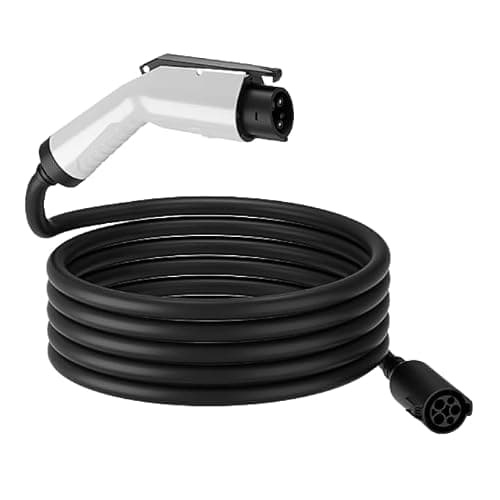 A2Z EV J1772 to J1772 Extension Cord, 16 ftA purpose-built EV extension on the car side of the charger — the correct place to add length — and the only one here whose maker publishes the code caveat that comes with it. A2Z EV J1772 to J1772 Extension Cord, 16 ftA purpose-built EV extension on the car side of the charger — the correct place to add length — and the only one here whose maker publishes the code caveat that comes with it. | A charger that will not reach | J1772 extension cable |
#1 · A charger that will not reach
A2Z EV J1772 to J1772 Extension Cord, 16 ft
A purpose-built EV extension on the car side of the charger — the correct place to add length — and the only one here whose maker publishes the code caveat that comes with it.
| Rating | 48A, AC Level 1 and Level 2source |
|---|---|
| Length | 16 ft / 5 msource |
| Compatibility | J1772 EV charging station into a J1772 / CCS1 vehiclesource |
| Component certification | UL-certified cable (E341631), UL 2251 connectors, UL 62 cabling; CE on the connector, FCC (EMI)source |
| Assembled-unit listing | Not UL Listed as an assembled unit — the manufacturer states an end-product category for EV extension cables is still being finalizedsource |
| Manufacturer's recommended use | Portable, occasional or emergency use; NEC Article 625 generally expects the cable to be integral to the station for permanent installationssource |
| Warranty | 12 months against manufacturing defectssource |
What those numbers mean
Extending on the J1772 side is safer than extending on the wall side, because the EVSE is still the thing controlling current and it still sits between the outlet and the extension.
Read the last three specification rows together, because they are the honest part. The components carry UL certification but the assembled cable is not UL Listed, and the manufacturer says so plainly rather than letting the component certifications imply something they do not. It also tells you NEC Article 625 expects a charging cable to be integral to the station for a permanent installation, and that this cord is for portable or occasional use. No other extension we looked at publishes any of that.
48A is well above the 40A ceiling of plug-in Level 2 charging, so the cable is never the constraint. Used at 24 amps on a shared dryer circuit it has a great deal of margin, which is exactly where you want to be.
What it does well
- Built for EV charging rather than a household cord pressed into the job
- 48A rating leaves real margin at any renter-reachable current
- The manufacturer publishes the UL-listing status and the NEC caveat instead of glossing over them
- Designed and tested in North America, with a stated 12-month warranty
What it does not
- Adds two contact interfaces to a circuit that runs for hours at high current
- Not UL Listed as an assembled unit — a real distinction, even though its components are certified
- 16 ft, so it is a shorter reach than some discontinued alternatives offered
- Not a substitute for a charger with a long enough cable in the first place
Skip this one if: You have not yet bought the charger. Buy a unit with a 23 or 25 ft cable and skip the extension entirely — one continuous cable always beats two joined ones.
#ad · how this is funded · price as of October 27, 2026
What the published specification tells you
Four things, and each one is doing work:
- 48 amp rating. That is roughly a fifth above the 40 amp ceiling of plug-in Level 2 charging, so the cable is never the constraint at any renter-reachable current. Used at 24 amps on a shared dryer circuit it has a great deal of margin, which is exactly where you want to be.
- 16 ft / 5 m. Enough to cross most of the gap that made you look for one, and short enough that voltage drop is not a consideration at these currents.
- UL-certified components, and an assembled unit that is not UL Listed. Both halves of that are published by the manufacturer: UL 2251 connectors and UL 62 cabling, on a finished cable that carries no end-product listing because the category for EV extension cables is still being finalized.
- A stated recommended use. The manufacturer says this is for portable, occasional or emergency use, and points at NEC Article 625 — which generally expects a charging cable to be integral to the station for a permanent installation.
What it does not fix
The listing caveat, read properly
Most extension cables in this category advertise their component certifications and stop there. This one states plainly that the assembled cable is not UL Listed and that a proper end-product category does not yet exist for it. That is a mark in its favor rather than against it: the underlying situation is the same across the category, and this is the manufacturer that tells you.
The NEC point is worth taking at face value too. Article 625 generally expects a charging cable to be part of the station for a permanent installation, so treat an extension as what its maker says it is — a portable or occasional solution — rather than as permanent infrastructure. If you find yourself relying on it every night for a year, the real answer is a charger with a longer cable.
heat at a connection is proportional to current squared × resistance
Dropping from 40A to 24A is 0.6 times the current, so about 0.36 times the heat at each contact.
Which is why "charge slower" appears on every safety page here. It is not caution for its own sake — it is the cheapest available improvement, and overnight it costs you almost nothing in range. The gauge chart has the rest.
Living with it
- Uncoiled and off standing ground. A cheap cable hook does more for this cable's life than any specification on the box.
- Couplings kept out of puddles. The manufacturer publishes no ingress rating for this cable, which is a reason to be more careful with the couplings rather than less.
- Check the couplings by hand after the first long session and again after the first cold snap. Warm is expected; hot is a stop signal.
- Do not run it across a path people walk on. The one place we offer no workaround — see street parking.
Who should not buy it
Anybody who has not yet bought their charger. Anybody whose gap is under about five feet, where repositioning the car solves it for free. And anybody trying to bridge a distance long enough that they should be asking whether that outlet is really the right one — a run to a socket on a different building is usually a sign that the answer is a different socket rather than a longer cable.
Questions people actually ask
Is a J1772 extension cable safe?
It is the safe way to add length, because it sits on the car side of the charger where the EVSE is still limiting current and monitoring the ground. Buy one rated above the current you draw, keep it uncoiled, and check the couplings after the first long session.
How long can a J1772 extension be?
Commonly 16 ft to 40 ft, depending on the maker. Buy the shortest that reaches. Longer runs mean more voltage drop and more heat at high current, so a long extension and a lower charger current setting go together.
Will an extension reduce charging speed?
Marginally, through voltage drop, and more so over longer runs at high current. At sensible lengths the effect is small enough not to plan around.
Can I use a J1772 extension with a NACS car?
Only with the appropriate adapter in the chain, and every additional connection is another interface. If you drive a NACS car and need reach, a longer NACS-connector charger is the cleaner answer — see best portable chargers for Tesla and NACS.
Sources
Every figure on this page traces to one of these. If a number here disagrees with the manufacturer, the manufacturer is right and we want to know — tell us.
Read next

Best EV Extension
EV extension cords and charging cables
Adding reach safely: EV-specific extensions, the right side of the charger to extend on, and the gauge arithmetic nobody publishes.
Top pick: A2Z EV J1772 to J1772 Extension Cord, 16 ft
Guide
Is an EV extension cord safe?
The extension cord safety question, answered with the actual failure mechanism, the specification that avoids it, and what we will not endorse.
Top pick: A2Z EV J1772 to J1772 Extension Cord, 16 ft
Guide
Gauge and length: the arithmetic
Wire gauge, current and distance, with the voltage-drop formula written out and a reference table built from it.
Top pick: A2Z EV J1772 to J1772 Extension Cord, 16 ft

Best Level 2 Portable
Best portable Level 2 EV chargers
The Level 2 roundup — plug-in 240V chargers compared on amperage range, cable length and published certification.
Top pick: Grizzl-E Mini Connect Portable Charger

Guide
Cables in rain, snow and heat
Weather ratings decoded, plus the drip loop, the hook and the temperature realities that decide how long an outdoor setup lasts.
Top pick: Lectron NEXUS Level 2 Charger (NEMA 14-50 plug)
Best A2Z Adapter
A2Z EV adapters, by direction
The A2Z lineup sorted by direction: both AC adapters, both DC adapters and the extension, with the published certificate on each.
Top pick: A2Z EV J1772 to NACS Adapter, 80A