Lectron Level 1 15A charger, reviewed
The second most-recommended product on this site, and the one whose suitability turns entirely on a number printed inside your breaker panel.
How this page is funded: the buy links below are affiliate links, and Renter Volt earns a commission on qualifying purchases at no cost to you. Nothing here was supplied by a manufacturer, and commission plays no part in the ranking — read the full disclosure. Picks are chosen from published specifications rather than hands-on testing; the method is written down so you can check it. Prices last verified October 27, 2026.
Buy this one only if the socket you will actually use sits on a 20 amp circuit. On that circuit it is the fastest Level 1 charging a renter can get — roughly a quarter more energy per night than the 12 amp units it competes with. On an ordinary 15 amp household circuit, which is most of them, buy a 12 amp charger instead.
That is the entire review in two sentences, and it is why the Level 1 roundup ranks this unit third rather than first. Everything below is Lectron's own published material and the listing itself; Renter Volt has not had this charger in its hands and says so plainly.
Quick picks
Ranked, with the reasoning underneath. Tap any row to jump to that write-up; tap the price to check it on Amazon. Prices come from the live layer, never from this page.
| # | Product | Best for | Type | Price |
|---|---|---|---|---|
| 1 | 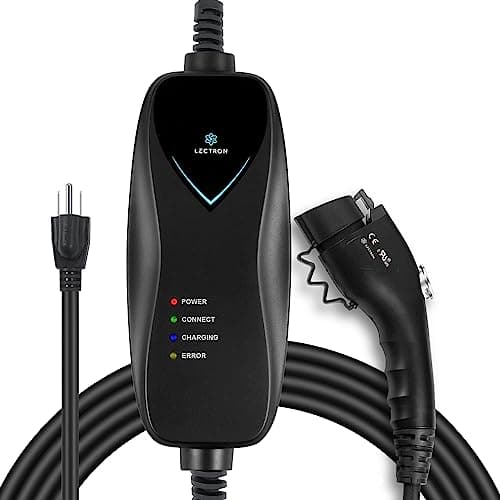 Lectron Portable Level 1 J1772 Charger (15A, NEMA 5-15)The unglamorous answer that covers most commutes: an ordinary 120V socket, overnight, and no conversation with anybody about electrical work. | An ordinary wall socket | Level 1 EVSE |
#1 · An ordinary wall socket
Lectron Portable Level 1 J1772 Charger (15A, NEMA 5-15)
The unglamorous answer that covers most commutes: an ordinary 120V socket, overnight, and no conversation with anybody about electrical work.
| Input | 120V, 15A maximumsource |
|---|---|
| Output power | 1.8 kWsource |
| Cable length | 16 ftsource |
| Plug / connector | NEMA 5-15 plug, J1772 connectorsource |
| Certification | UL 2594 / UL 2231 certified, and separately described as ETL-certified; no certificate number publishedsource |
| Ingress rating | IP65 weather-resistant, stated in the specification textsource |
| Manufacturer charge-rate claim | 45+ miles of range overnight; 3-5 miles of range per hoursource |
What those numbers mean
1.8 kW sounds trivial next to 9.6 kW, and for a road trip it is. For a commute it usually is not: the average US driver covers well under 45 miles a day, and this replaces that overnight while the car sits anyway.
The honest ceiling is the circuit behind the socket, not the cable. This unit draws 15 amps for hours, which a 20 amp circuit supports continuously and a 15 amp circuit does not — so check the breaker before the first overnight session, and on a 15 amp circuit choose a 12 amp unit instead.
This is the only category of EV charging that is genuinely invisible to a landlord. It draws less than a hair dryer and plugs into a receptacle that already exists.
What it does well
- Works with a socket that already exists, everywhere, with no permission needed
- UL 2594 and UL 2231 certified rather than a generic cordset
- Cheapest possible entry into home charging, by a wide margin
What it does not
- 1.8 kW will not recover a long driving day overnight
- 16 ft cable, and the nearest 120V socket is often not the nearest thing to the car
- Its 15 amp draw needs a 20 amp circuit behind the socket; an ordinary 15 amp circuit supports 12 amps continuously
Skip this one if: You regularly drive more than about 45 miles a day. Level 1 will fall a little further behind every night and you will spend the difference at public chargers.
The 15 amp question, which decides everything else
This charger draws 15 amps. That sounds like it belongs in a 15 amp socket, and that is exactly the trap. Charging is a continuous load — hours of near-constant current — and continuous loads are limited to 80% of the breaker rating.
breaker rating × 0.8 = continuous current permitted
15A breaker × 0.8 = 12A permitted → this 15A charger exceeds it · 20A breaker × 0.8 = 16A permitted → this 15A charger fits, with headroom · The socket on the wall looks identical in both cases
A NEMA 5-15 receptacle — the ordinary three-prong socket — is fitted to BOTH 15 amp and 20 amp circuits. You cannot tell them apart by looking at the wall. How to identify your outlet is the two-minute check, and the number is printed on the breaker, not the socket.
What you gain when the circuit does support it is real, though smaller than the amperage difference suggests, because the gap is 15 against 12 rather than anything dramatic.
amps × 120V ÷ 1000 × hours = kWh delivered
15A × 120V = 1.8 kW · over 12 hours = 21.6 kWh · 12A × 120V = 1.44 kW · over 12 hours = 17.3 kWh · the difference is 4.3 kWh, about 15 miles at 3.5 mi/kWh
Fifteen extra miles a night is worth having if your commute is near the edge of what Level 1 covers, and worth nothing at all if it is not. How long charging actually takes does this against your own mileage.
Which Lectron Level 1 this is — there are three, and they get confused
Lectron sells several Level 1 chargers and the listings read similarly. Getting the wrong one is the most common way this purchase goes wrong, and two of the three mistakes are not returnable-by-Tuesday mistakes — they are the wrong connector or the wrong current.
| Unit | Current | Connector | Cable | Who it is for |
|---|---|---|---|---|
| Portable Level 1 J1772, 15A — the one reviewed here | 15A, 1.8 kW | J1772 | 16 ft | A J1772 car on a confirmed 20 amp circuit |
| Portable Level 1 Tesla (NACS), WiFi, 12A | 12A, 1.44 kW | NACS | 16 ft | A Tesla-port car; app control is on this one |
| Portable Level 1 & 2 "Explorer", adjustable | 12A at 120V / 24A at 240V | J1772 | 20 ft | Someone who does not yet know which outlet they will have |
Two consequences worth stating plainly. The app belongs to the WiFi unit, not this one — Lectron's page says "Lectron App Control (WiFi version ONLY)", and the 15A J1772 charger reviewed here has no app. And the adjustable Explorer is a different product entirely: it is the one to buy if you might move to a place with a 240V outlet, and which direction your car needs settles the connector question before any of it matters.
What Lectron publishes for this unit
| Specification | Published? | Value |
|---|---|---|
| Voltage and current | Yes | 120V, 15A |
| Output power | Yes | 1.8 kW |
| Cable length | Yes | 16 ft |
| Plug | Yes | NEMA 5-15 |
| Connector | Yes | SAE J1772 |
| Ingress rating | Yes, in the spec text | IP65 weather-resistant |
| Safety standards | Yes, names only | "UL2594 / UL2231 Certified" and, separately, "ETL-certified" |
| Certificate number | No | Not published |
| Operating temperature range | No | Absent from the page |
| Warranty period | No | A 30-day return policy, which is not a warranty |
| Current adjustment | No | Not published for this model; fixed at 15A |
| Weight | No | Not published |
The IP65 inversion — the cheap one is better documented than the flagship
This is the finding worth the page. Lectron publishes IP65 for this charger in its specification text. Its 40 amp flagship — the unit this site recommends more than any other — publishes no ingress rating in its spec text at all; round 8's review of it found IP65 appearing only inside the alt text of a product image, with the FAQ saying only "weather-resistant for indoor/outdoor use".
So within one brand, the inexpensive Level 1 cord has the better-documented spec sheet on the specification that governs outdoor life. That inverts the assumption people bring to this category — and it matches what the cross-brand audit found across every maker on this site, where the single most complete spec sheet belongs to a Level 1 product rather than a Level 2 one.
Two certification claims, no certificate number
Lectron's page names "UL2594 / UL2231 Certified" and, separately on the same page, describes the unit as "ETL-certified" — without saying which body issued which mark. The Amazon listing leads with ETL: its title reads "Lectron Level 1 EV Charger - ETL Certified, 120V, 15 Amp".
None of that is a contradiction. UL 2594 and UL 2231 are the standards that apply to charging equipment; ETL is a testing laboratory that certifies products to those same standards. A product can legitimately be built to a UL standard and listed by ETL. What is missing is the thing that would let you check any of it: a certificate number, which refers to a specific file held by the issuing body and can be looked up. Naming the right standards puts Lectron ahead of the listings that say "safety certified" and stop; publishing no number keeps it behind the handful that do. Lectron against A2Z compares the two brands on exactly this habit.
The range claims do not quite agree
Lectron's page carries three different statements about what this charger returns: "45+ miles overnight", "an extra 40-50 miles of overnight charge", and "adding roughly 3-5 miles of range per hour of charging" — the last with the caveat that it depends on the vehicle, state of charge and temperature.
miles per hour × hours = miles overnight
3 mi/hr × 12 h = 36 miles · 5 mi/hr × 12 h = 60 miles · so the hourly claim spans 36-60 miles across a 12-hour night, against a headline of "45+" and a body figure of "40-50"
They are not inconsistent so much as imprecise: the headline sits inside the range the hourly figure implies. Treat 40-50 miles as the honest planning number for a full night and the hourly figure as the one that varies with your car. What charging actually costs prices that energy.
The caveat Lectron attaches is the correct one and worth repeating: the car's onboard charger, its state of charge and the ambient temperature all move this number, and none of them is under the cord's control. Why charging is slower than expected covers the cases where even the modest figure does not materialize.
No warranty period, again
Lectron's page for this charger publishes 30-day returns and no warranty period at all — the same gap round 8 found on the 40 amp unit, which makes it a brand pattern rather than an oversight on one listing. A return window covers a unit that arrives faulty or wrong. A warranty covers one that fails in month fourteen. They are not substitutes.
For context on how unusual that is: across every product on this site, three years is the category standard, and the competing Level 1 cord from Schumacher publishes a 3 Year Limited Warranty along with an IP66 rating and a longer cable. How long a portable charger lasts sets all of them side by side, and Lectron is the only brand in that table with no period at all.
Sixteen feet, and the listing's odd phrasing
The Amazon title describes this as a "16 ft Extension Cord & J1772 Cable", which reads as though an extension is supplied alongside the charger. It is not. The 16 feet is the charging cable itself — the same phrasing that appears on Lectron's 40 amp listing and causes the same misreading.
Measure before you order: from the socket to where your charge port sits with the car parked as it will actually be parked, not as you would like to park it. If 16 ft does not reach, the Schumacher's 20.5 ft is the cheaper fix than anything you can add afterwards — and if you are tempted to add a household extension cord instead, whether an EV extension cord is safe sets out why the car side is the only side worth extending on.
How this was judged
- Can a tenant put it into service unaided? Yes, more completely than anything else in this category. It plugs into a receptacle that already exists, draws less than a hair dryer, needs no electrician and no permission, and leaves with you. This is the only criterion this site treats as absolute.
- Is the current matched to a circuit the reader can actually reach? This is where the unit loses its ranking. 15 amps continuous requires a 20 amp circuit, and a renter frequently has 15. Nothing is credited for drawing more than the circuit permits.
- Are the safety standards named and checkable? Named correctly, from two angles, and not accompanied by a certificate number.
- Are the specifications governing outdoor life published? An IP65 rating in the spec text — better than its own 40 amp sibling — but no operating temperature range.
- Reach. 16 ft, which is shorter than the main Level 1 alternative and decides more purchases in a carport than amperage does.
- Warranty. None published, against a category standard of three years. This is the clearest reason to buy a competitor at a similar price.
Buy it, or do not
- Buy it if you have confirmed a 20 amp circuit, your car takes J1772, and 16 ft reaches. On that description it is the fastest overnight charging available without touching the building's wiring, and it is inexpensive.
- Do not buy it if the breaker says 15. The charger asks for more than that circuit permits continuously, and a 12 amp unit is the correct purchase — not a preference.
- Do not buy it if your car has a NACS port and you have no adapter. This is the J1772 unit; Lectron's NACS Level 1 charger is a different listing at a different current.
- Think twice if a warranty matters to you. Lectron publishes none for this charger, while a direct competitor publishes three years at a comparable price.
- Think twice if 16 ft is marginal. Cable length is the specification renters most often get wrong, and the alternative gives you 20.5 ft.
- Skip it entirely if you can reach a 240V outlet. The right move then is Level 2, and is a Level 2 charger worth it? is the honest version of that calculation.
Where these figures come from
Every specification above is Lectron's own published page for this charger, plus the wording of the Amazon listing where that is what is being described, plus the continuous-load rule from the National Electrical Code. There is no test bench behind this site, no loaner hardware and no hands-on durability claim — how the housing survives a winter, whether the IP65 rating holds after two years of being coiled and uncoiled, and whether Lectron answers a complaint are all things this page cannot tell you.
One correction made while writing this, recorded here rather than quietly: this product's registry entry previously cited Lectron's adjustable Level 1 and 2 charger page for every one of its specifications — a different unit that publishes 12A, 1.4 kW and a 20 ft cable. The values shown were correct for the 15 amp product; the citation was not, and it has been pointed at this charger's own page. The editorial policy covers how corrections are handled here.
Questions people actually ask
Is the Lectron Level 1 charger any good?
On a 20 amp circuit, yes — it is the fastest Level 1 charging a renter can get, it publishes an IP65 rating that its own 40 amp sibling does not state in its specifications, and it is inexpensive. Its real limits are that it draws 15 amps, which an ordinary 15 amp household circuit cannot supply continuously, that it publishes no warranty period and no operating temperature range, and that its 16 ft cable is shorter than the main alternative.
Can I use a 15 amp EV charger on a 15 amp circuit?
No. Charging is a continuous load, and continuous loads are limited to 80 percent of the breaker rating — 12 amps on a 15 amp circuit. A 15 amp charger needs a 20 amp circuit. The receptacle looks identical either way, so read the breaker rather than the socket.
How much faster is a 15 amp Level 1 charger than a 12 amp one?
About 25 percent. 15A at 120V is 1.8 kW against 1.44 kW, which over a twelve-hour night is roughly 21.6 kWh against 17.3 kWh — a difference of about 15 miles of range. Worth having if your commute sits near the edge of what Level 1 covers, and worth nothing if it does not.
Is the Lectron Level 1 charger weatherproof?
Lectron publishes IP65 for it in the specification text, which means protection against dust and against low-pressure water jets. That is more than its 40 amp charger states. What it does not publish is an operating temperature range, so for a cord that lives outdoors through winter the picture is still incomplete.
Is the Lectron Level 1 charger UL or ETL certified?
Its page says both, from two angles: it names UL 2594 and UL 2231, which are the standards for charging equipment, and separately describes the unit as ETL-certified — ETL being a testing laboratory that can certify to those standards. That is not a contradiction. What is missing is a certificate number, which is the difference between a claim you can look up and one you cannot.
Does the Lectron Level 1 charger come with a warranty?
No period is published. Lectron's page states a 30-day return policy, which covers a unit that arrives faulty rather than one that fails later. Three years is the standard across the other brands on this site, and the competing Schumacher Level 1 cord publishes exactly that.
How long is the Lectron Level 1 cable?
16 ft. Note that the Amazon title calls it a "16 ft Extension Cord & J1772 Cable", which reads as though an extension is included — it is not, the 16 feet is the charging cable itself. Measure from the socket to your charge port with the car parked where it really parks.
Which Lectron Level 1 charger should I buy?
The 15A J1772 unit reviewed here if your car takes J1772 and your circuit is 20 amps. Lectron's NACS version if your car has a Tesla port — it is a different listing at 12 amps, and it is the one with app control. Lectron's adjustable Level 1 and 2 Explorer if you might end up with a 240V outlet later, since it covers both.
Will a Level 1 charger harm my battery?
There is no published evidence that it does, and the worry generally runs backwards — Level 1 is the lowest-power way to charge a car. We cover what the DOE and the national labs actually publish on charging rate and battery life in a separate page.
Sources
Every figure on this page traces to one of these. If a number here disagrees with the manufacturer, the manufacturer is right and we want to know — tell us.
- Lectron — Portable Level 1 J1772 EV Charger, 120V / 15A / NEMA 5-15 (product page)
- Lectron — published specification table for the Level 1 and Level 2 charger range
- Lectron — Portable Level 2 J1772 EV Charger, 240V / 40A / NEMA 14-50 (product page)
- Schumacher Electric — SEV1670 Level 1 Portable EV Charger, 120V / 12A (product page and specifications)
- UL Solutions — UL 2594, standard for electric vehicle supply equipment
- SAE International — J1772 electric vehicle conductive charge coupler standard
- NFPA — NFPA 70, National Electrical Code (free public access)
- U.S. DOE Alternative Fuels Data Center — Electric vehicle charging levels and speeds
- U.S. Department of Energy — Electric vehicle charging at home
Read next
Best Portable Charger
Best portable EV chargers
The portable charger section: plug-in Level 1 and Level 2 units ranked by the outlet you can actually reach, with every spec cited.
Top pick: Grizzl-E Mini Connect Portable Charger

Best Level 1 Charger
The best Level 1 EV chargers
Level 1 chargers ranked for renters: 12 amps against 15 and the breaker that decides it, cable reach, connector and a safety listing you can check.
Top pick: Schumacher Electric SEV1670 Level 1 Portable EV Charger (12A, NEMA 5-15)
Guide
Lectron Level 2 40A charger, reviewed
A close read of the 40A Lectron: the WiFi-versus-Plug-and-Play trap, the two specifications it never publishes, the missing warranty, and the circuit on which it is the wrong purchase.
Top pick: Lectron Portable Level 2 J1772 Charger (40A, NEMA 14-50)
Guide
What to look for in a portable EV charger
A criteria-first guide to choosing a plug-in charger: the six specifications that matter in order, and a cross-brand table of which makers publish each one and which stay silent.
Top pick: Grizzl-E Mini Connect Portable Charger
Guide
Level 1 vs Level 2, for someone without a garage
The charging-level comparison rewritten for renters, with a renter-viability column and an honest case for Level 1.
Top pick: Lectron Portable Level 1 J1772 Charger (15A, NEMA 5-15)
Guide
Is Level 1 charging bad for your EV battery?
What the DOE and a controlled national-lab study actually publish about charging rate and battery life, why Level 1 was never the suspect, and the cords to buy if 120V is what you have.
Top pick: Lectron Portable Level 1 J1772 Charger (15A, NEMA 5-15)