Can you charge an EV with a generator?
The arithmetic says yes at Level 1 and no at Level 2. The manufacturer of the generators says ask your car maker first.
How this page is funded: the buy links below are affiliate links, and Renter Volt earns a commission on qualifying purchases at no cost to you. Nothing here was supplied by a manufacturer, and commission plays no part in the ranking — read the full disclosure. Picks are chosen from published specifications rather than hands-on testing; the method is written down so you can check it. Prices last verified October 27, 2026.
Yes — at Level 1 speeds, with a generator that can hold 1,000 to 2,000 watts cleanly, using an ordinary Level 1 charging cord. Level 2 from a portable generator is a different matter: Generac publishes that a 40 amp Level 2 charger needs 9,600 watts at 240V, which is outside what a portable unit delivers continuously.
That is the whole answer. The rest of this page is the three things that go wrong anyway, because the arithmetic working does not mean the charge starts.
Quick picks
Ranked, with the reasoning underneath. Tap any row to jump to that write-up; tap the price to check it on Amazon. Prices come from the live layer, never from this page.
| # | Product | Best for | Type | Price |
|---|---|---|---|---|
| 1 | 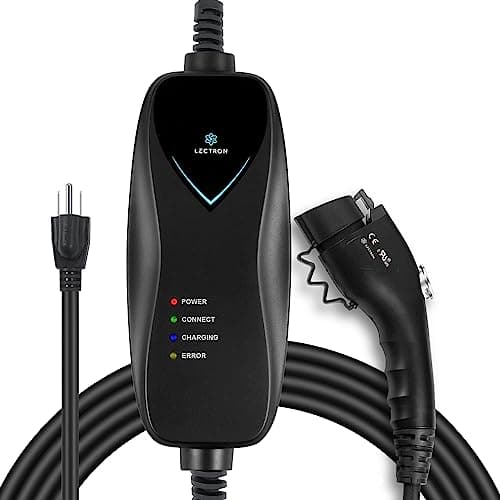 Lectron Portable Level 1 J1772 Charger (15A, NEMA 5-15)The unglamorous answer that covers most commutes: an ordinary 120V socket, overnight, and no conversation with anybody about electrical work. | An ordinary wall socket | Level 1 EVSE | |
| 2 | 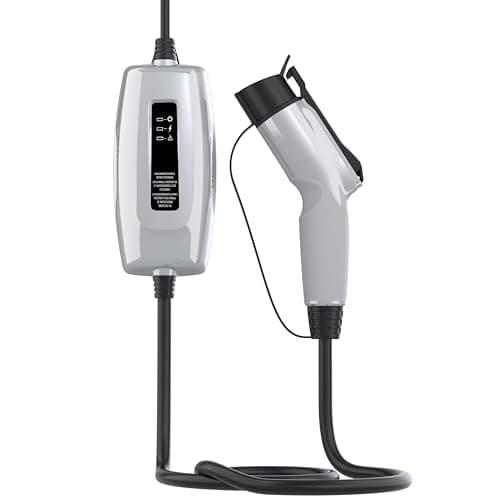 Schumacher Electric SEV1670 Level 1 Portable EV Charger (12A, NEMA 5-15)A 12 amp Level 1 charger sized correctly for an ordinary 15 amp household circuit, with a 20 ft cable that reaches further than most. | A 15 amp circuit and a longer reach | Level 1 EVSE | |
| 3 | 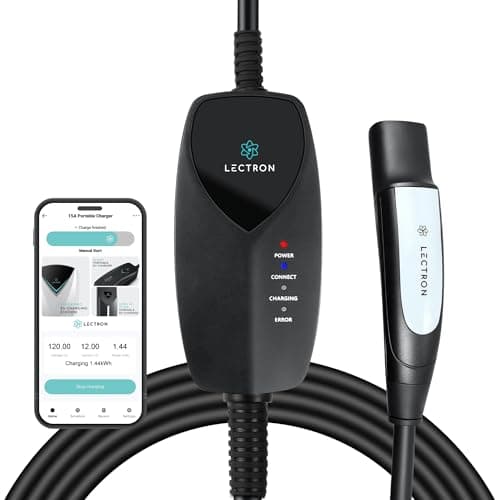 Lectron Portable Level 1 Tesla (NACS) Charger, WiFi (12A, NEMA 5-15)A 12 amp NACS Level 1 charger with app scheduling: the right current for a 15 amp circuit and the right connector for a Tesla, with no adapter in between. | A Tesla or NACS car on a household socket | Level 1 smart EVSE |
#1 · An ordinary wall socket
Lectron Portable Level 1 J1772 Charger (15A, NEMA 5-15)
The unglamorous answer that covers most commutes: an ordinary 120V socket, overnight, and no conversation with anybody about electrical work.
| Input | 120V, 15A maximumsource |
|---|---|
| Output power | 1.8 kWsource |
| Cable length | 16 ftsource |
| Plug / connector | NEMA 5-15 plug, J1772 connectorsource |
| Certification | UL 2594 / UL 2231 certified, and separately described as ETL-certified; no certificate number publishedsource |
| Ingress rating | IP65 weather-resistant, stated in the specification textsource |
| Manufacturer charge-rate claim | 45+ miles of range overnight; 3-5 miles of range per hoursource |
What those numbers mean
1.8 kW sounds trivial next to 9.6 kW, and for a road trip it is. For a commute it usually is not: the average US driver covers well under 45 miles a day, and this replaces that overnight while the car sits anyway.
The honest ceiling is the circuit behind the socket, not the cable. This unit draws 15 amps for hours, which a 20 amp circuit supports continuously and a 15 amp circuit does not — so check the breaker before the first overnight session, and on a 15 amp circuit choose a 12 amp unit instead.
This is the only category of EV charging that is genuinely invisible to a landlord. It draws less than a hair dryer and plugs into a receptacle that already exists.
What it does well
- Works with a socket that already exists, everywhere, with no permission needed
- UL 2594 and UL 2231 certified rather than a generic cordset
- Cheapest possible entry into home charging, by a wide margin
What it does not
- 1.8 kW will not recover a long driving day overnight
- 16 ft cable, and the nearest 120V socket is often not the nearest thing to the car
- Its 15 amp draw needs a 20 amp circuit behind the socket; an ordinary 15 amp circuit supports 12 amps continuously
Skip this one if: You regularly drive more than about 45 miles a day. Level 1 will fall a little further behind every night and you will spend the difference at public chargers.
#2 · A 15 amp circuit and a longer reach
Schumacher Electric SEV1670 Level 1 Portable EV Charger (12A, NEMA 5-15)
A 12 amp Level 1 charger sized correctly for an ordinary 15 amp household circuit, with a 20 ft cable that reaches further than most.
| Charging current | 12A continuous, 120Vsource |
|---|---|
| Output power | 1.44 kWsource |
| Cable length | 20 ftsource |
| Plug / connector | NEMA 5-15 plug, J1772 connectorsource |
| Certification | ETL and Energy Starsource |
| Enclosure | IP66 housingsource |
| Built-in protection | Leakage, undervoltage, overvoltage, overcurrent, over-temperature, ground-fault and relay-fault protectionsource |
What those numbers mean
Twelve amps is not a low number for this category; it is the correct one. A 15 amp circuit supports 12 amps of continuous load, and overnight charging is continuous by any definition, so this unit uses an ordinary household circuit right up to its limit and no further.
The 20 ft cable is four feet longer than the common 16 ft. At a carport or a curbside socket, those four feet are frequently the difference between reaching the charge port and reaching for an extension cord.
Over-temperature protection is on the manufacturer's list, but the published specification does not say where the sensor sits. Treat it as a backstop, and still feel the plug at the wall during the first few long sessions.
What it does well
- Sized for a 15 amp circuit, the most common household circuit there is
- 20 ft cable, longer than the usual 16 ft
- ETL and Energy Star certified, with an IP66 housing
- The manufacturer publishes the full list of built-in protections
What it does not
- J1772 only — a Tesla or other NACS car needs an adapter or a NACS unit
- No app or scheduling, and no current adjustment in the published specification
- 1.44 kW will not recover a long driving day overnight
Skip this one if: Your car has a NACS (Tesla-style) port, or you regularly drive more than about 40 miles a day. The first needs a different connector; the second needs more power than any Level 1 unit can deliver.
#3 · A Tesla or NACS car on a household socket
Lectron Portable Level 1 Tesla (NACS) Charger, WiFi (12A, NEMA 5-15)
A 12 amp NACS Level 1 charger with app scheduling: the right current for a 15 amp circuit and the right connector for a Tesla, with no adapter in between.
| Charging current | 12A, 120Vsource |
|---|---|
| Output power | Up to 1.44 kWsource |
| Cable length | 16 ftsource |
| Plug / connector | NEMA 5-15 plug, NACS (Tesla) connectorsource |
| Certification | UL 2594 / UL 2231 certifiedsource |
| Enclosure | IP67-rated control boxsource |
| App features | Charging schedules, real-time status and a kWh limit per session in the Lectron appsource |
What those numbers mean
The 12 amp rating is what makes this the NACS pick for most renters: it matches the continuous limit of an ordinary 15 amp circuit, where a 15 amp unit would need a 20 amp circuit behind the socket.
A NACS connector means a Tesla, or any other NACS car, plugs in directly. That is one fewer connection carrying current for twelve hours, and one fewer part to leave in a shared parking space.
The app earns its place on a time-of-use electricity rate, where starting the session inside the cheap window is worth money every night. On a flat rate it is mostly a status display.
What it does well
- Sized for a 15 amp household circuit
- Native NACS connector — no adapter needed on a Tesla
- Scheduling and a per-session kWh limit in the app
- UL 2594 / UL 2231 certified, with an IP67 control box
What it does not
- 16 ft cable, and the nearest socket is often further away than that
- The scheduling runs through the app, so it needs a network where you park
- NACS only — a J1772 car would need an adapter
Skip this one if: Your car has a J1772 port, or your electricity costs the same at every hour and there is no Wi-Fi where you park. A plain 12 amp unit does the same electrical job.
#ad · how this is funded · price as of October 27, 2026
The published numbers, from the company that makes the generators
Generac is a generator manufacturer rather than a charger brand, which makes its support article the most useful published source on this question. It states that "Level 1 chargers use a standard 120V outlet and typically require 1,000-2,000 watts", and that "a 40-amp Level 2 charger requires 9,600 watts at 240V".
| Charging level | Published power requirement | Realistic from a portable generator? |
|---|---|---|
| Level 1, 120V | 1,000-2,000 watts | Yes — this is within a mid-size portable unit's continuous rating |
| Level 2, 240V at 40A | 9,600 watts | No. That is standby-generator territory, not a unit you carry |
| Level 2, 240V at 24A (a dryer-circuit rate) | Roughly 5,800 watts by the same arithmetic | Only from a large 240V-capable generator, and the 240V output has to be real |
amps × volts = watts
12A × 120V = 1,440 W (a typical Level 1 cord) · 15A × 120V = 1,800 W (the larger Level 1 cord) · 24A × 240V = 5,760 W (a dryer-circuit Level 2 rate) · 40A × 240V = 9,600 W (full Level 2)
Compare each figure against the generator's CONTINUOUS rating, never its surge or peak rating. Charging is a continuous load for hours, which is the same reason the 80% continuous rule governs every circuit on this site.
The three things that actually go wrong
1. The charger refuses to start
This is the failure people hit and do not expect, and Generac names it: some chargers "may not perform as expected with generator power and could experience issues such as ground faults". A charging cord contains ground-fault detection by design — that protection is a requirement of the standards these products are built to — and a generator's electrical arrangement does not always present the conditions that circuitry expects.
2. The power is not clean enough
Generac defines clean power as "AC electricity with less than 6% total harmonic distortion (THD)", and says its inverter, EFI portable and home standby units are designed to produce it. It also adds, in the same breath, that "power quality is only one factor in safe battery charging" — which is a manufacturer declining to promise that clean output alone makes charging work.
In practical terms: a conventional contractor-grade generator is the least likely to cooperate, and an inverter generator is the category designed for sensitive electronics. Neither one is a guarantee.
3. Your car maker may not be on board
Generac's own recommendation is unambiguous: "we recommend consulting your vehicle manufacturer before using any generator as a charging source." That is the generator company telling you to go ask the car company. Check your owner's manual before you plan around this, because the two industries have not settled the question between them.
What a night on a generator is actually worth
watts × hours ÷ 1000 = kWh delivered
1,440 W × 8 h ÷ 1000 = 11.5 kWh · At roughly 3.5 miles per kWh that is about 40 miles · On a 75 kWh pack it is about 15% of the battery
Forty miles overnight is genuinely useful if your commute is short, and it is about what a 120V socket gives you anyway — see the cost of charging for what the same energy costs from a wall. The generator's fuel bill, by contrast, is never free.
That is the honest shape of the answer. A generator does not unlock fast charging; it recreates the slowest kind of charging, at a running cost, with a chance that the charger will not start at all. It is an answer for a power cut or a genuinely remote stay, not a charging strategy.
If this is about having no outlet, read this instead
Most people who arrive at the generator question are really asking a different one: *I have nowhere to plug in — what now?* A generator is the most expensive, least reliable answer to that question. The ones worth trying first are all on this site:
- No-install options — the complete set of things that work without an electrician, in order.
- The apartment complex playbook — how to get access to an outlet that already exists in the building.
- Charging from a shared laundry room — usually the best 240V outlet in a rental building.
- Charging at an RV park — a real 240V pedestal, for the genuinely stuck.
- What renters are entitled to ask for — before you assume the answer is no.
How these three picks were chosen
- Level 1 only, deliberately. Every pick here is a 120V cord, because 120V is the only charging level a portable generator realistically supports. Recommending a 40 amp unit for this page would be selling hardware the scenario cannot feed.
- Lower current is better here, not worse. A 12A cord asks about 1,440 W of a generator; a 15A cord asks about 1,800 W. On a marginal generator the smaller draw is the one that holds.
- Cable length, because the generator will not be beside the car. Generators need ventilation and distance. The Schumacher's 20.5 ft is the longest here and that matters more in this scenario than in any other on the site.
- Published weather ratings, because this happens outdoors. The Schumacher publishes IP66. That is a specific, checkable figure, and most of this category publishes nothing at all.
- Connector match. Two J1772 units and one native NACS unit, so the page covers both kinds of car without an adapter. Which direction your car needs settles that if you are unsure.
What this page cannot tell you
We have not run any charger on any generator — there is no bench here and the methodology page says so without hedging. Every figure above is Generac's published support article or arithmetic from the voltages and currents the manufacturers publish. Whether your particular generator will satisfy your particular car's charging cord is not something either manufacturer publishes, and this page is not going to pretend otherwise. Generac's own advice — ask the vehicle maker — is the correct next step, not a disclaimer.
Questions people actually ask
Can you charge an electric car with a portable generator?
At Level 1 speeds, usually yes. Generac publishes that Level 1 charging typically requires 1,000 to 2,000 watts, which a mid-size portable generator can hold continuously. Level 2 at 40 amps needs 9,600 watts by the same source, which is beyond a portable unit. The practical risk is not the wattage but the charger refusing to start on generator power.
What size generator do I need to charge an EV?
For Level 1, size against the published 1,000-2,000 watt range using the generator's continuous rating rather than its surge rating; a 12 amp cord asks about 1,440 watts. For 40 amp Level 2 the figure is 9,600 watts, which is standby-generator territory. Always use the continuous number, because charging runs for hours.
Why won't my EV charger work on my generator?
Generac's own support article warns that some chargers may not perform as expected on generator power and could experience issues such as ground faults. Charging cords contain ground-fault protection by design. The common online workaround is to bond neutral to ground at the generator, which defeats that protection — we do not recommend it. Use a different generator or a different approach instead.
Will a solar generator or portable power station charge my EV?
Only marginally, and not for the reason people expect. A large portable power station publishes around 3.6 kWh of capacity against an EV pack of roughly 75 kWh, so a full discharge is under 5 percent of a charge. The capacity question is covered in full on our page about portable batteries for EVs.
Does charging from a generator damage the car?
We have no evidence either way and will not invent any. What is published is Generac's recommendation to consult your vehicle manufacturer before using a generator as a charging source, and its note that power quality is only one factor in safe battery charging. Check your owner's manual, because that is the document that governs your warranty.
Is an inverter generator better for EV charging?
Generac describes its inverter and EFI portable generators, and its home standby units, as designed to produce clean, stable power with low total harmonic distortion, which it defines as under 6%. That makes an inverter generator the more likely of the two categories to work. It is not a guarantee, and Generac does not present it as one.
How many miles does a generator add overnight?
Roughly 40 miles from eight hours at 1,440 watts, at about 3.5 miles per kWh. That is around 15 percent of a 75 kWh pack, and it is about what the same hours on an ordinary 120V wall socket would give you at no fuel cost.
Sources
Every figure on this page traces to one of these. If a number here disagrees with the manufacturer, the manufacturer is right and we want to know — tell us.
- Generac — Can I use a portable or home standby generator to charge my electric vehicle (EV)?
- U.S. DOE Alternative Fuels Data Center — Electric vehicle charging levels and speeds
- U.S. Department of Energy — Electric vehicle charging at home
- NFPA — NFPA 70, National Electrical Code (free public access)
- U.S. Energy Information Administration — Average retail price of electricity to residential customers
- Schumacher Electric — SEV1670 Level 1 Portable EV Charger, 120V / 12A (product page and specifications)
- Lectron — Portable Level 1 J1772 EV Charger, 120V / 15A / NEMA 5-15 (product page)
- Lectron — Portable Level 1 Tesla (NACS) EV Charger, WiFi, 120V / 12A / NEMA 5-15 (product page)
Read next

Start here
You don't have a garage. Here's what actually works.
The pillar guide: what charging looks like when there is no garage, no driveway and no landlord willing to run a new circuit.
Top pick: Lectron Portable Level 1 J1772 Charger (15A, NEMA 5-15)
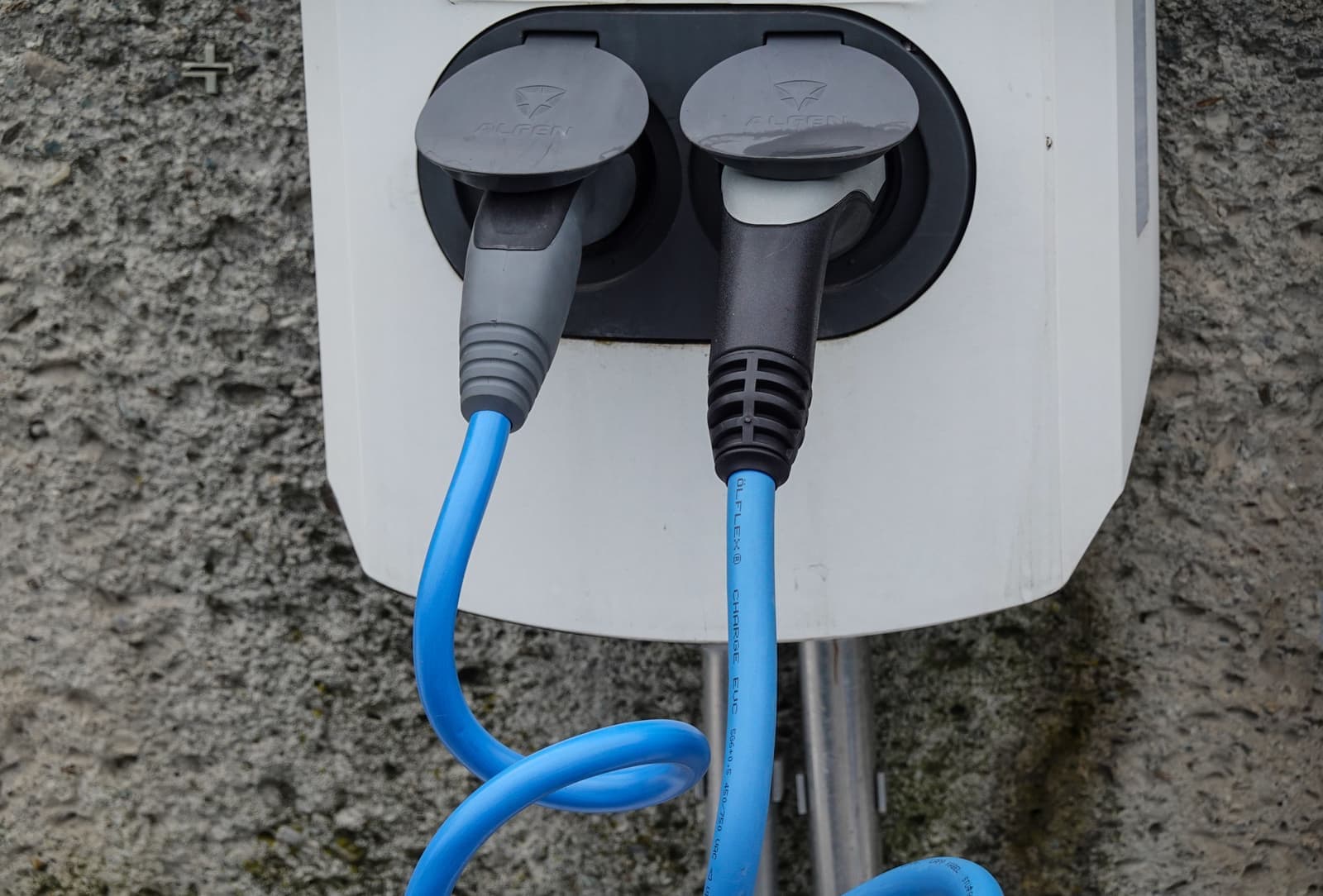
Best No-Install Setup
The best EV chargers that need no installation
Ranked no-install charging setups, from an ordinary wall socket to a shared dryer circuit — every one of them plugs in and leaves with you.
Top pick: Grizzl-E Mini Connect Portable Charger

Best RV-Pedestal Setup
Charging an EV at an RV park
Using an RV pedestal as a charging fallback: which receptacle to look for, the etiquette and the gear that makes it work.
Top pick: Lectron Portable Level 2 J1772 Charger (40A, NEMA 14-50)

Best Level 1 Charger
The best Level 1 EV chargers
Level 1 chargers ranked for renters: 12 amps against 15 and the breaker that decides it, cable reach, connector and a safety listing you can check.
Top pick: Schumacher Electric SEV1670 Level 1 Portable EV Charger (12A, NEMA 5-15)
Guide
Is there a portable battery that charges an EV?
The power-bank question, answered with arithmetic: why a battery pack cannot meaningfully charge a car, what the phrase "portable EV charger" really sells, and the cords that do the job.
Top pick: Lectron Portable Level 1 J1772 Charger (15A, NEMA 5-15)

Guide
What it actually costs to charge
The cost arithmetic in full: cost per charge, cost per mile, and an honest comparison against gasoline using your own numbers.
Top pick: Lectron Portable Level 1 J1772 Charger (15A, NEMA 5-15)