Lectron Level 2 40A charger, reviewed
The charger this site recommends more than any other. A review owes you its limits rather than a sixth recommendation.
How this page is funded: the buy links below are affiliate links, and Renter Volt earns a commission on qualifying purchases at no cost to you. Nothing here was supplied by a manufacturer, and commission plays no part in the ranking — read the full disclosure. Picks are chosen from published specifications rather than hands-on testing; the method is written down so you can check it. Prices last verified October 27, 2026.
This is the charger this site puts first more often than any other — the top pick on six different pages. That is a reason to examine it properly rather than recommend it again. Everything below comes from Lectron's own published material and the listing itself; Renter Volt has not had this unit in its hands and says so plainly.
Quick picks
Ranked, with the reasoning underneath. Tap any row to jump to that write-up; tap the price to check it on Amazon. Prices come from the live layer, never from this page.
| # | Product | Best for | Type | Price |
|---|---|---|---|---|
| 1 | 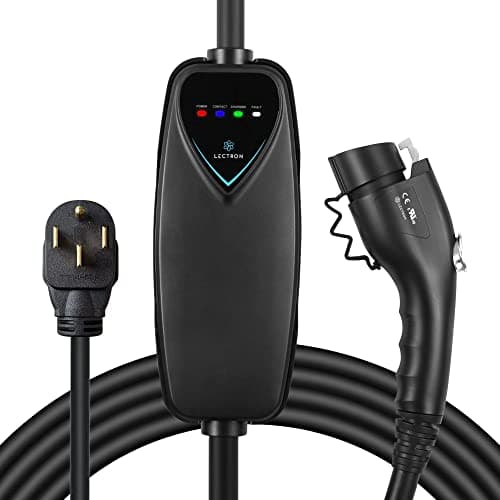 Lectron Portable Level 2 J1772 Charger (40A, NEMA 14-50)The plainest answer to a NEMA 14-50 outlet you can reach: 40 amps, a plug on the end, and nothing screwed to a wall you do not own. | A reachable 14-50 outlet | Plug-in Level 2 EVSE |
#1 · A reachable 14-50 outlet
Lectron Portable Level 2 J1772 Charger (40A, NEMA 14-50)
The plainest answer to a NEMA 14-50 outlet you can reach: 40 amps, a plug on the end, and nothing screwed to a wall you do not own.
| Input | 240V, 40A maximumsource |
|---|---|
| Output power | Up to 9.6 kWsource |
| Cable length | 16 ftsource |
| Plug / connector | NEMA 14-50 plug, J1772 connectorsource |
| Certification | UL 2594 / UL 2231 certifiedsource |
| Manufacturer charge-rate claim | Roughly 30 miles of range per hour of chargingsource |
What those numbers mean
9.6 kW is the ceiling this unit can deliver, not what your car will take. A vehicle with a 7.2 kW onboard charger draws 7.2 kW from it and no more, and that is a car limitation no charger fixes.
The 16 ft cable is the number to check before anything else. Measure from the outlet to where your charge port sits when the car is parked as it will actually be parked, not as you would like to park it. Sixteen feet disappears faster than people expect once it has to route around a wall.
A 40 amp unit needs a 50 amp circuit behind the outlet to run at 40 amps continuously. If the outlet is on a smaller breaker, the answer is a lower-amperage charger, not this one turned down.
What it does well
- Plugs in and unplugs — it leaves with you at the end of the lease
- UL 2594 and UL 2231 certified, the two standards that matter for EVSE
- 40 amps covers the fastest charging any renter-reachable outlet realistically supports
What it does not
- 16 ft of cable is short for a parking space that is not directly beside the outlet
- No amperage adjustment, so it is the wrong unit for a 30 amp circuit
Skip this one if: Your only 240V outlet is a 30 amp dryer receptacle. This unit expects a 50 amp circuit behind a NEMA 14-50, and derating it is not an option it offers.
#ad · how this is funded · price as of October 27, 2026
The short version: it is a plain, well-specified 40 amp plug-in charger that does exactly one job and does not pretend otherwise. The three things worth knowing before you order are which of its two variants you are buying, two specifications Lectron never publishes, and the one circuit on which this is the wrong purchase entirely.
The variant trap — settle this before you order
Lectron sells this charger in two versions on its own store: WiFi-Enabled and Plug & Play, at a modest price difference. They are not the same product in the way that matters most to a renter.
The only current or power limiting Lectron documents anywhere is a kilowatt cap set in the app, and the app belongs to the WiFi version. For the Plug & Play unit its page describes on-board LED indicators and says nothing about adjustability at all. If you need to hold the charger below the full 40 amps, that distinction is the entire purchase.
One further wrinkle, stated plainly because it affects what arrives: the Amazon listing this site links does not mention WiFi in its title. Check the variant on the listing before ordering if the app matters to you, because the two are easy to confuse once a listing has been through a few revisions.
What it is, and the one number people misread
Lectron publishes it as 240V at up to 40 amps, delivering up to 9.6 kW, on a NEMA 14-50 plug with a J1772 connector and a 16 ft cable. There is no hardwiring and no electrician, which is the whole reason it appears on this site at all — hardwired against plug-in sets out why that line is absolute for a tenant.
The 9.6 kW is the number people misread. It is the unit's ceiling, not the rate your car will take, and three separate limits apply at once. Only the lowest of them decides anything.
amps × 240V ÷ 1000 = kW
This charger at its rated 40A → 9.6 kW · A NEMA 14-50 on a 50A breaker, at the 80% continuous limit → 40A → 9.6 kW · The same charger on a 30A dryer circuit → capped at 24A → 5.8 kW · A car with a 7.2 kW onboard charger → 7.2 kW whatever the cord is rated for
The charger and the 14-50 circuit are matched at 40A, which is the point of this product. The car is usually the real limit: a 7.2 kW onboard charger leaves a quarter of this unit's capacity unused, and no charger fixes that. Working out the amp rating you need does this for your own outlet and car.
So this unit makes sense when you can reach a genuine NEMA 14-50 on a 50 amp breaker. On anything smaller the breaker caps you below what the charger offers and you have bought headroom you cannot use — how to identify your outlet is the step that settles it, and the 14-50 page covers what that receptacle can feed.
Sixteen feet, measured rather than hoped
Sixteen feet sounds generous and disappears quickly. It has to leave the receptacle, clear a wall or a bollard, reach the car, and still have slack at the charge port. In a carport or an uncovered bay the honest test is a tape measure with the car parked where it will actually be parked.
Note that the Amazon listing's title describes the cable as a "16 ft Extension Cord & J1772 Cable", which reads oddly: the 16 feet is the charging cable, not an extension supplied alongside it. If sixteen feet does not reach, an extension is a separate purchase and whether an EV extension cord is safe sets out the conditions that make that reasonable rather than a shortcut.
Certification: the right standards, no certificate number
Lectron names UL 2594 and UL 2231 for the unit, which are the two standards that actually apply to charging equipment, and UL 2251 for the handle, which is the coupler standard. It also lists Energy Star, ETL and FCC. The Amazon listing leads with ETL rather than UL.
Naming the correct standards puts Lectron ahead of most of this category, where listings say "safety certified" and stop. What it does not publish is a certificate number, and that is the difference this site keeps insisting on: a number refers to a specific file held by the body that issued it and can be looked up, while the word certified refers to nothing checkable. Lectron against A2Z compares the two brands on exactly this habit.
The two specifications it never publishes
This is the part a review can tell you that a spec table cannot, and it is the strongest reservation on this page. Lectron publishes no operating temperature range for this charger — none, anywhere on its page. And it publishes no ingress rating in the specification text: IP65 appears only inside the alt text of a product image, while the FAQ says only that the unit is "weather-resistant for indoor/outdoor use".
Which is odd, because Lectron's own Level 1 charger publishes IP65 plainly in its specification text. Within one brand the inexpensive cord documents its weather rating and this flagship does not — the Level 1 review sets the two spec sheets against each other.
| Specification | Published? | What the page actually says |
|---|---|---|
| Input / output | Yes | 240V, up to 40A, up to 9.6 kW |
| Cable length | Yes | 16 ft |
| Plug and connector | Yes | NEMA 14-50 plug, J1772 connector |
| Safety standards | Yes, names only | UL 2594 / UL 2231, handle UL 2251, plus ETL |
| Certificate number | No | Standards named, no number given |
| Ingress rating | Not in the spec text | IP65 in an image's alt text; "weather-resistant" in the FAQ |
| Operating temperature range | No | Absent; temperature appears only as a factor affecting speed |
| Warranty period | No | A 30-day return policy, which is not a warranty |
Those two gaps matter because they are precisely the two specifications this site's outdoor and winter roundup ranks on — a published mated ingress figure and a real temperature range. A single line in an image's alt text is not a published specification, and an unmated IP figure would not be the relevant one anyway: the number that applies is the one while the connector is mated and sitting out all night.
The practical consequence is narrow rather than disqualifying. If this charger will live indoors, in a garage bay or a sheltered carport, none of it matters. If it would sit exposed to weather year-round, buy something that publishes the figures instead — and note that this unit is not among the picks on any of this site's outdoor pages, which is the consistent position rather than a new one. Leaving a portable charger outside covers the join between charger and outlet, which is where the trouble actually starts.
The missing warranty
Lectron's page for this charger states a 30-day return policy and no warranty period at all. A return window covers a unit that arrives faulty or wrong; a warranty covers one that fails in month fourteen. They are not substitutes and this page is not going to treat them as though they were. How long a portable charger lasts compares every published warranty on this site side by side, and this unit is the only one in that table with no period at all.
Check the current terms on the listing and on Lectron's site before you buy, because return and warranty policies change more often than specifications do and this is the sort of detail worth two minutes of your own verification rather than our word from a particular Tuesday.
How this was judged
- Can a tenant put it into service unaided? Plug, no electrician, no permit, leaves with you at the end of the lease. This unit passes on the only criterion this site treats as absolute.
- Is the current matched to a circuit a renter can actually reach? 40A on a genuine NEMA 14-50 is the ceiling that outlet supports continuously, so the match is exact. Nothing is credited for exceeding what the outlet can feed.
- Are the safety standards named and checkable? Named correctly here; not accompanied by a certificate number.
- Are the specifications that govern outdoor life published? Ingress and temperature. Both missing, and that is the finding that bounds where this unit belongs.
- Does it cover a case the cheaper options do not? Against an adjustable unit it trades configurability for simplicity, which is a real trade rather than a flaw — on a 50 amp circuit there is nothing to configure.
- Reach. Sixteen feet, which decides more purchases in a carport than amperage ever does.
Buy it, or do not
- Buy it if you can reach a real NEMA 14-50 on a 50 amp breaker, sixteen feet covers the distance, and the charger will not live outdoors year-round. On that description it is the plainest correct answer in this category and there is nothing to configure.
- Do not buy it if the outlet is a 30 amp dryer circuit. The breaker caps you at 24 amps and this unit has no setting to match it — take an adjustable charger instead.
- Do not buy it if it has to sit exposed to weather all year. Buy from something that publishes an ingress figure and a temperature range, because this one publishes neither.
- Think twice if a long warranty matters to you. Lectron publishes a return window and no warranty period for this charger.
- Think twice if you want scheduling, cost tracking or load management. This is a plain charger by design — are smart chargers worth it? is the honest comparison, and the WiFi variant is the in-between option.
- It is probably more charger than your car needs if your EV's onboard charger is 7.2 kW, which is common. It will not charge any faster than a 30 amp unit on that car — the LEAF page works that case through in full.
Where these figures come from
Every specification above is Lectron's own published material for this charger, cited below, plus the wording of the Amazon listing where that is what is being described. There is no test bench behind this site, no loaner hardware and no hands-on durability claim — contact wear, how the housing survives a winter, and whether Lectron honors a claim are all things this page cannot tell you, and it is not going to imply otherwise. The absences reported here are absences from Lectron's published page as of this page's date; they are a statement about what is documented, not a claim that the hardware lacks the property. The method is written down, including what it cannot establish.
Questions people actually ask
Is the Lectron Level 2 charger any good?
On its own terms, yes. It is a correctly specified 40 amp plug-in charger with the right safety standards named, and on a genuine NEMA 14-50 it is the plainest answer in the category. Its real limits are that it publishes no operating temperature range and no ingress rating in its spec text, states no warranty period, and has no amperage adjustment.
What is the difference between the Lectron WiFi and Plug & Play versions?
The WiFi version adds an app, and the only power limiting Lectron documents anywhere is a kilowatt cap set in that app. For the Plug & Play unit the page describes on-board LED indicators and says nothing about adjustability. Check which variant a listing is selling before you order.
Can I use the 40A Lectron on a 30 amp circuit?
No, and this is the clearest reason to buy something else. A 30 amp circuit permits 24 amps continuously and this charger has no setting to hold it there. An adjustable charger is the correct tool for that outlet.
Is the Lectron Level 2 charger weatherproof?
Lectron does not publish an ingress rating in its specification text for this charger. IP65 appears only inside the alt text of a product image, and the FAQ says only that the unit is weather-resistant for indoor and outdoor use. No operating temperature range is published at all. For a charger that lives outdoors year-round, buy one that publishes both figures.
Is the Lectron 40A charger UL certified?
Lectron names UL 2594 and UL 2231 for the unit and UL 2251 for the handle, which are the correct standards for charging equipment and for the coupler respectively, and also lists Energy Star, ETL and FCC. It does not publish a certificate number, which is the difference between a claim you can look up and one you cannot.
How long is the Lectron charging cable?
16 ft. Measure from the receptacle to where your charge port sits with the car parked as it will actually be parked, because sixteen feet goes quickly once it has to route around a wall.
Does the Lectron Level 2 charger come with a warranty?
Lectron's page for this charger publishes a 30-day return policy and no warranty period. A return window and a warranty are different things. Check the current terms yourself before buying, since policies change more often than specifications.
Will a 40 amp charger charge my car faster than a 32 amp one?
Only if your car can accept more than 32 amps. Many EVs have a 7.2 kW onboard charger, which is about 30 amps, and on those a 40 amp unit and a 30 amp unit finish at the same time. The onboard charger is a ceiling no external charger raises.
Sources
Every figure on this page traces to one of these. If a number here disagrees with the manufacturer, the manufacturer is right and we want to know — tell us.
- Lectron — Portable Level 2 J1772 EV Charger, 240V / 40A / NEMA 14-50 (product page)
- Lectron — published specification table for the Level 1 and Level 2 charger range
- UL Solutions — UL 2594, standard for electric vehicle supply equipment
- SAE International — J1772 electric vehicle conductive charge coupler standard
- NFPA — NFPA 70, National Electrical Code (free public access)
- U.S. DOE Alternative Fuels Data Center — Electric vehicle charging levels and speeds
Read next
Best Portable Charger
Best portable EV chargers
The portable charger section: plug-in Level 1 and Level 2 units ranked by the outlet you can actually reach, with every spec cited.
Top pick: Grizzl-E Mini Connect Portable Charger
Best Budget Level 2
Best budget Level 2 EV chargers
Cheap Level 2 charging done properly: what to give up, what to keep, and the safety listing that is never the place to save money.
Top pick: Lectron Portable Level 2 J1772 Charger (40A, NEMA 14-50)

Best Adjustable Portable
Grizzl-E Mini Connect, reviewed
The adjustable 7-40A portable charger examined properly: what the range buys you, what the 25 ft cable is worth, and who should buy something else.
Top pick: Grizzl-E Mini Connect Portable Charger
Best Smart Charger
Emporia Classic EV Charger, reviewed
The Emporia Classic examined for somebody who does not own the building: variant traps, the real plug-in amperage, and whether the Pro is worth it.
Top pick: Emporia Classic Level 2 EV Charger (NEMA 14-50 plug)
Best Networked Charger
ChargePoint Home Flex, reviewed
A close read of the Home Flex: the 50 amp asterisk, the 40-or-50 amp circuit rule, the outdoor caveat, and the app that no rival can match.
Top pick: ChargePoint Home Flex Level 2 EV Charger (40A, NEMA 14-50 plug)
Guide
Working out the amp rating you need
A step-by-step method for sizing charger amperage to a real circuit, including how to find the breaker and what to do when you cannot.
Top pick: Grizzl-E Mini Connect Portable Charger