The dryer outlet splitter, reviewed
The device that turns a shared laundry circuit into a legitimate EV circuit. Two are worth buying and the difference between them is your outlet.
How this page is funded: the buy links below are affiliate links, and Renter Volt earns a commission on qualifying purchases at no cost to you. Nothing here was supplied by a manufacturer, and commission plays no part in the ranking — read the full disclosure. Picks are chosen from published specifications rather than hands-on testing; the method is written down so you can check it. Prices last verified October 27, 2026.
A splitter switch is not a Y-adapter, and the difference is the entire product. A passive splitter gives you two outlets on one circuit and lets both draw at once — which on a 30 amp circuit with a dryer and a car is a tripped breaker on a good day. A splitter switch monitors both sockets, switches power between them in hardware, and carries its own breaker.
That switching is what makes a shared laundry circuit into a legitimate EV circuit rather than an improvisation. It is also why this is one of the very few product categories where the cheap option is genuinely the wrong one.
Quick picks
Ranked, with the reasoning underneath. Tap any row to jump to that write-up; tap the price to check it on Amazon. Prices come from the live layer, never from this page.
| # | Product | Best for | Type | Price |
|---|---|---|---|---|
| 1 | 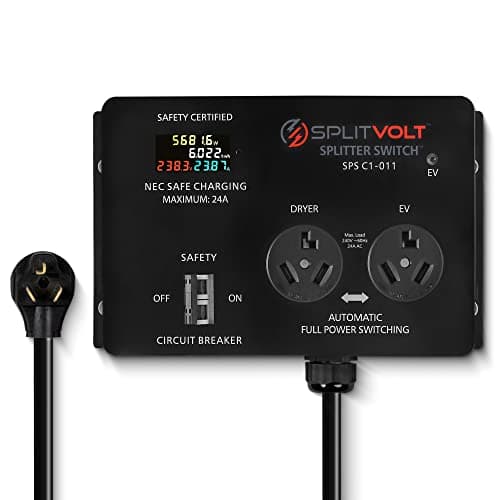 Splitvolt Splitter Switch (NEMA 10-30, 240V, 24A)The one device that makes a shared older dryer outlet a legitimate EV circuit — it switches automatically and carries its own breaker. Splitvolt Splitter Switch (NEMA 10-30, 240V, 24A)The one device that makes a shared older dryer outlet a legitimate EV circuit — it switches automatically and carries its own breaker. | An older 3-prong dryer outlet | Automatic 240V splitter | |
| 2 | 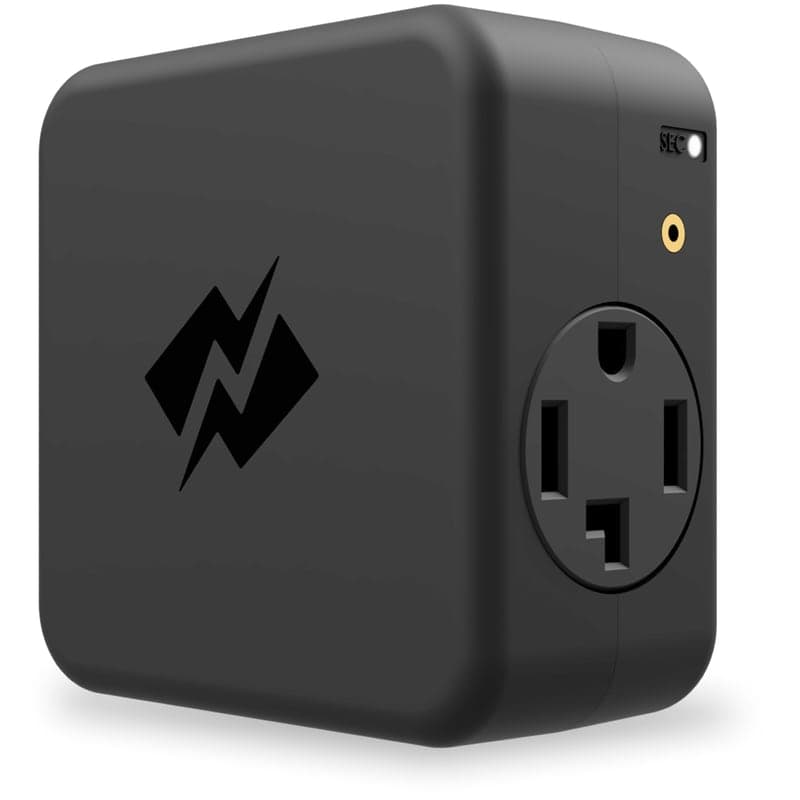 NeoCharge Smart Splitter (NEMA 14-30)The four-prong equivalent: it shares a modern dryer circuit, prioritizes the dryer, and switches to the car when the laundry finishes. NeoCharge Smart Splitter (NEMA 14-30)The four-prong equivalent: it shares a modern dryer circuit, prioritizes the dryer, and switches to the car when the laundry finishes. | A modern 4-prong dryer outlet | Automatic 240V splitter | Check price#ad |
#1 · An older 3-prong dryer outlet
Splitvolt Splitter Switch (NEMA 10-30, 240V, 24A)
The one device that makes a shared older dryer outlet a legitimate EV circuit — it switches automatically and carries its own breaker.
| Input plug | NEMA 10-30 malesource |
|---|---|
| Output sockets | Two NEMA 10-30 female outlets — one for the dryer, one for the EV chargersource |
| Rating | 240V ~ 60Hz, 24A AC maximum loadsource |
| Protection | Integrated 24A circuit breaker with easy resetsource |
| Switching | Automated power switching between the dryer and EV power socketssource |
| Certification | Conforms to UL 60730-1, certified to CSA E60730-1, cETLus listed Intertek 5021938source |
| Installation | No electrical installation required — plug and playsource |
What those numbers mean
24A is the number to design around, and it is not the manufacturer being cautious. A 30 amp circuit supports 24 amps of continuous load under the 80% rule, and continuous is exactly what EV charging is.
Automatic switching is what makes this a device rather than a Y-splitter. Both loads on one 30 amp circuit at once would trip the breaker at best; the switch guarantees only one draws at a time.
The integrated 24A breaker is the part that earns the trust. It means the splitter protects the circuit itself instead of relying only on a panel breaker you cannot see and wiring you cannot inspect.
What it does well
- Plugs in — genuinely no electrician, no permit, no landlord construction
- Its own 24A breaker rather than trusting the panel alone
- cETLus listed with the Intertek file number published
- Automatic switching, so the dryer keeps priority without anybody replugging anything
What it does not
- 24A caps charging at roughly 5.7 kW, well below a NEMA 14-50's ceiling
- NEMA 10-30 is an ungrounded three-wire configuration, which is a real caveat rather than a formality
- Only useful if you can physically reach the laundry outlet from the car
Skip this one if: Your dryer outlet is the modern four-prong NEMA 14-30. Buy the four-prong splitter instead — this one will not fit, and forcing the fit is exactly the wrong instinct.
#ad · how this is funded · price as of October 27, 2026
#2 · A modern 4-prong dryer outlet
NeoCharge Smart Splitter (NEMA 14-30)
The four-prong equivalent: it shares a modern dryer circuit, prioritizes the dryer, and switches to the car when the laundry finishes.
| Outlet type | Plugs into an existing four-prong 220/240V NEMA 14-30 dryer outletsource |
|---|---|
| EV current limit | The EV or charger must be set to 24 amps or less when sharing with a dryersource |
| Switching | Auto-switching prioritizes the dryer and switches to EV charging when it finishessource |
| Certification | UL safety certified and NEC compliantsource |
| Installation | No electrician needed — plug and playsource |
What those numbers mean
NEMA 14-30 is the four-prong dryer outlet standard in homes built after the mid-1990s, so which splitter you need is really a question about the age of the building.
The 24 amp ceiling is the same arithmetic as the three-prong version, for the same reason: 30 amp circuit, 80% continuous rule.
Dryer priority is the right default for a shared household. A dryer cycle is an hour; a charging session has all night to finish.
What it does well
- Works with the grounded four-prong outlet, which is the safer configuration to begin with
- UL safety certified
- Auto-switching, so nobody has to remember to unplug anything
What it does not
- Same 24A ceiling as any 30 amp circuit sharing arrangement
- Wrong device for a three-prong NEMA 10-30 outlet
Skip this one if: Your building predates the four-prong standard and the laundry outlet has three prongs. That is a NEMA 10-30 and needs the three-prong splitter instead.
#ad · how this is funded · price as of October 27, 2026
Which one you need is decided by your outlet
| Your dryer outlet | Prongs | Buy |
|---|---|---|
| NEMA 10-30 | 3 | The 10-30 splitter switch |
| NEMA 14-30 | 4 | The 14-30 smart splitter |
| NEMA 14-50 | 4, larger | Neither — you have a 50 amp circuit, use it directly |
There is no universal splitter and there should not be. The configurations are electrically different, and a device that claimed to fit both would be doing it with an adapter. Identify the outlet first.
What to look for in one
- A safety listing, with the file number published. Splitvolt publishes cETLus listing Intertek 5021938, conforming to UL 60730-1 and certified to CSA E60730-1. NeoCharge publishes UL safety certification. A published number is checkable; a claim of "certified" is not.
- Its own circuit breaker. Splitvolt's carries an integrated 24A breaker with a manual reset. That is the device protecting the arrangement itself rather than relying entirely on a panel breaker you cannot see, in wiring you cannot inspect.
- Automatic switching with a sane priority. The appliance should win and the car should wait. Both of these do that.
- A visible status indication. Knowing which socket has power without unplugging anything is worth more day to day than it sounds.
The 24 amp ceiling, and why it is a feature
Both devices cap EV charging at 24 amps, and Splitvolt enforces it with its own breaker rather than trusting you to configure the charger. That is the correct design: the safety limit should not depend on a setting somebody could change.
24 amps at 240V is about 5.8 kW, which returns roughly 200 miles over a twelve-hour night. Framed as a ceiling it sounds like a restriction; framed as an outcome it is a full charge for most cars while the laundry still gets done.
What we could not evaluate
Living with one
- Expect the charge to pause during a dryer cycle and resume afterwards. Overnight you will not notice.
- Set the charger to 24 amps or below anyway, even though the device enforces it. Defense in depth costs nothing.
- Check the receptacle behind it. The splitter is new; the dryer outlet it plugs into may be forty years old.
- If the laundry is shared with other units, this is a building conversation before it is a purchase — shared laundry room charging.
Who should skip both
Anyone with a reachable NEMA 14-50, who should use it directly at 40 amps. Anyone whose laundry outlet is nowhere near where the car parks, where the honest answer is that the outlet is not available regardless of what device you attach to it. And anyone whose only 240V is in a unit they do not control, where the conversation comes first.
One case this page does not cover: a household with two electric cars rather than a car and a dryer. The hardware overlaps but the arithmetic and the switching behavior are different, and charging two EVs from one outlet handles it separately — including the one splitter here that gives a NEMA 14-50 charger somewhere to plug in.
Questions people actually ask
What is a dryer outlet splitter for EV charging?
A listed device that plugs into an existing 240V dryer receptacle, provides one socket for the dryer and one for an EV charger, and switches power between them automatically so only one draws at a time. The good ones carry their own circuit breaker.
Is a splitter switch the same as a Y-adapter?
No. A Y-adapter is passive and lets both loads draw simultaneously, which a 30 amp circuit cannot support. A splitter switch monitors both sockets and switches between them in hardware.
Do I need an electrician to install a dryer splitter?
No. Both devices plug into the existing receptacle. Splitvolt states plainly that no electrical installation is required.
Which splitter do I need for my dryer outlet?
Count the prongs. Three means NEMA 10-30 and the 10-30 splitter. Four means NEMA 14-30 and the 14-30 splitter. They are not interchangeable.
Will the dryer still work normally?
Yes. Both devices give the appliance priority; the car simply waits and resumes when the cycle finishes. Overnight the pause is invisible.
Sources
Every figure on this page traces to one of these. If a number here disagrees with the manufacturer, the manufacturer is right and we want to know — tell us.
- Splitvolt — Splitter Switch NEMA 10-30, 240V / 24A, cETLus certified (product page)
- Splitvolt — frequently asked questions
- NeoCharge — NEMA 14-30 Smart Splitter (product page)
- NeoCharge — How to charge your EV using your dryer outlet (NEMA 14-30 guide)
- NFPA — NFPA 70, National Electrical Code (free public access)
Read next
Best Dryer-Outlet Setup
Charging from an outlet you already have
The existing-240V section: dryer, range and RV outlets, how to share one safely, and what changes in an older building.
Top pick: Splitvolt Splitter Switch (NEMA 10-30, 240V, 24A)

Guide
NEMA 14-30: the modern dryer outlet
How to use a four-prong dryer circuit for EV charging, what the 24 amp limit returns overnight, and the sharing device that makes it work.
Top pick: NeoCharge Smart Splitter (NEMA 14-30)

Guide
NEMA 10-30 charging in older buildings
The three-prong dryer outlet examined properly — what the shared neutral-ground means, why it still works, and the equipment to use.
Top pick: Splitvolt Splitter Switch (NEMA 10-30, 240V, 24A)
Guide
Charging from a shared laundry room
How to use a shared laundry circuit for EV charging: the hardware, the conversation, and the etiquette that stops it being withdrawn.
Top pick: NeoCharge Smart Splitter (NEMA 14-30)
Guide
24A vs 32A vs 40A: which amperage do you need?
24, 32 or 40 amps — what each needs from the circuit, what each returns overnight, and why the difference matters less than it looks.
Top pick: Grizzl-E Mini Connect Portable Charger
Guide
Your EV charger keeps tripping the breaker
A diagnostic order for breaker trips during charging, from the amperage setting through shared loads to GFCI interaction — and what fixes each.
Top pick: Grizzl-E Mini Connect Portable Charger