What it actually costs to charge
Two formulas and one worked example. Substitute your own rate and your own car, because an average computed for somebody else is not an answer.

How this page is funded: the buy links below are affiliate links, and Renter Volt earns a commission on qualifying purchases at no cost to you. Nothing here was supplied by a manufacturer, and commission plays no part in the ranking — read the full disclosure. Picks are chosen from published specifications rather than hands-on testing; the method is written down so you can check it. Prices last verified October 27, 2026.
Cost per mile = (your electricity rate in dollars per kWh) ÷ (your car's miles per kWh). That is the whole thing. Everything else on this page is where to get those two numbers and what to do once you have them.
We are not going to print a national average and call it your cost. Residential electricity prices vary by more than a factor of three across US states, and car efficiency varies by nearly a factor of two, so an average is off by enough to change decisions. The formula is printed instead.
Getting your two numbers
Your electricity rate
It is on your utility bill, usually as a per-kWh figure. Add the delivery or distribution charge to the supply charge — the all-in number is what you actually pay, and using the supply rate alone understates it, sometimes by a lot. If your rate varies by time of day, note the overnight rate, since that is when charging happens. The Energy Information Administration publishes state averages if you need a placeholder while you find your bill.
Your car's efficiency
Most EVs display it, either as miles per kWh or as kWh per 100 miles. If yours shows the second, divide 100 by it to get the first. Use your own observed figure rather than the EPA rating — real efficiency moves with temperature, speed and how you drive, and winter figures can be 20-30% worse than summer ones.
cost per mile = rate ($/kWh) ÷ efficiency (miles/kWh)
$0.17/kWh ÷ 3.5 miles/kWh = $0.049 per mile, or about $4.86 per 100 miles.
Substitute your own numbers. The example rate and efficiency are placeholders chosen to be arithmetically clear, not claims about your situation.
cost = usable battery capacity (kWh) × rate ($/kWh) ÷ charging efficiency
70 kWh × $0.17 ÷ 0.88 ≈ $13.52 for a full charge from empty.
The 0.88 accounts for charging losses — the energy the meter records is more than the energy that reaches the battery, and at Level 1 the overhead is proportionally larger because the car's own systems run for longer.
The charging-loss point, which most calculators omit
Not all the electricity you pay for ends up in the battery. Conversion losses in the onboard charger and the energy the car uses running its own systems while charging both count against you, and they are proportionally worse at Level 1 because the session lasts much longer. A rough allowance of 10-15% is reasonable; if you want your own figure, compare the meter reading across a charging session against the car's reported energy added.
Quick picks
Ranked, with the reasoning underneath. Tap any row to jump to that write-up; tap the price to check it on Amazon. Prices come from the live layer, never from this page.
| # | Product | Best for | Type | Price |
|---|---|---|---|---|
| 1 | 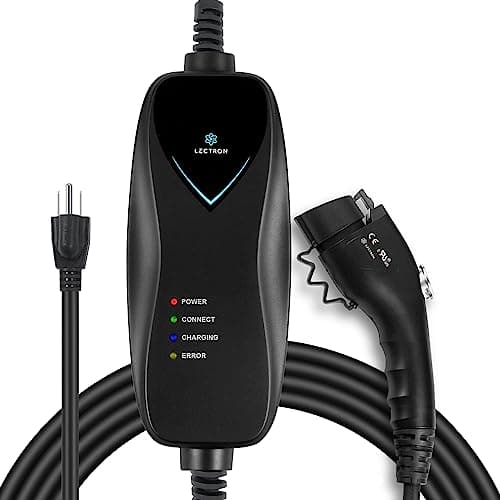 Lectron Portable Level 1 J1772 Charger (15A, NEMA 5-15)The unglamorous answer that covers most commutes: an ordinary 120V socket, overnight, and no conversation with anybody about electrical work. Lectron Portable Level 1 J1772 Charger (15A, NEMA 5-15)The unglamorous answer that covers most commutes: an ordinary 120V socket, overnight, and no conversation with anybody about electrical work. | An ordinary wall socket | Level 1 EVSE | |
| 2 | 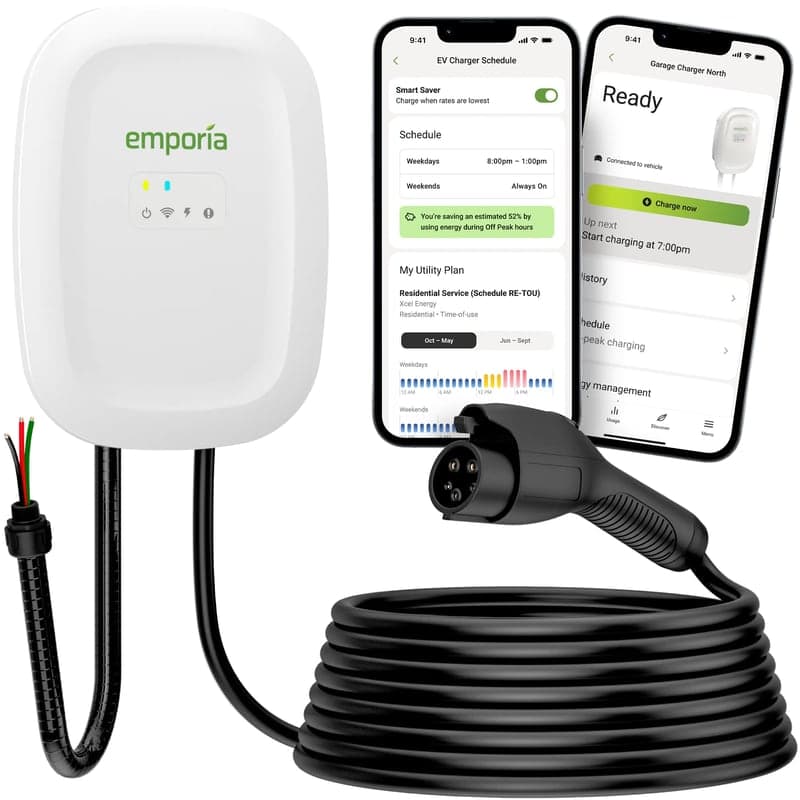 Emporia Classic Level 2 EV Charger (NEMA 14-50 plug)A plug-in smart charger whose scheduling genuinely pays for itself if your utility bills you differently overnight. Emporia Classic Level 2 EV Charger (NEMA 14-50 plug)A plug-in smart charger whose scheduling genuinely pays for itself if your utility bills you differently overnight. | Charging on a schedule | Plug-in smart EVSE | Check price#ad |
#1 · An ordinary wall socket
Lectron Portable Level 1 J1772 Charger (15A, NEMA 5-15)
The unglamorous answer that covers most commutes: an ordinary 120V socket, overnight, and no conversation with anybody about electrical work.
| Input | 120V, 15A maximumsource |
|---|---|
| Output power | 1.8 kWsource |
| Cable length | 16 ftsource |
| Plug / connector | NEMA 5-15 plug, J1772 connectorsource |
| Certification | UL 2594 / UL 2231 certified, and separately described as ETL-certified; no certificate number publishedsource |
| Ingress rating | IP65 weather-resistant, stated in the specification textsource |
| Manufacturer charge-rate claim | 45+ miles of range overnight; 3-5 miles of range per hoursource |
What those numbers mean
1.8 kW sounds trivial next to 9.6 kW, and for a road trip it is. For a commute it usually is not: the average US driver covers well under 45 miles a day, and this replaces that overnight while the car sits anyway.
The honest ceiling is the circuit behind the socket, not the cable. This unit draws 15 amps for hours, which a 20 amp circuit supports continuously and a 15 amp circuit does not — so check the breaker before the first overnight session, and on a 15 amp circuit choose a 12 amp unit instead.
This is the only category of EV charging that is genuinely invisible to a landlord. It draws less than a hair dryer and plugs into a receptacle that already exists.
What it does well
- Works with a socket that already exists, everywhere, with no permission needed
- UL 2594 and UL 2231 certified rather than a generic cordset
- Cheapest possible entry into home charging, by a wide margin
What it does not
- 1.8 kW will not recover a long driving day overnight
- 16 ft cable, and the nearest 120V socket is often not the nearest thing to the car
- Its 15 amp draw needs a 20 amp circuit behind the socket; an ordinary 15 amp circuit supports 12 amps continuously
Skip this one if: You regularly drive more than about 45 miles a day. Level 1 will fall a little further behind every night and you will spend the difference at public chargers.
#2 · Charging on a schedule
Emporia Classic Level 2 EV Charger (NEMA 14-50 plug)
A plug-in smart charger whose scheduling genuinely pays for itself if your utility bills you differently overnight.
| Maximum output | 9.6 kW (40A) with a NEMA 14-50 outlet; 11.5 kW (48A) hardwiredsource |
|---|---|
| Connector | J1772 or NACS (Tesla) modelssource |
| Enclosure | Type 4 enclosure, watertight, indoor or outdoorsource |
| Certification | UL certified and GFCI protectedsource |
| Scheduling | Off-peak scheduling and real-time charge-rate monitoring in the Emporia appsource |
What those numbers mean
Note the honest asymmetry in the first row: the 48 amp headline number is the hardwired figure. On a NEMA 14-50 plug — the only version a renter should be looking at — it is a 40 amp charger. That is not a downgrade, it is what the plug is rated for.
The scheduling is the actual reason to pay more here. If you are on a time-of-use rate, charging on a timer is worth real money over the length of a lease.
It is a wall-mount form factor with a plug on it. You can hang it on a hook or leave it in the trunk; nothing about it requires a bracket screwed into the landlord's drywall.
What it does well
- Scheduling and energy monitoring that are useful rather than decorative
- Type 4 watertight enclosure rated for outdoor use
- Sold with either a J1772 or a NACS connector
- The plug-in version needs no electrician and comes off the wall when you move
What it does not
- The advertised 48 amps is hardwired-only; the plug-in version is 40 amps
- Scheduling needs Wi-Fi, which is not a given in a detached carport or a parking structure
Skip this one if: Your electricity costs the same at every hour and there is no Wi-Fi where you park. You would be paying for a feature set you cannot reach or use.
#ad · how this is funded · price as of October 27, 2026
Comparing against gasoline honestly
cost per mile = gas price ($/gal) ÷ vehicle mpg
$3.40/gal ÷ 30 mpg = $0.113 per mile, or about $11.33 per 100 miles.
Compare that against your electric figure from the first formula. Both use prices that move, so re-run it rather than trusting a comparison somebody else made last year.
In the worked examples above, home charging is roughly a third to a half the per-mile cost of gasoline. That gap is real and it is the main running-cost argument for an EV. It also narrows or disappears if your electricity is expensive or if most of your charging is at public DC fast chargers — which is exactly the situation of a renter with no home access, and it is why home versus public exists as its own page.
Where a renter can actually save money
- Charge overnight if your rate varies. Time-of-use tariffs frequently halve the overnight rate, and a charger with scheduling captures that without you thinking about it.
- Do not pay for speed you cannot use. A 40 amp charger and a 24 amp charger cost the same per kWh; the faster one just finishes earlier in a night you were asleep for anyway.
- Avoid DC fast charging when you have any alternative. It is frequently several times the per-kWh price of residential electricity.
- Set a charge limit. Charging to 100% every night is slower per kWh at the top of the range and is not what most manufacturers recommend for daily use.
- Check whether your utility has an EV rate. Many do, and many customers on them never signed up because nobody told them.
What this page will not tell you
Questions people actually ask
How much does it cost to charge an EV at home?
Multiply your car's battery capacity by your all-in electricity rate and divide by about 0.88 to allow for charging losses. Per mile, divide your rate by your car's miles per kWh. Both formulas are on this page with worked examples.
Is charging an EV cheaper than gasoline?
At typical residential electricity rates, home charging is usually a fraction of the per-mile cost of gasoline. The gap narrows sharply if your electricity is expensive, and it can close entirely if most of your charging is at public DC fast chargers.
Does Level 1 charging cost more than Level 2?
Slightly more per useful kWh, because the longer session means the car's own systems run for longer and the proportional overhead is higher. The difference is small and it does not change the recommendation.
What is charging efficiency?
The share of the electricity you pay for that actually reaches the battery. Conversion losses and the car's own consumption during charging account for the rest — roughly 10-15% is a reasonable allowance.
Should I charge to 100% every night?
Most manufacturers suggest a lower daily limit and reserve 100% for trips. It also charges more slowly near the top of the range, so you gain little by doing it routinely.
Sources
Every figure on this page traces to one of these. If a number here disagrees with the manufacturer, the manufacturer is right and we want to know — tell us.
- U.S. Energy Information Administration — Average retail price of electricity to residential customers
- U.S. DOE Alternative Fuels Data Center — Electric vehicle charging levels and speeds
- U.S. Department of Energy — Electric vehicle charging at home
- Emporia Energy — Classic Level 2 EV Charger specifications
Read next
Guide
Learn
Reference and explainers: charging levels, cost per mile, session times, outdoor safety and a glossary written in plain English.
Guide
Home vs public charging
The home-versus-public cost comparison for renters, plus a workable routine for anyone with no home charging at all.
Top pick: Lectron Portable Level 1 J1772 Charger (15A, NEMA 5-15)
Guide
Level 1 vs Level 2, for someone without a garage
The charging-level comparison rewritten for renters, with a renter-viability column and an honest case for Level 1.
Top pick: Lectron Portable Level 1 J1772 Charger (15A, NEMA 5-15)
Guide
How long does charging actually take?
Charging times by outlet and battery size, and the reframe that makes slow charging a non-problem for anyone who parks overnight.
Top pick: Grizzl-E Mini Connect Portable Charger
Guide
Before you buy an EV without a garage
The pre-purchase checklist for a garage-less buyer: reachable power, daily mileage, connector type, cable reach and the real cost of the gap.
Top pick: Lectron Portable Level 1 J1772 Charger (15A, NEMA 5-15)
Best Head-to-Head
Grizzl-E Mini vs Emporia Classic
The head-to-head renters actually run: adjustable 7-40A flexibility against app scheduling and energy reporting.
Top pick: Grizzl-E Mini Connect Portable Charger