"UL listed" EV chargers, decoded
UL is a standard, not the company that inspected your charger. Once that is clear, most of this category's safety marketing reads differently.

How this page is funded: the buy links below are affiliate links, and Renter Volt earns a commission on qualifying purchases at no cost to you. Nothing here was supplied by a manufacturer, and commission plays no part in the ranking — read the full disclosure. Picks are chosen from published specifications rather than hands-on testing; the method is written down so you can check it. Prices last verified November 8, 2026.
"UL" is a standard, not the company that inspected your charger — and the lab that actually tested it is usually ETL. Once you know that, a listing reading "ETL Listed to UL 2594" stops looking like a weaker claim than "UL Certified" and starts looking like a more precise one.
The finding that took reading every manufacturer page on this site: of 21 products here, exactly three publish a certificate number you can look up — and not one of them is a charger. The best-documented charger is the Lectron NEXUS, which names four separate UL standards. Everything below is from each manufacturer's own published material.
Quick picks
Ranked, with the reasoning underneath. Tap any row to jump to that write-up; tap the price to check it on Amazon. Prices come from the live layer, never from this page.
| # | Product | Best for | Type | Price |
|---|---|---|---|---|
| 1 | 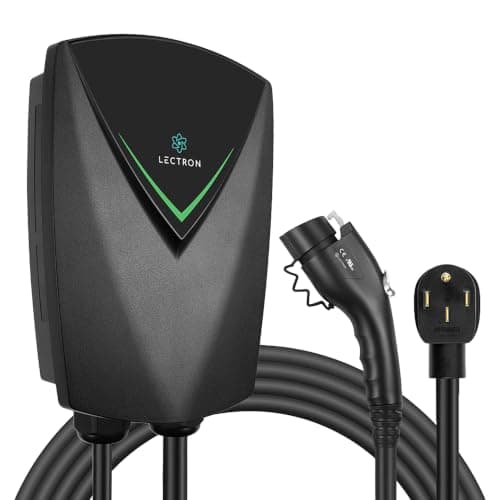 Lectron NEXUS Level 2 Charger (NEMA 14-50 plug)A 23 ft cable on a plug-in 40 amp unit, which is the specification that decides whether a parking space two bays from the outlet works at all. | Long cable reach | Plug-in Level 2 EVSE | |
| 2 | 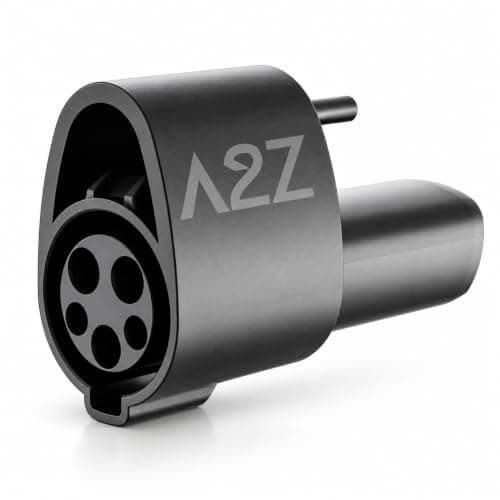 A2Z EV J1772 to NACS Adapter, 80ASame direction as the Lectron, with an integrated locking pin — the answer if your charging happens somewhere other people walk past. | Cables that get knocked | AC charging adapter | |
| 3 | 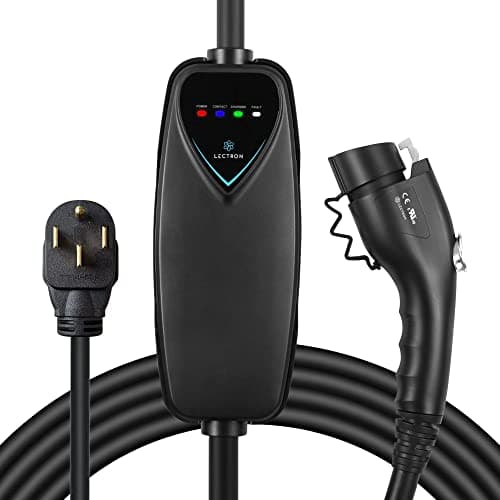 Lectron Portable Level 2 J1772 Charger (40A, NEMA 14-50)The plainest answer to a NEMA 14-50 outlet you can reach: 40 amps, a plug on the end, and nothing screwed to a wall you do not own. | A reachable 14-50 outlet | Plug-in Level 2 EVSE | |
| 4 | 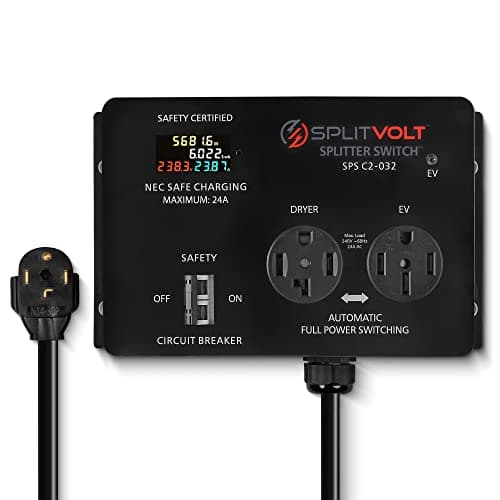 Splitvolt Splitter Switch (NEMA 14-30 in, 14-30 + 14-50 out, 240V, 24A)The only splitter here that ends in a NEMA 14-50, so a 14-50 charger reaches a dryer circuit — at 24 amps, which you must set yourself. | A 14-50 charger on a dryer circuit | Automatic 240V splitter |
#1 · Long cable reach
Lectron NEXUS Level 2 Charger (NEMA 14-50 plug)
A 23 ft cable on a plug-in 40 amp unit, which is the specification that decides whether a parking space two bays from the outlet works at all.
| Input | 240V, 40A maximumsource |
|---|---|
| Output power | 9.6 kWsource |
| Cable length | 23 ftsource |
| Plug / connector | NEMA 14-50 plug, J1772 / CCS connectorsource |
| Enclosure | IP66-rated automotive-grade housingsource |
| Certification | UL 2594 / UL 2231 / UL 2251 / UL 817 certifiedsource |
| Manufacturer charge-rate claim | Up to 38 miles of range per hoursource |
What those numbers mean
23 ft against the 16 ft of the cheaper Lectron unit is the whole argument for this one. Cable length is the specification renters underestimate most and the one an extension cable is the worst way to fix.
IP66 means the housing tolerates jets of water. Read that as permission to leave the unit outdoors, not as permission to leave the outlet it plugs into exposed.
The manufacturer's 38 miles per hour figure assumes a car that can accept the full 9.6 kW. Halve your car's onboard charger rating and you halve that number.
What it does well
- 23 ft cable, seven feet more than the common 16 ft portable
- IP66 housing rated for sustained outdoor exposure
- Four UL listings including UL 2251 for the coupler
What it does not
- Physically larger and heavier to move between parking spots than a bare portable
- Fixed 40 amps, so it cannot step down onto a 30 amp dryer circuit
Skip this one if: Your outlet is within a few feet of the charge port. You would be paying for reach you do not need and carrying the extra bulk for nothing.
#ad · how this is funded · price as of November 8, 2026
#2 · Cables that get knocked
A2Z EV J1772 to NACS Adapter, 80A
Same direction as the Lectron, with an integrated locking pin — the answer if your charging happens somewhere other people walk past.
| Rated current | 80A maximum at 240VACsource |
|---|---|
| Maximum power | 19.2 kWsource |
| Direction | SAE J1772 charger into a NACS vehicle portsource |
| Charging type | AC only (Level 1 and Level 2)source |
| Certification | UL 2252 / CSA-C22.2 certified, certificate number 80259177source |
| Ingress rating | IP54, Type 3R enclosuresource |
| Operating temperature | -22°F to 122°F (-30°C to 50°C)source |
| Retention | Integrated locking pin prevents accidental disconnectionsource |
What those numbers mean
The locking pin is the differentiator and it addresses a real failure: an adapter that separates when someone brushes the cable ends the charging session, and you find out in the morning.
Type 3R is an enclosure classification for outdoor use against falling rain. Together with IP54 it describes an adapter meant to stay connected outside, not one meant to be sheltered.
19.2 kW is the theoretical AC ceiling of the standard, not a speed you will see. No residential circuit a renter can reach produces it.
What it does well
- Integrated locking pin against accidental disconnection
- UL 2252 and CSA certified with the certificate number published
- Type 3R and IP54 rated, with a stated temperature range
What it does not
- More expensive than adapters that do the same electrical job
- The locking pin is one more thing to operate in the cold with gloves on
Skip this one if: You charge in a private, sheltered spot nobody walks past. The retention feature you are paying for solves a problem you do not have.
#ad · how this is funded · price as of November 8, 2026
#3 · A reachable 14-50 outlet
Lectron Portable Level 2 J1772 Charger (40A, NEMA 14-50)
The plainest answer to a NEMA 14-50 outlet you can reach: 40 amps, a plug on the end, and nothing screwed to a wall you do not own.
| Input | 240V, 40A maximumsource |
|---|---|
| Output power | Up to 9.6 kWsource |
| Cable length | 16 ftsource |
| Plug / connector | NEMA 14-50 plug, J1772 connectorsource |
| Certification | UL 2594 / UL 2231 certifiedsource |
| Manufacturer charge-rate claim | Roughly 30 miles of range per hour of chargingsource |
What those numbers mean
9.6 kW is the ceiling this unit can deliver, not what your car will take. A vehicle with a 7.2 kW onboard charger draws 7.2 kW from it and no more, and that is a car limitation no charger fixes.
The 16 ft cable is the number to check before anything else. Measure from the outlet to where your charge port sits when the car is parked as it will actually be parked, not as you would like to park it. Sixteen feet disappears faster than people expect once it has to route around a wall.
A 40 amp unit needs a 50 amp circuit behind the outlet to run at 40 amps continuously. If the outlet is on a smaller breaker, the answer is a lower-amperage charger, not this one turned down.
What it does well
- Plugs in and unplugs — it leaves with you at the end of the lease
- UL 2594 and UL 2231 certified, the two standards that matter for EVSE
- 40 amps covers the fastest charging any renter-reachable outlet realistically supports
What it does not
- 16 ft of cable is short for a parking space that is not directly beside the outlet
- No amperage adjustment, so it is the wrong unit for a 30 amp circuit
Skip this one if: Your only 240V outlet is a 30 amp dryer receptacle. This unit expects a 50 amp circuit behind a NEMA 14-50, and derating it is not an option it offers.
#ad · how this is funded · price as of November 8, 2026
#4 · A 14-50 charger on a dryer circuit
Splitvolt Splitter Switch (NEMA 14-30 in, 14-30 + 14-50 out, 240V, 24A)
The only splitter here that ends in a NEMA 14-50, so a 14-50 charger reaches a dryer circuit — at 24 amps, which you must set yourself.
| Wall socket connection | NEMA 14-30 male (the modern four-prong dryer outlet)source |
|---|---|
| Outlets provided | NEMA 14-30 female (dryer) and NEMA 14-50 female (EV)source |
| Maximum load | 240V ~ 60Hz 24A ACsource |
| Internal protection | Integrated 24A circuit breaker with easy resetsource |
| Certification | cETLus listed Intertek 5021938; conforms to UL 60730-1, certified to CSA E60730-1source |
| Switching | Automated power switching between the dryer and EV socketssource |
| Dust and water protection | Indoor use onlysource |
| Warranty | 1 year manufacturer's limited warranty; a 4 year extension is sold separatelysource |
What those numbers mean
The NEMA 14-50 output is what makes this different from every other splitter on this site. A charger that ends in a 14-50 plug physically cannot reach a dryer receptacle; this gives it a 14-50 to plug into.
What it does NOT do is raise the current. The circuit behind it is still 30 amps, the device is capped at 24, and Splitvolt states plainly that you must set your EV or adjustable charger to 24 amps maximum. A fixed 40 amp charger is the wrong partner for it.
Splitvolt publishes an actual certificate number — Intertek 5021938 — rather than the word "certified". That is a claim you can look up, which is the distinction this site keeps insisting on.
What it does well
- Publishes a checkable cETLus certificate number, not just a certification claim
- The only splitter here with a NEMA 14-50 output, so a 14-50 charger can use a dryer circuit
- Integrated 24A breaker with a reset, so the protection is inside the device
- Automatic switching — nobody has to remember to unplug the dryer
What it does not
- Expensive — it costs more than many of the chargers it feeds
- Indoor use only, per Splitvolt's own specification
- 24A ceiling, and you have to set the charger down to it yourself; the device will not do it for you
- One year of warranty as standard, which is short against the three years the charger brands publish
Skip this one if: Your charger has no current adjustment. A fixed 40 amp unit plugged into this will try to draw 40 amps from a 30 amp circuit, which is the exact situation the 24 amp setting exists to prevent.
#ad · how this is funded · price as of November 8, 2026
Standards and labs are different things
This is the distinction that explains most of the confusion in this category, and almost no listing spells it out.
- A standard
- The written requirements a product must meet — UL 2594, UL 2231 and so on. A standard is a document. It does not test anything and it does not issue marks.
- A testing laboratory (an NRTL)
- The organization that actually tests the product against that standard and lets it carry a mark. UL Solutions is one. Intertek is another, and its mark is ETL. SGS and CSA are others. In the US these are Nationally Recognized Testing Laboratories.
- What "ETL Listed to UL 2594" means
- Intertek tested the product against the UL 2594 standard and listed it. That is a complete claim — the standard and the lab are both named. It is not a downgrade from "UL Listed", which names a lab and leaves the standard unstated.
- cETLus
- The same Intertek mark, certified for both Canada (c) and the United States (us). You will see it on the splitters here.
So the phrase to look for is a standard number plus a lab. The Lectron NEXUS listing gets this exactly right — "UL2594 Certified (ETL Listed)" — and it is close to the only one in this category that does.
The five standards that actually apply here
| Standard | What it covers | Applies to |
|---|---|---|
| UL 2594 | Electric vehicle supply equipment — the charger itself | Every Level 1 and Level 2 charger |
| UL 2231 | Personnel protection systems for EV supply circuits | Every charger; this is the ground-fault side |
| UL 2251 | Plugs, receptacles and couplers for EV charging | Connectors and handles; some adapters |
| UL 2252 | EV adapters specifically | NACS and J1772 adapters |
| UL 817 | Cord sets and power-supply cords | The cable on a portable unit |
A charger that names UL 2594 and UL 2231 has named the two that matter for a charger. An adapter that names UL 2252 has named the one written for adapters — the adapter guide goes further on why the coupler standards are separate, and the glossary keeps the short definitions.
What is NOT a safety certification
Three marks turn up constantly on this hardware and none of them says anything about electrical safety:
- ENERGY STAR — the EPA's efficiency program. Genuinely useful, independently verifiable in the EPA's own product database, and entirely about how much power the unit wastes when idle. Not a safety listing.
- DOE — Department of Energy efficiency compliance. Same category.
- FCC — electromagnetic interference. It means the device will not interfere with your radio, not that it will not start a fire.
This matters because two products on this site lead with exactly these marks. The Autel MaxiCharger publishes ENERGY STAR certification — real, and checkable in the EPA database — while naming no UL standard at all, and its page still carries a note reading "*Certification Pending May 2022". The Schumacher SEV1670 publishes DOE, FCC and Energy Star, with its description saying it "meets ETL and Energy Star certification standards", which is conformity wording rather than a listing claim. Neither is dishonest. Both are easy to misread as safety certifications, and the Autel review and the Schumacher review each take that up in detail.
The test almost nothing passes: a certificate number
A certificate number refers to a specific file held by the body that issued it. It is the difference between a claim you can verify and a word on a box. Here is the complete picture across this site's catalog:
| Product | What the manufacturer publishes | Checkable number? |
|---|---|---|
| A2Z Atom Plug J1772-to-NACS adapter | UL 2252 / CSA-C22.2, certificate 80259177 | Yes |
| A2Z Stellar NACS-to-J1772 adapter | UL 2252 / CSA-C22.2, certificate 80265273 | Yes |
| Splitvolt Splitter Switches | cETLus listed Intertek 5021938, conforms to UL 60730-1 | Yes |
| Lectron NEXUS (Level 2, 40A) | UL 2594 / 2231 / 2251 / 817 — four standards named | No |
| Lectron Level 2 40A | UL 2594 / UL 2231 | No |
| Lectron Level 1 15A | UL 2594 / UL 2231, and separately "ETL-certified" | No |
| Lectron NACS-to-J1772 adapter | UL 2252, tested by SGS (an NRTL) | No |
| ChargePoint Home Flex | "UL Listed for safety" — no standard named | No |
| Emporia Classic | "UL certified and GFCI protected" | No |
| Grizzl-E Mini | "UL tested and certified", Energy Star | No |
| NeoCharge Smart Splitter | "cUL Listed, NEC compliant" | No |
| Autel MaxiCharger | No UL standard named; ENERGY STAR certified | No |
| Schumacher SEV1670 | No UL standard named; DOE / FCC / Energy Star | No |
How these four were ranked
- Is a certificate number published? The strictest test, and the one that separates the A2Z adapter and the Splitvolt splitter from everything else here.
- Are the correct standards named, by number? UL 2594 and UL 2231 for a charger; UL 2252 for an adapter. Naming them beats the word "certified" by a wide margin.
- How many of the applicable standards are covered? The NEXUS names four — equipment, personnel protection, coupler and cord set — which is the most complete disclosure of any charger on this site.
- Is the lab named as well as the standard? "ETL Listed to UL 2594" is the complete form. Several products name one or the other.
- Renter-installable, without exception. Everything here plugs in, as on every page of this site.
- What is NOT credited: ENERGY STAR, DOE and FCC marks, and the unqualified word "certified". None of the three is a safety listing, and the last one names nothing at all.
What to buy
- The best-documented charger here is the Lectron NEXUS — four UL standards named plus a published IP66 rating, which is the most complete spec sheet of any Level 2 unit on this site. Its gap is that Lectron publishes no warranty period, which the warranty comparison sets out in full.
- If you want a verifiable certificate number, you are buying an adapter or a splitter. The A2Z Atom Plug publishes UL 2252 / CSA with its number; so does the Stellar in the other direction; so do the Splitvolt switches. No charger here offers that.
- The plain Lectron 40A names the two standards that matter for a charger and costs substantially less than the NEXUS. Its full review covers what else it does and does not publish.
- Do not pay a premium for the word "certified". Across this catalog there is no relationship between price and disclosure quality — one of the best-documented products is a splitter and one of the least-documented is among the more expensive chargers.
How to check a claim yourself, in two minutes
- Look at the unit's own label, not the listing. The mark is molded or printed on the body: UL, ETL, cETLus, CSA. A listing can say anything; the label is what the lab permitted.
- Find the standard number. If the product or its documentation names UL 2594 and UL 2231 for a charger, or UL 2252 for an adapter, the right standards are in play.
- If a certificate number is published, look it up in the issuing body's online directory. Intertek and UL both run searchable directories.
- Treat "safety certified" with nothing after it as unverified. It is not evidence of a problem — plenty of safe hardware is described lazily — but it is not evidence of anything else either.
What this page cannot tell you
We have not tested any of this hardware and we have not independently verified any certificate with an issuing body — the methodology is explicit about both. What this page reports is what each manufacturer publishes, read off their own pages and listings as of this date. A blank in the table above means a company has not published something; it is not a claim that the product lacks the property, and several of these units may well hold listings their marketing never mentions. That distinction is the whole point of reporting publication rather than performance.
Questions people actually ask
What does it mean for an EV charger to be UL listed?
Strictly, that a Nationally Recognized Testing Laboratory has tested it against a UL standard and permitted it to carry a mark. UL is the standard — UL 2594 for charging equipment, UL 2231 for personnel protection. The lab is often Intertek, whose mark is ETL. A listing reading "ETL Listed to UL 2594" names both and is a complete claim.
Is ETL as good as UL?
Yes. ETL is Intertek's mark, and Intertek is a Nationally Recognized Testing Laboratory that tests to the same UL standards. "ETL Listed to UL 2594" is if anything more precise than "UL Listed", because it names the standard as well as the lab.
Which EV charger standards should I look for?
For a charger, UL 2594 (the equipment) and UL 2231 (personnel protection). For an adapter, UL 2252. UL 2251 covers plugs, receptacles and couplers, and UL 817 covers the cord set. A charger naming UL 2594 and UL 2231 has named the two that matter.
Does ENERGY STAR mean an EV charger is safe?
No. ENERGY STAR is the EPA's efficiency program — it is about wasted power, not electrical safety. It is genuinely verifiable in the EPA's product database, which is more than many safety claims offer, but it is not a safety listing. The same goes for DOE compliance and FCC marks.
Which EV chargers publish a certificate number?
On this site, none of them. Across all 21 products we track, exactly three publish a number you can look up: two A2Z adapters (UL 2252 / CSA, certificates 80259177 and 80265273) and the Splitvolt splitter switches (cETLus Intertek 5021938). For chargers specifically, a named standard is the strongest disclosure currently available.
What is the best-certified EV charger?
Of the units on this site, the Lectron NEXUS names the most standards — UL 2594, 2231, 2251 and 817 — alongside a published IP66 rating. No charger here publishes a certificate number, so "best certified" means most completely disclosed rather than most verifiable.
Is an uncertified EV charger dangerous?
We will not make that claim about any specific product, because an absent certification claim is missing information rather than evidence of a defect. What we will say is that a charger draws its rated current continuously for hours through connections nobody is watching, and that a named standard is cheap insurance on a purchase you keep for years.
How do I check whether my charger is really certified?
Look at the unit's own label rather than the listing — the UL, ETL, cETLus or CSA mark is printed or molded on the body. Then find the standard number in the documentation. If a certificate number is published, Intertek and UL both run searchable online directories where you can confirm the file exists.
Sources
Every figure on this page traces to one of these. If a number here disagrees with the manufacturer, the manufacturer is right and we want to know — tell us.
- UL Solutions — UL 2594, standard for electric vehicle supply equipment
- SAE International — J1772 electric vehicle conductive charge coupler standard
- NFPA — NFPA 70, National Electrical Code (free public access)
- Lectron — Level 2 EV chargers, published specifications by model
- Lectron — Portable Level 2 J1772 EV Charger, 240V / 40A / NEMA 14-50 (product page)
- A2Z EV — J1772 Charger to NACS Vehicle adapter, UL 2252 / CSA-C22.2 certified (product page)
- A2Z EV — NACS Charger to J1772 Vehicle adapter, UL 2252 certified (product page)
- Splitvolt — Splitter Switch NEMA 14-30/14-50, 240V / 24A, cETLus listed Intertek 5021938 (product page)
- Autel Energy (US store) — MaxiCharger AC Elite Home 40A, NEMA 14-50 plug-in (published specifications)
- ENERGY STAR (U.S. EPA) — certified EV charger record, AUTEL Maxi US AC W12, EVSE specification v1.2
- ChargePoint — Home Flex home charger: configurations, amperage and certifications
- Schumacher Electric — SEV1670 Level 1 Portable EV Charger, 120V / 12A (product page and specifications)
- Grizzl-E — frequently asked questions (warranty terms, enclosure type, support process)
- Emporia Energy — Classic Level 2 EV Charger specifications
Read next
Guide
Learn
Reference and explainers: charging levels, cost per mile, session times, outdoor safety and a glossary written in plain English.
Guide
What to look for in a portable EV charger
A criteria-first guide to choosing a plug-in charger: the six specifications that matter in order, and a cross-brand table of which makers publish each one and which stay silent.
Top pick: Grizzl-E Mini Connect Portable Charger
Guide
EV charging glossary
A plain-English glossary of the charging vocabulary, with the ambiguous terms flagged rather than smoothed over.
Best Charging Adapter
NACS and J1772 adapters
The adapter section — direction first, brand second. Which adapter your car needs, why AC-only is not a limitation, and what to buy.
Top pick: A2Z EV Stellar NACS to J1772 Adapter, 80A
Guide
Lectron Level 2 40A charger, reviewed
A close read of the 40A Lectron: the WiFi-versus-Plug-and-Play trap, the two specifications it never publishes, the missing warranty, and the circuit on which it is the wrong purchase.
Top pick: Lectron Portable Level 2 J1772 Charger (40A, NEMA 14-50)
Guide
Autel MaxiCharger AC Elite Home, reviewed
A close read of the plug-in 40A MaxiCharger: the 25 ft cable, the published NEMA 4 enclosure, the certification line still marked pending since 2022, and the outdoor advice Autel gives that a tenant cannot follow.
Top pick: Autel MaxiCharger AC Elite Home (40A, NEMA 14-50 plug)